

Term vs Whole Life Insurance: Key Differences and Which to Choose
Last Updated: September 21, 2026
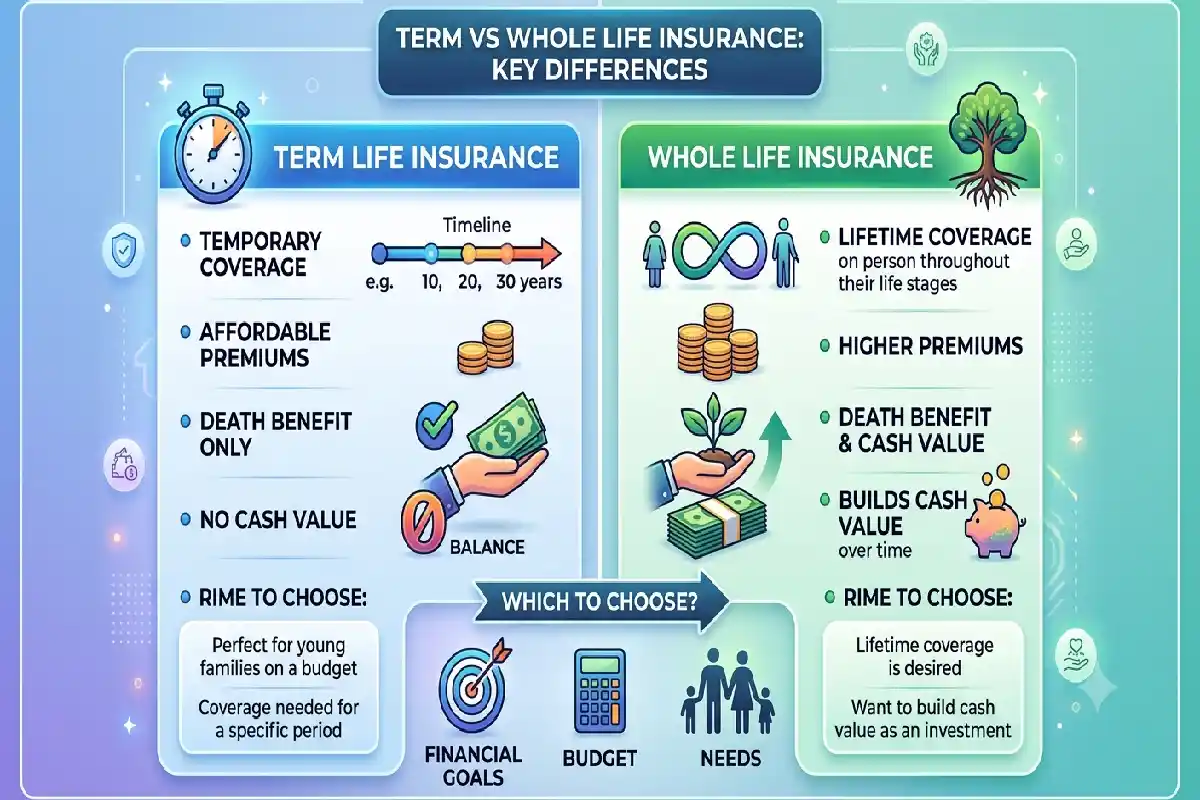
Term or Whole Life Insurance is the decision many individuals face as they begin to navigate life insurance choices. While they will offer a measure of financial protection to your loved ones, the two are meant to serve distinctively different needs and goals. Term insurance typically focuses on offering substantial death benefits for a predetermined duration for minimal out-of-pocket expense, while whole life is intended to provide a lifetime coverage with possible a cash value or savings element to it.
Ultimately, deciding which policy is the correct policy for you should not be about what may seem to be the “better deal”, but rather about what you need your life insurance to do. Should replacing income and dependents remain your top concern throughout your working career,term insurance might be more suitable. If, however, securing benefits throughout life, perhaps for a family legacy, becomes your ultimate need, whole life will probably require evaluation.
How Term Life Insurance Works
Term life insurance covers the life for a limited duration (policy term). During the term of the policy, the insured pays the premium for this term and if death occurs during the policy term, the nominee is entitled to the respective death benefits according to the terms and condition of the policy.
For example, someone with a home loan, young children and dependent family members might choose coverage that extends through the years when their financial obligations are highest. Once the term ends, standard term insurance generally does not provide a maturity payout simply because the policyholder survived.
The major advantage is efficiency: because the policy primarily provides financial protection rather than a savings component, premiums can be substantially lower than those of permanent or savings-oriented policies.
Term insurance can therefore be particularly useful for income replacement, loan protection and children’s future financial needs.
How Whole Life Insurance Works
These are intended to be insurance contracts that pay out during the entire duration of the life of the insured person, provided of course that the conditions and terms of the policy have been adhered to; provided too that premiums have been paid and other contract provisions maintained (although not all policies offered today as “whole-life” come with these features but are combined with a savings scheme, a guarantee on benefits or have added bonuses or a cash value component).
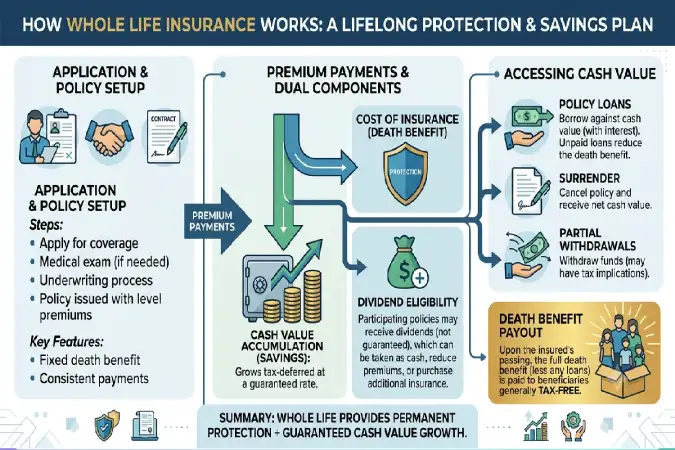
This creates a fundamentally different proposition from standard term insurance. The policy is not simply designed to protect income during a particular working period; it can also be used for longer-term financial planning.
However, “whole life” does not automatically mean that every policy offers the same cash value, return, bonus structure or surrender value. These features depend on the specific product.
Before purchasing, review the guaranteed benefits separately from non-guaranteed benefits and examine the policy’s benefit illustration rather than relying only on projected maturity figures.
Cost Comparison Over Time
Cost is one of the biggest differences between term and whole life insurance.
To take another example; an Aviva India example quotes a 1 crore comparison. The premium for a health 30 year old non smoker with 30 years term life cover ranges between 10,000-15,000pa and on its whole life illustration (equivalent cover) approx. 90,000-1.2 lakhs. Premiums for both the cover structures will differ a great deal according to the factors as enumerated above (the above figures were just for the 30yr illustration).
Illustrative annual premium difference
Term Insurance ₹10k–₹15k ███
Whole Life ₹90k–₹1.2L ████████████████████
This should not be interpreted as a universal market quote. It demonstrates the basic economic trade-off: lifelong coverage and additional policy features can require substantially higher premiums.
India’s insurance cost environment also changed in 2025. From September 22, 2025, GST on individual life insurance policies was reduced from 18% to zero. As stated by the Department of Financial Services, individual life policies remain outside the scope of this exemption whereas group life policies are still liable to the Goods and Services Tax.
Therefore when comparing 2026 premiums with articles published previously consumers should be careful to only compare current quotes as opposed to previous GST-inclusive estimates.
Consequently, when comparing 2026 premiums with older articles, consumers should make sure they are comparing current quotes rather than historical GST-inclusive figures.
Cash Value and Investment Component
Cash value is another important distinction, but it should not be confused with a guaranteed investment return.
Standard term insurance generally does not accumulate cash value. You are paying primarily for the insurance protection provided during the selected period.
Some whole-life and other permanent/savings-oriented policies can accumulate a cash or surrender value. Depending on the product, this value may be accessible through withdrawals or policy loans, subject to policy rules. Outstanding loans or withdrawals can affect the policy’s future benefits.
The key question is therefore not simply, “Does whole life build cash value?” It is:
“What guaranteed value am I receiving, what benefits are non-guaranteed, what are the costs, and what happens if I surrender the policy early?”
That distinction is critical when comparing insurance with separate investment products.
When to Choose Term Over Whole Life
Term insurance may be more appropriate when your primary objective is financial protection.
Consider term insurance if you:
- Need substantial coverage at a comparatively low premium.
- Have children or other financial dependents.
- Have a mortgage or other significant debt.
- Want income replacement during your working years.
- Prefer keeping insurance and investments as separate financial decisions.
- Want a relatively simple policy structure.
For many households, the most important question is not whether the policy produces a maturity value but whether the death benefit is large enough to protect the family’s financial goals.
When Whole Life May Make Sense
Whole life can be worth considering when the need for insurance is genuinely lifelong.
It may suit people who:
- Want permanent financial protection.
- Have lifelong dependents.
- Are planning wealth transfer or an inheritance.
- Have specific estate-planning objectives.
- Understand and value the policy’s cash-value or guaranteed-benefit structure.
- Can comfortably maintain the higher premium without compromising other financial priorities.
A higher premium does not automatically make whole life better. It simply means you are paying for a different combination of protection and policy features.
FAQ: Term vs Whole Life Insurance
Is term insurance better than whole life insurance?
Neither is universally better. Term insurance is generally better suited to affordable income protection for a defined period, while whole life may suit people who need lifelong coverage or have legacy-planning objectives.
What is the biggest difference between term and whole life insurance?
The biggest differences are the duration of coverage, premium cost and cash-value structure. Term insurance covers a defined period, whereas whole life is designed for lifelong coverage under the policy’s terms.
Does term insurance have cash value?
Standard term insurance generally does not build cash value. Some specialized products, such as return-of-premium plans, work differently and should be evaluated separately.
Does whole life insurance guarantee returns?
Not necessarily. Some benefits may be guaranteed, while bonuses or other projected values may not be. Always distinguish guaranteed benefits from non-guaranteed benefits in the policy illustration.
Can I use whole-life policy cash value during my lifetime?
Depending on the product, cash or surrender value may be accessible through permitted withdrawals or policy loans. However, accessing policy value can affect future benefits and may have other financial consequences.
Is term insurance cheaper than whole life insurance?
Generally, yes. Term insurance usually costs less because it provides coverage for a specified period and typically does not include a cash-value component.
Conclusion
The term vs whole life insurance decision should begin with your financial need, not the promise of a particular product. Term insurance can provide substantial protection at a lower cost, while whole life can provide lifelong coverage and additional long-term features. Compare the actual policy terms, guaranteed benefits, premium commitment and long-term purpose before buying.
For most people evaluating life insurance for income replacement, dependents and major liabilities, the first question should be how much protection is needed and for how long. Only after answering that should you compare the policy structures available.