

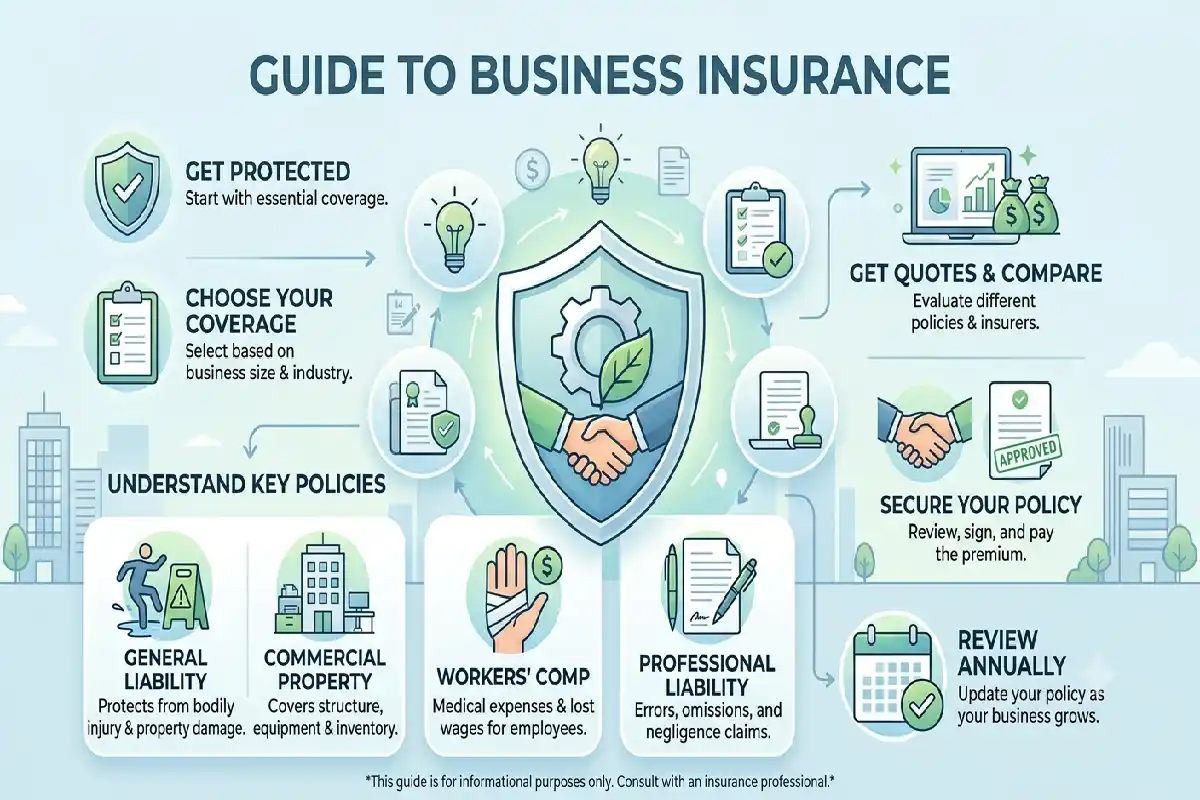
Business Insurance: A Complete Guide (2026)
Last Updated: October 19, 2026
Business insurance covers a company against financial losses due to hazards ranging from lawsuits, to damaged property, to injured employees, errors on the job, even cyber risk and more. The exact coverage you need will vary depending on what kind of work your business is in, where you operate it, what assets you own and whether or not you have employees. In the U.S., some insurance must be maintained due to State law while other forms of coverage are acquired because they respond to significant financial risks.
Purchasing business insurance is not merely a quest for the least expensive insurance premium. An inexpensive policy with coverage limits too low for your business or significant exclusions can leave you stranded when a costly claim appears. Let’s take a look at the common types of business insurance and average benchmarks in 2026 so you know how to select coverage for risks that are relevant to your actual business.
Why Business Insurance Matters
You could suddenly be sued, hit by a car, get robbed, your premises could burn down, one of your employees may be injured, a client may lose data due to a hacking breach or you could even be sued as part of a professional liability claim. Insurance is the solution, to transfer part of that financial risk burden on to an underwriter for payment of a premium.
Types of Business Insurance
The ideal insurance package for any company will vary. A freelance consultant operating a home business won’t have the same exposures as a restaurant, factory, builders, or even an internet retailer.
| Insurance type | Businesses that may need it | What it generally protects |
| General liability | Most businesses | Third-party bodily injury, property damage and certain advertising claims |
| Professional liability/E&O | Consultants, agencies, accountants, IT firms | Claims involving professional mistakes, negligence or inadequate services |
| Workers’ compensation | Businesses with employees, subject to state rules | Covered employee work-related injuries and occupational illness |
| Commercial property | Businesses with physical assets | Buildings, equipment, inventory and other physical property |
| Cyber liability | Businesses handling digital or sensitive information | Certain costs associated with cyber incidents and data breaches |
| BOP | Many small businesses | Common combination of liability, property and business-income coverage |
General Liability Insurance
Small business coverage typically starts with general liability insurance. It may help respond to bodily injury claims, property damage claims and specific personal and advertising injury claims.

For instance, the general liability insurance may help respond to eligible defense expenses and damages in the event of a customer slips and falls inside a company business and alleges negligence.
Insureon says the average 2026 monthly premium it received from its small business customers for general liability insurance was around $45 per month, but clarifies that “Pricing is based on industry, geography, revenue, claims history, limits and deductible.”
Professional Liability (E&O) Insurance
Professional liability, also known as errors and omissions (E&O), on the other hand, covers claims that professional service or work-or advice or service rendered-resulted in financial damages to the client.
This includes claims against marketing firms which made a damaging mistake, accountants with claims of malpractice, or even IT consultants whose project was a failure.
According to Insureon’s 2026 data, the average small business premium for professional liability was $88/month, but depending on industry-especially risk-this number varied widely.
Workers’ Compensation Insurance
The basis of workers’ compensation is benefits paid on account of covered work-related injuries and illnesses. It is different from general liability insurance in that it is linked to employee workplace injuries only.
Key, for the business owner, is the workers’ compensation requirements vary by state. The U.S. Dept. Of Labor refers employers to their state workers’ comp agency for what applies in their state.
Do not assume part-time or contract or nontraditional employees are treated equally. Check classification and coverage needs prior to hiring them.
Commercial Property Insurance
Commercial property insurance protects eligible physical business assets against covered losses. Depending on the policy, this may include buildings, equipment, inventory, furniture and other business property.
The NAIC notes that commercial property coverage can address losses involving physical property and may be structured around actual cash value or replacement cost. Business interruption coverage can also help address lost earnings and continuing expenses following certain covered property losses.
Cyber Liability Insurance for Businesses
Cyber risk has become an important consideration even for smaller organizations. Businesses increasingly depend on cloud applications, payment systems, email, customer databases and online services.
IBM’s 2026 Cost of a Data Breach Report puts the global average cost of a data breach at $4.99 million, up 12% year over year. IBM also reported a 56% increase in AI-driven attacks. These figures represent organizations globally rather than typical small-business claims, but they demonstrate why cyber risk deserves separate consideration.
Verizon’s 2025 DBIR found that small businesses recorded thousands of incidents and that system intrusion, social engineering and basic web application attacks accounted for 96% of breaches in its small-business analysis.
Cyber insurance should therefore be evaluated alongside security controls rather than treated as a substitute for cybersecurity.
How Much Does Business Insurance Cost in 2026?
There is no universal business insurance price. Industry, revenue, payroll, location, employees, claims history, property value, coverage limits and deductibles can all affect premiums.
A useful 2026 benchmark from Insureon’s small-business customer data is:
| Coverage | Average monthly cost | Approx. annual cost |
| General liability | $45 | $538 |
| Business Owner’s Policy | $83 | $990 |
| Professional liability/E&O | $88 | $1,051 |
| Workers’ compensation | $54 | $643 |
| Commercial property | $108 | $1,301 |
| Cyber insurance | $129 | $1,552 |
These are marketplace-specific averages, not guaranteed quotes.
BOP vs. Buying Policies Separately
A Business Owner’s Policy can be attractive to eligible small businesses because it combines several common coverages.
| Option | Best suited for | Main advantage |
| BOP | Many small businesses | Combines common coverages |
| Separate policies | Specialized or higher-risk businesses | More customization |
| BOP + additional policies | Growing businesses | Core protection plus specialized coverage |
A BOP does not automatically replace every policy. Professional liability, workers’ compensation, commercial auto and cyber coverage may need to be purchased separately depending on the business.
Frequently Asked Questions
Is business insurance legally required?
It depends on the type of coverage, state, employees, industry and contractual obligations. Workers’ compensation is regulated primarily at the state level, while other insurance requirements can arise from contracts or specific regulations.
What is the most important business insurance?
There is no single policy that is best for every company. General liability is a common starting point, while service businesses may also need professional liability and companies handling sensitive data may need cyber coverage.
Is a BOP enough for a small business?
Sometimes, but not always. A BOP can combine general liability, property and business-income coverage, but specialized risks may require additional policies.
How can I lower business insurance costs?
Compare multiple quotes, maintain good safety practices, review unnecessary coverage, choose appropriate deductibles and keep accurate business records. Avoid reducing essential coverage simply to obtain a lower premium.
Should a small online business have cyber insurance?
It can be worth considering if the business stores customer information, processes payments, operates online systems or depends heavily on digital infrastructure. Cyber insurance should complement, not replace, cybersecurity controls.
Conclusion
Business insurance works more like a risk-management system than just one policy. Commercial general liability, or CGL, covers common third-party claims. Professional liability covers businesses offering services from errors and omissions liability.
Workers’ compensation covers employee injury, whereas commercial property covers tangible and intangible property. Cyber liability covers select digital risks.
A mixture that best suit your business is determined by how the company works and what assets it, and how it hires and uses employees, as well as what contracts cover the company, not to mention the particular risks.
For a growing company, the goal is not to buy the most insurance. It is to transfer the risks that could otherwise create a financial loss the business cannot comfortably absorb.