

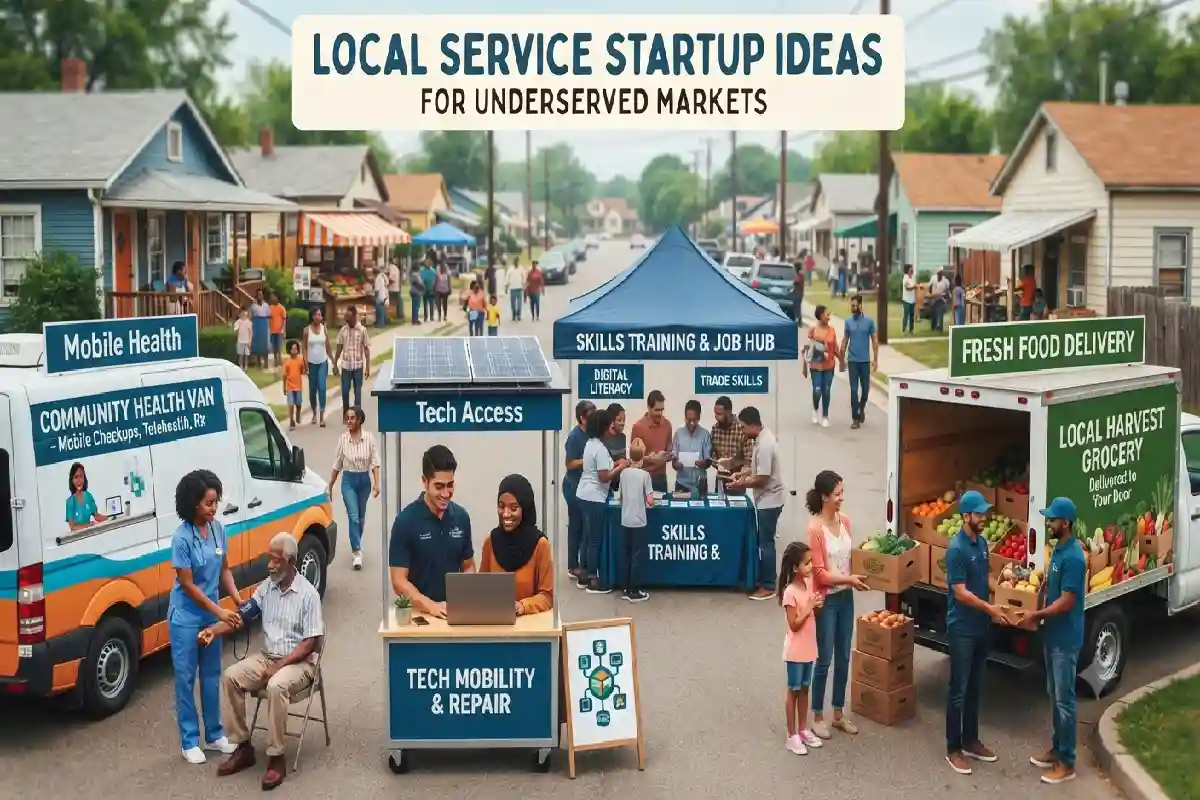
Local Service Startup Ideas for Underserved Markets
Last Updated: September 23, 2026
Launching a local service operation can appeal to first-time business owners who want to minimize inventory investment, avoid complex technology, and directly address everyday issues. Many local areas contain gaps where consumers have difficulty finding simple, inexpensive, and accessible services. Such opportunities can lend themselves well to small businesses that serve specific localities, markets, and needs.
The trick, then, is that it isn‘t enough just to “pick the most profitable sounding service”. The successful local business has to serve a real need, have an affordable operational cost, and have a compelling proposition for the customer to choose it over similar other services.
Spot Gaps in Your Local Service Market
The most promising local service startup ideas are seldom concocted through brainstorming. Just observe your local environment and discover things that people tend to complain about, delay, or have trouble locating assistance with.
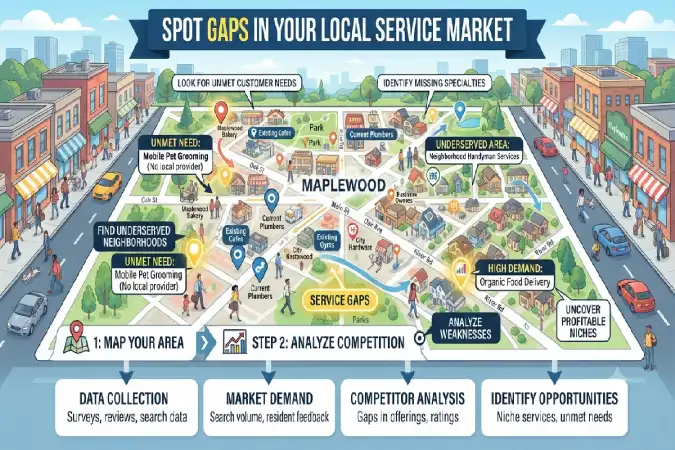
Start by asking simple questions:
- Which services are more than hard to get appointments for?
- What providers have negative reviews or do not have consistent availability?
- What is the work that homeowners/businesses are repeatedly Hiring other people to do?
- Is some areas underserved?
- Are current services unaffordable for the average consumer?
- Would a common service be more accessible with online booking or home visitation?
- Reviews of the online competition will show other gaps in services, be sure to check the local competitors for complaints of late,
Unreliable quality were found and noted.
Since this is where the demand is, it is easy to imagine ways to meet this need. For instance, if a bunch of cleaning services are getting complaints about pricing delays, a start-up might be able to enter on the basis of providing scheduled cleaning for that week. If small businesses can‘t find affordable maintenance companies, targeted maintenance for local shops may have a sale.
The opportunity is to identify a problem that is common enough to generate multiple repeat demand.
Home and Property Service Opportunities
Property related services such as, Home and rental property will require ongoing maintenance and could be a potential source of repeat business for many areas. Many householders would prefer to hire a contractor to do the work rather than perform the more mundane tasks themselves.
Potential opportunities include:
- Residential cleaning
- Lawn and garden maintenance
- Pressure washing
- Pest-control coordination
- Handyman services
- Painting and touch-up work
- Appliance installation
- Furniture assembly
- Moving and packing assistance
- Home organization
- Pool or outdoor-area maintenance
- Property inspection services
- Rental-property turnover cleaning
Some services can start with basic equipment and one person. Others may require technical skills, licenses, insurance, or specialized equipment.
Property services can also be packaged into recurring plans. For example, instead of selling one garden-maintenance visit, an entrepreneur could offer weekly or monthly maintenance packages. A rental cleaning company could provide landlords with a fixed-price turnover service between tenants.
Convenience can become an important differentiator. Customers may be willing to pay more for providers who offer online scheduling, predictable arrival windows, transparent pricing, and digital invoices.
Before launching, check local regulations and any licensing or certification requirements for the specific service. Services involving electrical work, plumbing, pest control, construction, or other regulated activities may have additional requirements.
Services for Local Shops and Small Businesses
Small businesses often need help with routine tasks but may not have enough work to justify hiring full-time employees. This creates opportunities for local service startups that operate on an outsourced or subscription basis.

Potential B2B service ideas include:
- Commercial cleaning
- Social media management
- Local SEO services
- Website maintenance
- Bookkeeping support
- Photography and product photography
- Signage installation coordination
- Delivery and pickup services
- IT support
- Equipment maintenance
- Inventory counting
- Office organization
- Administrative assistance
- Event setup and teardown
A Rather than helping with each of the million businesses these customers have, it seems preferable to help only one type:
For instance, instead of trying to sell a general digital marketing agency to all, the startup could focus on promoting one to local restaurants only, or rather, an admin support service to only individual clinics, salon, retailers or offices.
Specialization can reduce the role of marketing because the business can develop a powerful offer that meets the needs of a particular customer.
For local B2B services, schedules contracts can be even more important. A plumber may have a customer who want the boiler checked once a year. In contrast, a shop may want somebody to clean it all the time and a website developer might want to work constantly on a site.
Compare Equipment, Staffing and Travel Costs
A promising service idea can become difficult to operate if the costs are underestimated. Before launching, calculate the expenses required to deliver every job.
Start with equipment. Some businesses need little more than a laptop and smartphone, while others may require vehicles, tools, cleaning machines, ladders, safety equipment, or specialized machinery.
Next, consider staffing. If you cannot personally perform every job, determine whether you need employees, contractors, or temporary workers. Include wages, training, payroll costs, and administrative expenses in your calculations.
Travel is another important consideration for local businesses. A service may appear profitable when viewed on a per-job basis but become less attractive after accounting for fuel, parking, vehicle maintenance, and travel time.
A simple cost calculation can help:
Estimated profit per job = Customer price − Direct service costs − Travel costs − Labor costs
For example, suppose a service charges $100 for a job but spends $20 on materials, $15 on travel, and $40 on labor. The remaining $25 must cover overhead and profit.
Creating this calculation before launch can help identify services that look attractive on paper but have weak margins in practice.
It is also useful to compare one-time jobs with recurring services. A recurring customer may be more valuable because the business spends less time and money acquiring the customer again.
Choose a Service Area and Initial Offer
Trying to cover an entire city from the beginning can create unnecessary travel costs and make scheduling difficult. A better approach may be to start with a clearly defined service area.
Choose a neighborhood, group of nearby neighborhoods, or small geographic zone where customers have a strong need for your service.
A focused service area can provide several advantages:
- Lower travel expenses
- More efficient scheduling
- Faster response times
- Easier local marketing
- Stronger word-of-mouth referrals
- Higher number of jobs per day
Next, create a simple initial offer. Avoid launching with a long list of unrelated services. Start with one core problem and make the offer easy to understand.
For example:
Home Cleaning: Standard two-bedroom cleaning from a fixed starting price.
Small Business Support: Weekly administrative assistance for local retailers.
Property Maintenance: Monthly outdoor maintenance package for residential properties.
A clear offer helps potential customers immediately understand what they are buying.
Once the business begins generating customers, track which services produce the most demand, revenue, repeat bookings, and referrals. You can then expand into related services based on actual customer behavior rather than assumptions.
Conclusion
Services small businesses at a local level can offer real solutions to everyday consumer needs in a situation where the market offers limited choice or variable service delivery. The best opportunities are likely to be through everyday issues relating to homes, properties, shops, and small businesses.
Begin with uncovering an un-met need, doing competitor research, and working out the true cost of delivery. Next, settle on a limited service area and begin with a tight, early offering.
You do not need to establish a big business right away. However, a small, dependable service which adequately addresses a specific local issue can be the basis of a household of repeat business, recommended business, and expansion.