

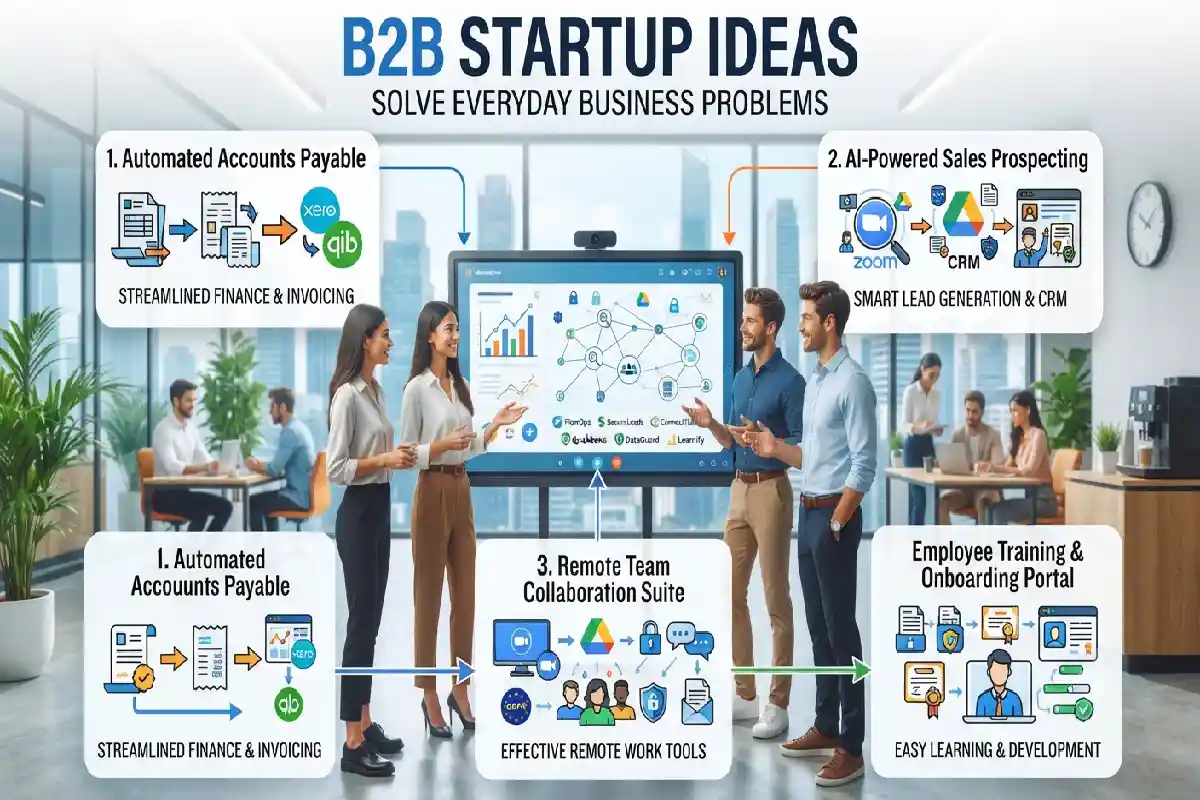
B2B Startup Ideas That Solve Everyday Business Problems
Last Updated: September 23, 2026
Business to business (B2B) businesses address a need for other businesses, not of the individual consumer. For this reason business-to-business businesses can be very appealing business to run. Companies are, after all, constantly purchasing services, software, and tools designed to save time, lower costs, improve productivity, boost revenues, and generate easier compliance.
An excellent B2B business does not have to address a big or difficult problem. Lots of great business ideas are based on small irritations such as: constant admin, having to send the same message several ways, running reports by hand, bad customer follow-up, misaligned software or just plain tedium that employees are doing several times each day.
First to build is a solution built to a problem that was identified, and a product that can be sold to the right user who gets value from using it. It would be easier to target a narrow segment of customers to start with, rather than opening a product to the mass market.
Find Repetitive Problems in Business Workflows
Some of the most attractive B2B startup opportunities are found within repetitive business processes.
Employees could take hours each week to transfer data between spreadsheets, generate reports, respond to the same customer inquiries, book meetings, follow up with prospects, or file away documents.
There are many information management and communication efficiencies which not only cost tasks individually, but, combined, can be extremely costly.
Look for activities that are:
- Performed frequently
- Highly repetitive
- Dependent on spreadsheets or manual data entry
- Prone to human error
- Difficult to track
- Delayed because someone must perform them manually
- Important enough that businesses already spend money addressing them
For example, a small sales team may manually create weekly pipeline reports. A startup could offer a reporting service that collects information from existing systems and produces standardized reports.
A property management company might struggle with repetitive tenant communications. A specialized communication workflow could reduce administrative work.
An accounting practice could spend substantial time collecting documents from clients. A document-request and tracking solution could address that bottleneck.
The important question is not simply:
“Can this process be automated?”
Instead ask:
“Is this problem painful enough that a business will pay to solve it?”
Talk to potential customers before building. Ask how they currently handle the task, how frequently they encounter the problem, what it costs them in time or money, and what alternatives they have already tried.
B2B Service Ideas for Small Teams
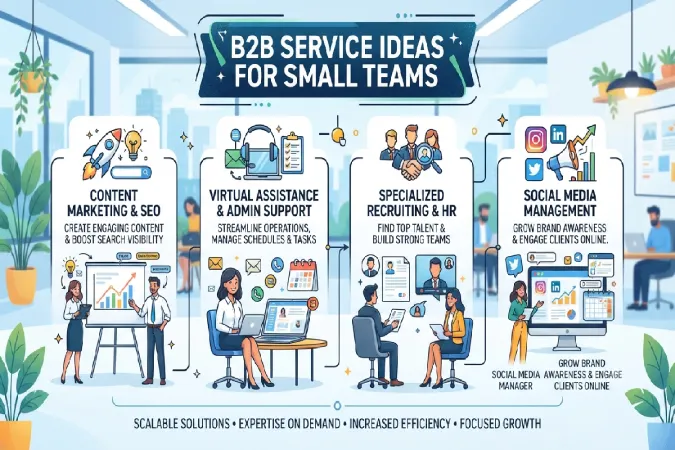
Not every B2B opportunity requires software. Services can be an effective way to solve business problems with relatively little initial development.
Bookkeeping and Financial Administration
Might need assistance with keeping tracks of transactions, preparing financial records, invoicing or handling other bookkeeping tasks.
A dedicated service has the potential to be targeted at certain consumer teams, such as freelancers, companies, ebay.com sellers or specialized business.
Lead Generation
Small business owners find it hard to nurture and qualify leads over time. B2 B lead-generation service providers can help many small businesses by creating prospect lists, researching accounts, running prospecting processes or improving lead qualifications.
It must promote honest, permission-aware business policies and adhere to relevant privacy and marketing regulations.
Content and SEO Services
Businesses need websites, articles, newsletters, case studies, product descriptions, and other content. A specialized agency can create content for a specific industry rather than attempting to serve every type of company.
Industry specialization can make it easier to understand customer terminology, common questions, and purchasing decisions.
Customer Support Services
Small companies may not have enough employees to provide consistent customer support. Outsourced support can cover email responses, chat support, appointment scheduling, basic troubleshooting, and customer follow-up.
Administrative Support
Virtual assistants and specialized administrative providers can handle scheduling, document organization, research, CRM updates, and other routine activities.
A founder can start with a service and later turn the most repetitive part of the workflow into software.
Compliance and Documentation Support
Businesses often need organized records, recurring documentation, training materials, and process checklists. A specialized provider can help companies manage administrative requirements.
Because compliance requirements vary by industry and location, providers should understand the relevant rules and avoid presenting general administrative assistance as legal or professional advice unless properly qualified.
Software and Automation Opportunities
Software becomes particularly valuable when the same problem occurs frequently across many businesses.
Workflow Automation
A startup could automate repetitive actions between existing business applications. For example, when a new customer completes a form, the system could automatically create a CRM record, notify the appropriate employee, and generate a follow-up task.
Reporting Dashboards
Regardless of industry, companies usually keep data across various spreadsheets and software applications. A customized dashboard can pull these KPIs together on one platform.
Possible recipients of the information could be marketing and sales department, ecommerce companies, logistics businesses or professional business.

Appointment and Scheduling Tools
Scheduling, reminders, rescheduling, availability management and notification of customers are essential features of an appointment based business.
The pitch is more compelling when a startup is catering to a niche with specific needs instead of competing as a general scheduling app.
Invoice and Payment Workflows
Often, small businesses allocate their resources from time spent on invoicing, tracking received payments and following-up on overdue payments.
A dedicated device could automate part of this workflow and integrate with current accounting or payment solutions.
Internal Knowledge Tools
Employees often have the same operational questions. An internal knowledge base or AI-supported company information retrieval system might speed up access to and retrieval of official procedures, documentation and answers.
The security, the access controls, the way the data is handled, and the accuracy are really important for these products.
Customer Follow-Up Automation
Opportunities are missed because the leads and customers are not followed up with in a timely basis. Develop software that will put reminders, record conversations, and activate appropriate communications.
The best opportunities for automation typically exhibit three attributes: problem occurs often, current process uses significant resources, and business can quantify improvement.
State who the Buyer is and the basis of the Buying Process
In B2B startups, one of the most common errors is thinking that the user of the product is necessarily the buyer.
B2B buying decisions may be made by a number of people.
For example:
- User: The employee. The person who uses the product.
- Manager: the head of the team Who is this?
- Budget owner: The individual responsible for controlling expenditure.
- Decision-maker: The individual who has the authority to purchase.
A startup should understand this process before investing heavily in product development.
Ask potential customers:
- Who experiences the problem?
- Who currently solves it?
- Who controls the budget?
- What does the current solution cost?
- How are new vendors evaluated?
- How long does approval usually take?
- What concerns could prevent a purchase?
The answers can influence your pricing, sales process, product features, and marketing message.
For small businesses, the buyer and user may be the same person, allowing faster purchasing decisions. Larger organizations may have longer procurement processes and additional security or legal requirements.
Compare Recurring Revenue Potential and Delivery Costs
Recurring revenue can make a B2B business more predictable, but recurring revenue alone does not guarantee a sustainable business.
Founders should compare revenue potential with the cost of delivering the service.
Consider a monthly service priced at $500 per customer. If serving each customer requires 15 hours of manual work every month, growth may require hiring more employees.
A software product might have higher development costs initially but relatively low incremental delivery costs for additional customers.
A simple comparison can include:
| Business Model | Revenue Pattern | Delivery Cost | Scalability |
| Consulting | Project or hourly | High | Moderate |
| Managed service | Monthly recurring | Medium to high | Moderate |
| SaaS | Subscription | Low per additional user | High |
| Digital product | One-time or recurring | Low | High |
| Automation service | Setup + recurring | Medium | Moderate to high |
| Marketplace | Transaction-based | Variable | Potentially high |
These categories are not guarantees. Actual economics depend on pricing, customer acquisition costs, retention, support requirements, infrastructure, and the complexity of the problem.
Look Beyond Revenue
A startup should also track:
- Customer acquisition cost
- Gross margin
- Customer retention
- Churn
- Average revenue per customer
- Support costs
- Implementation costs
- Time required to serve each account
A service business with high prices can still be difficult to scale if every customer requires extensive manual work. Conversely, software with low delivery costs can struggle if customers are expensive to acquire or frequently cancel.
The ideal opportunity will depend upon what the founding entrepreneur intends to want to achieve, what resources it brings to the task, the amount of capital available, and the target market.
Final Thoughts
The prospect of a new B2B startup is often lurking in an everyday business process. Rather than seeking a phenomenon, a founder can analyze the unglamorous daily routine of employees and isolate where, in their opinions, time, cash and efficiency are being wasted.
Begin by conducting interviews with potential customers and mapping out their processes. Identify frequent challenges that already have an economics or operations cost associated with them.
Once established, determine whether the opportunity aligns more with a service, a software product, an automation offering, or a mixture of these approaches.
Similarly it is critically important to understand the buyer. If a product addresses a real customer pain point, the startup can still fail if the product does not understand the respondents to who makes purchasing decision or how a business goes about selecting vendors.
Finally, compare recurring revenue potential to delivery costs. A healthy B2B opportunity must be one that will not only solve a genuine problem, but also reach the point when economics sustain the business of scale.
To be most effective this path is most simply begun by being narrow: pick a single customer segment, focus on one costly problem to fix, create a small first offer, then learn from real customers. After the offering works reliably, a startup can move on to neighboring problems, neighboring customer segments, or neighboring software features.