

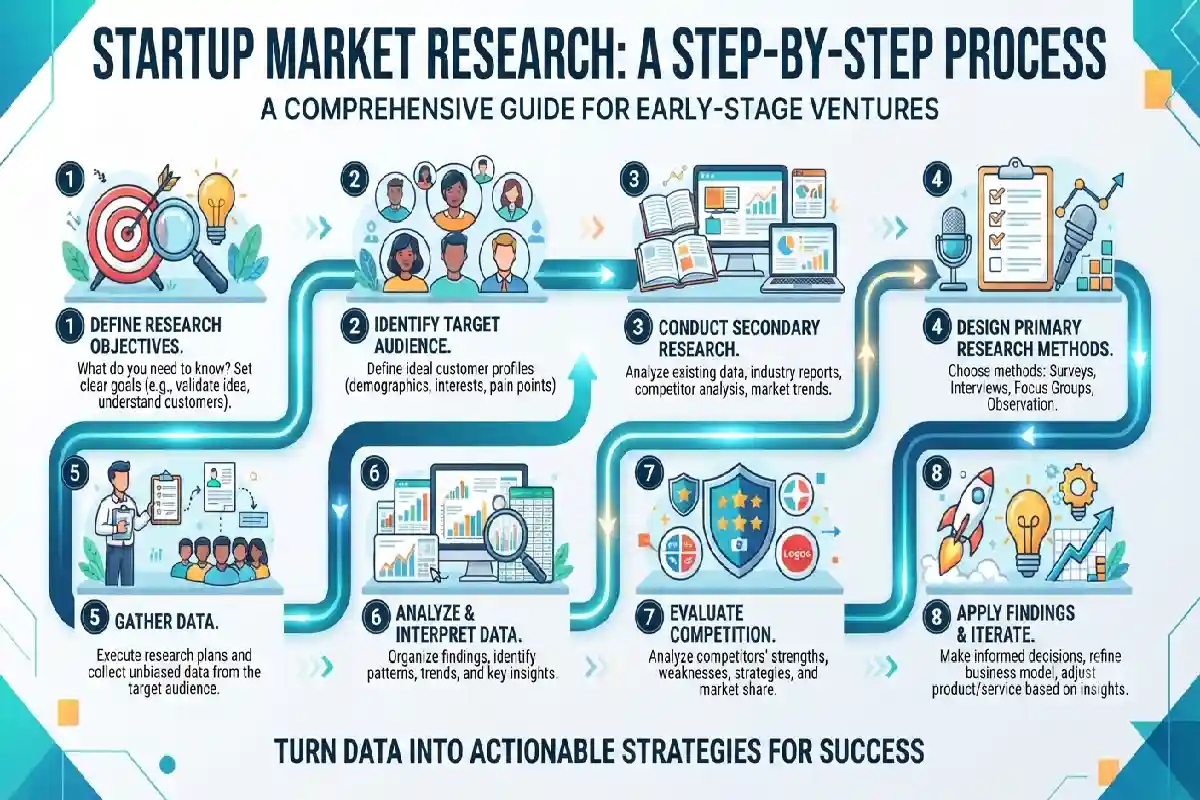
Startup Market Research: A Step-by-Step Process
Last Updated: September 28, 2026
Early in a startup, entrepreneurs require some evidence of the existence of a true market for the solution they would like to provide before they can commit a major share of their business‘s human and/or financial resources. Startup market research answers the critical questions about.
Even thorough research does not help a startup succeed. It does, however, help founders create less unnecessary uncertainty and make better decisions. This can involve starting with lightweight desk research and add more rigor as an idea gets more refined.
Below is a simple, step by step method of how to do market research for a startup:
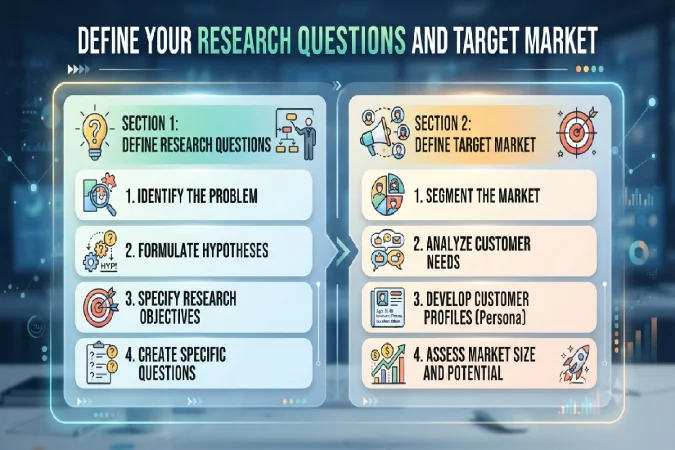
Define Your Research Questions and Target Market
First, determine what it is that you need to learn. Beginning with nonspecific searches will bring back a wealth of information without helping you reach a conclusion.
Create a list of questions based on your startup idea.
For example:
- Who experiences the problem?
- How frequently does the problem occur?
- How do customers solve it today?
- What alternatives already exist?
- What are customers willing to pay?
- How large is the potential market?
- Which customer segment has the strongest need?
- What barriers could prevent adoption?
Make sure your research questions give you guidance for decisions you are likely to have to make.
Identify your target market. Don‘t try to describe your audience to a general term. For startups, this can be as specific as the customer they are targeting due to industry, size of company, location of industry, age range, income range, job function, behaviour or specific needs.
For a B2B startup, say, the ideal market could be self-governed stores with five to 20 employees, that are currently handling inventory manually. A consumer startup, it could be a niche niche of users with a certain buying behaviour, or a certain problem.
A well defined target market will make the rest of your research more targeted.
Collect Reliable Secondary Market Data
Secondary research involves using information that has already been collected and published by other organisations.
Potential sources include government statistics, industry reports, trade associations, company reports, academic research, regulatory publications and reputable research organisations.
Look for data related to:
- Market size and growth
- Customer demographics
- Industry trends
- Purchasing behaviour
- Technology adoption
- Economic conditions
- Regulatory changes
- Consumer spending
- Industry structure
The quality of your data sources counts. Using a figure from the UK Office of National Statistics may be more helpful in estimating population or economic activity than using an unsupported figure from some random blog.
Be aware of the date, the location and methodology for every significant source. Five year‘s old market figure might be relevant for the current environment. At the same time a number for the entire world market could be irrelevant for the country and the city you want to start the business in.
If an important assumption is central to your business model, do not use only one source. Use multiple credible sources and look into major discrepancies.
Secondary research should provide some background, however, it may not answer all of your questions. In particular, published reports may not reveal whether your specific target customers are willing to buy your proposed solution.
Map Competitors and Existing Alternatives
Competition research helps you understand how customers currently solve the problem.
Start by identifying direct competitors. These are businesses offering a similar product or service to the same target customers.
Then consider indirect competitors and alternatives. Customers may solve the problem using spreadsheets, internal staff, existing software, freelancers, manual processes or simply by doing nothing.
Create a simple competitor research table containing information such as:
| Area | Questions to Research |
| Target customers | Who does the competitor serve? |
| Product or service | What exactly does it offer? |
| Pricing | How does it charge customers? |
| Positioning | What benefit does it emphasise? |
| Distribution | How do customers purchase it? |
| Strengths | What appears to attract customers? |
| Limitations | What gaps or complaints can you identify? |
Study competitor websites, product pages, customer reviews, public documentation, advertisements and other credible sources.
Avoid assuming that a competitor’s marketing claims are proven facts. Separate what the company says about itself from independently observable evidence.
The objective is not simply to create a list of competitors. You want to understand the market structure and identify unanswered customer needs or underserved segments that you can investigate further.
Estimate Market Size with Clear Assumptions
Market sizing gives founders an idea of the size of the opportunity, but early stage market sizing includes many assumptions so the method should be clearly stated.
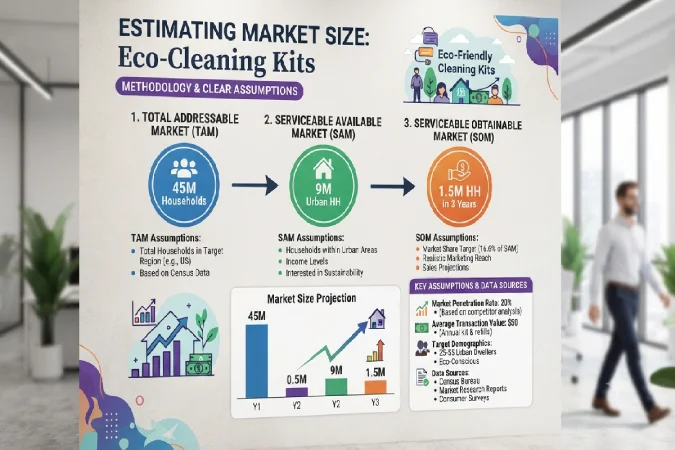
There are three concepts: TAM, SAM and SOM.
- Total addressable market (TAM) TAM: Is the overall potential market should the company could serve each and every relevant client.
- SAM, Serviceable Available Market, is reduced here to what can be made to fit your product, geography and business model.
- SOM (Serviceable Obtainable Market) this is the section that was feasible to pursue today.
For example, a startup might sell software for $50 a month and consider 20 000 businesses to be a good market.
A simplified annual TAM calculation would be:
20,000 businesses × $50 × 12 months = $12 million
This is only an illustrative estimate. The actual market calculation would need to consider factors such as purchasing behaviour, eligibility, pricing, competition and geographic availability.
Another approach is a bottom-up market estimate, where you calculate the number of potential customers, expected adoption and expected revenue per customer.
For example:
Potential customers × Expected adoption rate × Average annual revenue per customer
Document every major assumption. If you cannot verify a number, label it as an estimate rather than presenting it as established market data.
Turn Research Findings into Testable Decisions
Research becomes valuable when it changes what you do next.
After collecting information, organise your findings into three categories:
Known: Information supported by reliable evidence.
Assumed: Something you currently believe but have not adequately tested.
Unknown: An important question for which you do not yet have sufficient evidence.
This framework prevents assumptions from being mistaken for facts.
Next, turn important assumptions into testable hypotheses.
For example:
“Small retailers will pay $30 per month for automated inventory alerts.”
This can be tested through customer interviews, landing-page experiments, product demonstrations, pre-orders or other appropriate validation methods.
Prioritise assumptions that could significantly affect the business. If customers do not have the problem, or are unwilling to pay for the proposed solution, other research may become less important.
You can then create a simple decision framework:
Evidence → Assumption → Test → Result → Decision
The decision might be to continue testing, change the target customer, modify the product, adjust pricing or stop pursuing the idea.
Final Thoughts
Market research for a startup should ultimately point founders toward understanding customers, competitors, market conditions, and the size of an opportunity. It begins with well focused research questions, proceeds through credible secondary research and competitor analysis, and results in a transparent estimate of market size.
Most of all, research must be translated into action.
Do not regard market research as a guarantee that a startup idea will succeed. Use it to pinpoint assumptions that you need to test. Complement the research with conversations directly with potential customers and pilots in the field, and revise your position as evidence is accumulated.
A solid research process will not eliminate uncertainty, but it will allow you to figure out which uncertainties are most important and turn them of f before you invest a lot of resources in them.