

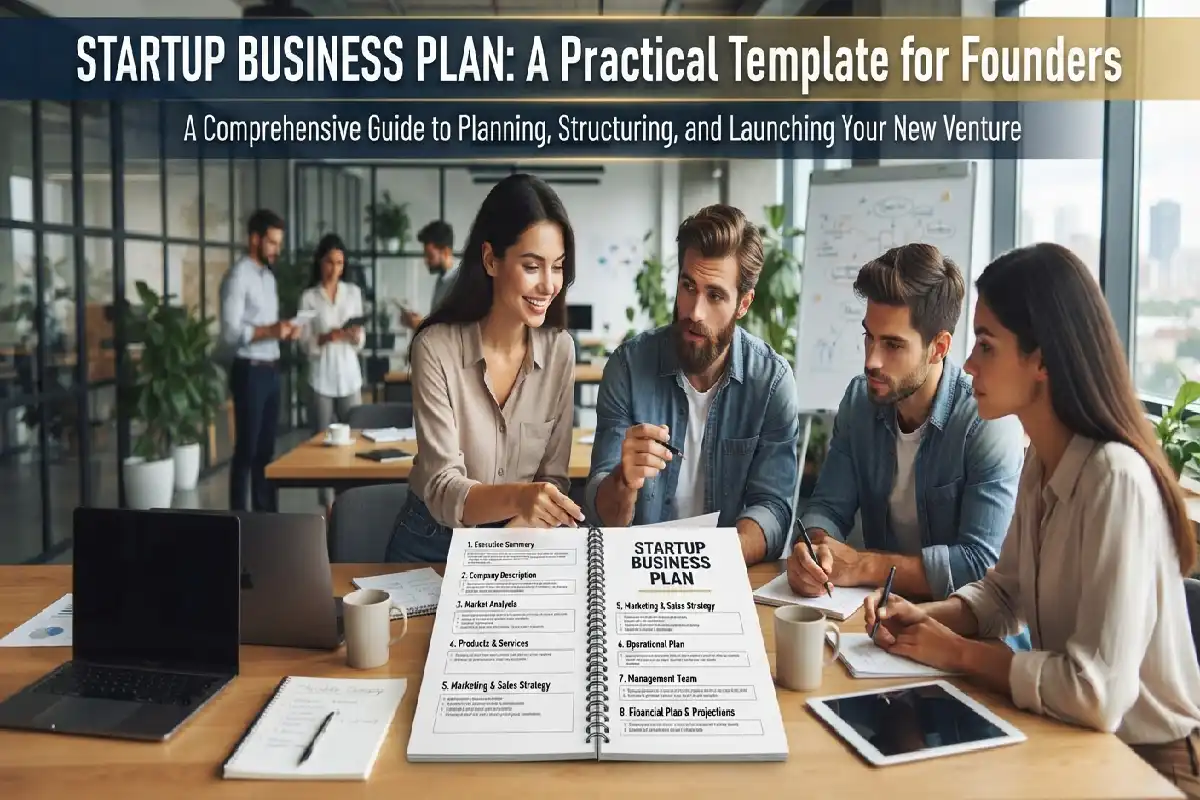
Startup Business Plan: A Practical Template for Founders
Last Updated: September 28, 2026
Creating a startup is harder than just being a good idea. Startup founders have to know what problem they are solving, who will pay for it, how will the idea find the customers and what resources are necessary. A startup business plan combines this information in a single actionable document.
A business plan does not have to be technical or full of predictions, however serious. For an early stage startup it should simply turn assumptions into questions, show some critical risks and give somewhere to make a decision from.
This practical startup business plan template covers the areas that entrepreneurs should think through beforehand as well as as they move along.
Write a Clear Problem and Solution Summary
In the first part of your startup business plan, you will describe the challenge that your startup is seeking to resolve. Your problem statement should center on a real-world customer pain rather than the product you will sell to fill the need.
Begin by pinpointing who the problem affects, where the pain points are, and how customers presently address the issue.
Instead, focus on the problem you are solving: For instance, rather than put We are creating a new smartphone productivity tool you could put the problem you are solving: ‘Owners of small businesses currently spend hours each week manually organizing customer enquiries across emails, spreadsheets and messaging applications’
Next, explain your solution and identify the problem it solves.
Your summary should answer questions such as:
- What problem are you solving?
- Who experiences the problem?
- Why does the problem matter?
- What solution are you offering?
- How does your solution improve the current alternative?
- Why would customers pay for it?
Keep this section simple. Avoid making claims that have not yet been tested. At the startup stage, clearly separating facts from assumptions makes the rest of the plan more useful.
Describe Your Target Market and Business Model
A startup should rather have a well-clear target customer segment than a broad market like “everyone with a smartphone” or “any small business”.
Describe your target market: who is MOST LIKELY to have the problem and GREAT REASON to buy your solution.
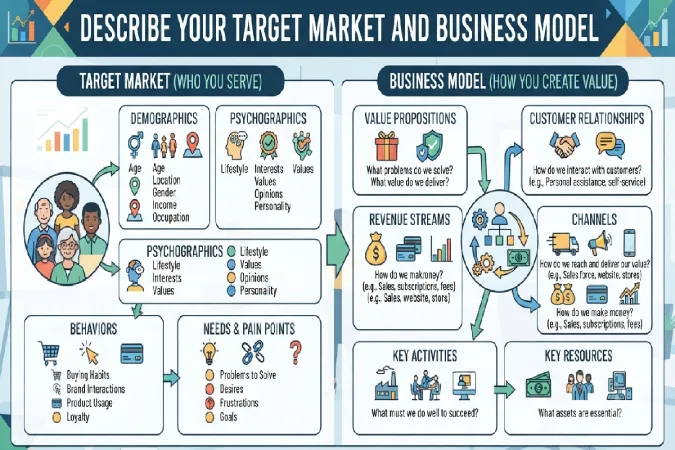
In terms of your business, helpful attributes could be any of the following: industry, company size, location, needs of your customers, buying habits, budget and use case.
You should also do some research on the market and on your competitors. This means looking on the alternatives that are already in place and what people already buy. It does not mean that you have to show that what your competitors do is not good. It is more about what do people want.
Next, explain your business model. This describes how the startup creates value for customers and generates revenue.
Common models include:
- One-time product sales
- Monthly or annual subscriptions
- Transaction fees
- Service fees
- Commission-based revenue
- Licensing
- Advertising
- Freemium plans with paid upgrades
State what customers will pay you for, what customers are willing to pay you for, and when you‘ll receive revenue from these activities.
For instance, a SaaS start-up in a service business may invoice customers on a monthly basis by the number of users or projects served. A service business may bill a customer for completing a project or an ecommerce start-up may profit from an ongoing sale of a product.
Early figures should be treated as estimates until supported by customer research and actual sales data.
Outline Your Route to Market and Operations
Having a product is only one part of building a startup. Your plan should explain how customers will discover, evaluate and purchase your offer.
This is your route to market.
Potential channels include:
- Search engine optimisation
- Content marketing
- Social media
- Email marketing
- Paid advertising
- Direct sales
- Partnerships
- Marketplaces
- Referral programmes
- Events and communities
Choose channels based on where your target customers already look for information or solutions. A startup does not need to use every marketing channel from day one.
Describe the customer journey from first contact to purchase. For a B2B startup, this might involve content, a sales call, a product demonstration and a contract. For an ecommerce business, it could involve search, a product page, checkout and delivery.
Your business plan should also outline basic operations.
Consider how you will:
- Develop or source the product
- Deliver products or services
- Manage suppliers
- Handle customer support
- Process payments
- Manage technology
- Maintain quality
- Track important business information
Clearly identifying operations requirements to ensure founders are clear on what has to go on behind the scenes to get the customer promise.
Estimate Costs, Revenue Assumptions and Resources
Insurance is another item that is usually featured in a startup business plan under financial planning, even if the exact figures are unknown.
First, consider your startup costs:What potential costs might you have? Equipment? Software? Website development? Inventory? Legal or administrative fees? Logo and branding? Marketing?
Distinguish between one-time charges and ongoing expenses.
For instance, equipment can be bought just once, but software subscriptions, wages, hosting, advertising can go on forever each month.
Next, create simple revenue assumptions. Estimate:
- Number of customers
- Average transaction or subscription value
- Purchase frequency
- Expected monthly revenue
- Customer acquisition costs
- Gross margin
- Major operating expenses
Avoid presenting assumptions as guaranteed results. Instead, document how you arrived at each estimate.
For example:
Monthly revenue = Number of paying customers × Average monthly revenue per customer
If you expect 100 customers paying an average of $30 per month, your estimated monthly revenue would be $3,000. The purpose of the calculation is to make the assumption visible so you can later compare it with actual performance.
Also identify the resources required to execute the plan. These might include founders, employees, contractors, technology, equipment, suppliers, funding and specialist expertise.
Set Milestones and Review Your Plan
A business plan becomes more useful when it includes measurable milestones.
Instead of writing “grow the business,” define specific outcomes such as:
- Interview 30 potential customers
- Launch a minimum viable product
- Acquire the first 10 paying customers
- Reach a specific monthly revenue target
- Establish a repeatable sales process
- Launch in a second customer segment
- Reach a defined customer retention rate
Assign a timeframe to each milestone and identify the evidence that will show whether it has been achieved.
The plan should be looked at on a regular basis. Conditions at start-up can change rapidly. Customer feedback may indicate the that the key problem was not what you assumed it to be. Marketing costs may be more expensive than anticipated or one customer segment may be responding more favourably.
Conduct periodic reviews to compare your assumptions with actual results. Regenerate your financial forecasts, customer data, marketing plan and operating requirements as new evidence emerges.
The purpose of a startup business plan it’s not to forecast the future perfectly. It is to construct a logical view of the entreprise, to make assumptions explicit and essentially define test driven decisions.
Final Thoughts
A good initial thinking [startup] business plan communicates five things clearly: the problem and solution; the target market and business model; the route to market and to operate; the financial assumptions and resources; the milestones to track progress.
Save version one short and data-driven. Validate your offer and obtain real business data, then revise the plan.
A handy plan isn‘t a document that remains static in a folder. It is an operational instrument assisting founders in determining what to test, in which areas to allocate resources, and at which point to alter their approach.