

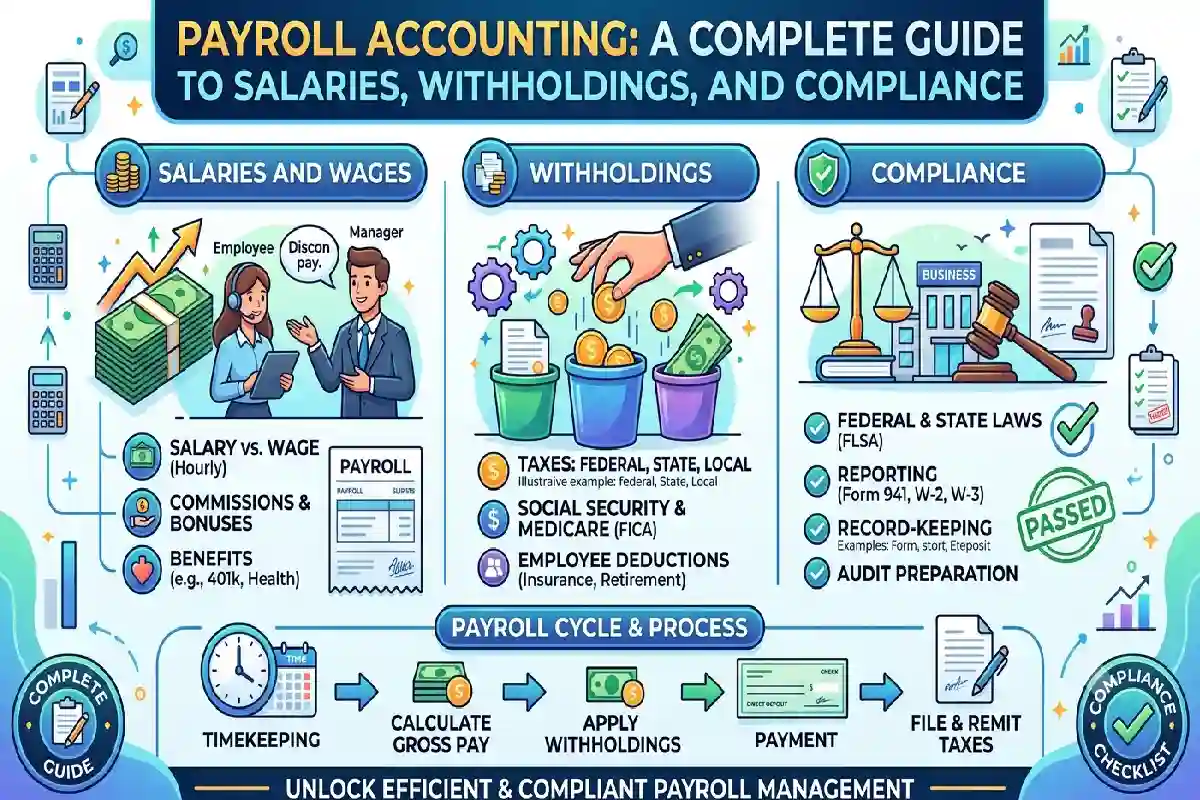
Payroll Accounting: A Complete Guide to Salaries, Withholdings, and Compliance
Last Updated: September 21, 2026
Payroll is arguably the most critical financial function in any company. On the one hand, employee expects to be paid in full and on time; and on the other hand, it is up to the company‘s payroll department to spend the right amount of time calculating the wages, taxes, benefits, deductions and other payroll liabilities.
Payroll accounting denotes the recording of the remuneration of the employees in the books of a company, together with all liabilities towards the payroll. It is the link between human resources, accounting, tax reporting and cash flow within organizations.
Adopting an effective payroll system ensures that a business prevents over or under payments, accurate financial reporting, reporting deadlines are achieved, and employment and taxation legislation are complied with.
This guide will help clarify the basics of payroll accounting, the difference between gross and net pay, tax withholdings and deductions, payroll compliance, and payroll software tools.
1. Payroll Accounting Basics
Payroll accounting begins with accurately recording everything associated with employee compensation.
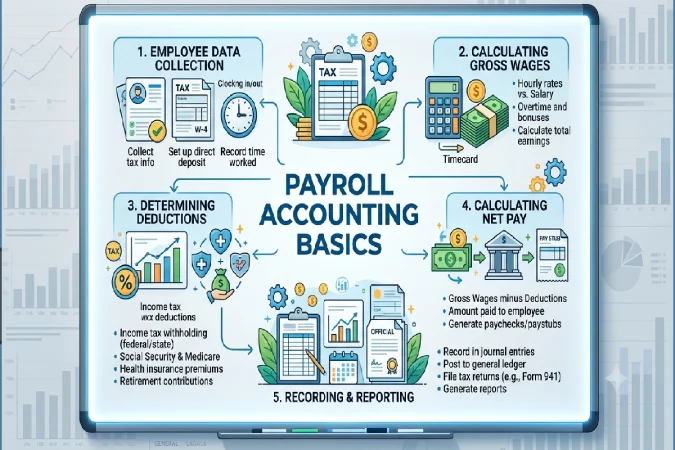
A typical payroll process includes:
- Calculating employee wages or salaries
- Tracking working hours
- Calculating overtime where applicable
- Recording bonuses and commissions
- Calculating taxes and other withholdings
- Recording employee benefits
- Paying employees
- Recording employer payroll costs
- Remitting withheld amounts to the appropriate authorities
- Preparing payroll reports
Payroll Journal Entries
Accounting-wise, payslips are normally accounted not only for the employee‘s remuneration but also for the associated liabilities.
Suppose an employee has a gross wage of $5,000. The employee is entitled to a net wage of $4,000 after deduction and withholding.
The accounting records may include:
Debit: Wage expense — $5,000
Credit: Payroll liabilities — $1,000
Credit: Cash/payroll payable — $4,00
The exact accounts and amounts depend on the company’s accounting system and applicable regulations.
Employer Payroll Costs
Employers may also have additional payroll expenses beyond an employee’s gross wages.
These can include:
- Employer payroll taxes
- Retirement contributions
- Health insurance contributions
- Workers’ compensation costs
- Paid leave obligations
- Other employee benefits
Understanding the difference between employee deductions and employer expenses is essential for accurate financial reporting.
2. Calculating Gross vs. Net Pay
One of the most important payroll concepts is understanding the difference between gross pay and net pay.
What Is Gross Pay?
Gross pay is the employee’s total compensation before applicable taxes and deductions are removed.
For an hourly employee, gross pay may be calculated as:
Regular hours × hourly rate + applicable overtime + other earnings = gross pay
For example:
An employee works 160 regular hours at $25 per hour.
160 × $25 = $4,000 gross wages
If the employee receives a $500 bonus, gross pay becomes $4,500 before applicable deductions.
For salaried employees, gross pay is generally based on their salary and payroll frequency.
What is Net Pay?
Net pay is the amount the employee actually receives after applicable withholdings and deductions.
A simplified calculation is:
Gross pay − taxes − employee deductions = net pay
A simplified calculation is:
| Payroll Component | Amount |
|---|---|
| Gross pay | $4,500 |
| Taxes and required withholdings | -$700 |
| Retirement contribution | -$225 |
| Health insurance | -$150 |
| Net pay | $3,425 |
The actual calculation varies based on the employee’s location, tax status, benefits, and other circumstances.
Why the Difference Matters
In addition to the wages an employee receives, the employer has to consider other costs as well. Any costs not part of net wages, such as gross wages, taxes paid on behalf of the employee, benefits paid, and any other costs paid to the employee must be estimated as well.
3. Tax Withholdings and Deductions
Deductions applied to an employees wages assume off the gross figure before the final net balance is paid.

Some deduction are mandated by law others are permissioned by the employee or result from an employment benefit.
Common Tax Withholdings
Depending on the country and jurisdiction, payroll may involve withholding amounts for:
- Income taxes
- Social insurance programs
- Social Security-type contributions
- Medicare or healthcare programs
- Local or regional payroll taxes
The employer generally calculates and withholds the applicable amounts before paying the employee.
Voluntary Deductions
Employees may also have deductions related to benefits or other authorized programs.
Examples can include:
- Retirement contributions
- Health insurance premiums
- Dental insurance
- Vision insurance
- Flexible spending arrangements
- Employee loan repayments
- Other authorized deductions
Businesses should obtain appropriate employee authorization where required and ensure deductions comply with applicable employment laws.
Pre-Tax vs. Post-Tax Deductions
Some deductions may be taken before certain taxes are calculated, while others are deducted after taxes.
The tax treatment depends on the specific benefit, jurisdiction, and applicable rules.
For this reason, employers should avoid assuming that every employee benefit receives identical tax treatment.
Keep Payroll Records
Maintain documentation supporting:
- Employee wages
- Hours worked
- Tax withholding
- Benefits
- Deductions
- Employer contributions
- Payroll payments
Good records make payroll reconciliation and tax reporting significantly easier.
4. Payroll Compliance and Reporting
Payroll compliance involves adhering to employment, tax, wage and reporting laws and regulations that relate to your enterprise.
The requirements depend on the location, industry, classification of worker and business structure.
Pay Employees Correctly and on Time
The supervisor should be installed in a stable system of payroll and the employees should get the term value on the assigned payday.
Errors can occur when businesses fail to account for:
- Overtime
- Bonuses
- Commissions
- Paid leave
- Unpaid leave
- Changes in salary
- Employee benefits
- New hires
- Terminations
- Remit Payroll Taxes
Withheld payroll taxes generally must be sent to the relevant tax authorities according to required schedules.
Missing payment deadlines can result in interest, penalties, or other compliance problems.
File Payroll Reports
Businesses may need to submit periodic payroll and employment reports to tax authorities or other government agencies.
Depending on the jurisdiction, reporting may occur:
- Monthly
- Quarterly
- Annually
- At employee onboarding
- When employment ends
Employers should maintain a calendar of applicable filing and payment deadlines.
Classify Workers Correctly
Worker classification can have major payroll consequences.
Employees and independent contractors can have different tax, benefit, withholding, and reporting requirements.
Misclassifying workers can expose a business to back taxes, penalties, interest, and employment-related claims.
When classification is unclear, professional advice can help determine the appropriate treatment.
Reconcile Payroll
After each payroll period, compare payroll records with accounting records and bank transactions.
Look for:
- Incorrect employee payments
- Duplicate transactions
- Missing liabilities
- Incorrect tax amounts
- Unrecorded benefits
- Bank discrepancies
Regular reconciliation helps identify problems before they accumulate.
5. Best Payroll Software Tools
Payroll software can automate many repetitive tasks and reduce manual calculations.
The right system depends on the size of your workforce, location, payroll complexity, budget, and existing accounting software.
Important Payroll Software Features
Look for features such as:
- Automated payroll calculations
- Direct deposit
- Employee self-service
- Time and attendance integration
- Tax calculation and withholding
- Payroll tax filing support
- Benefits administration
- Payroll reporting
- Accounting integration
- New-hire onboarding
- Mobile access
- Security controls
Cloud-Based Payroll
Cloud payroll platforms allow employers and payroll professionals to access information through secure online systems.
Potential advantages include:
- Automated updates
- Centralized employee records
- Easier payroll processing
- Employee access to pay information
- Integration with accounting systems
- Automated reporting
However, automation does not ensure compliance. Employers still need to check the payroll settings on a regular basis and verify that employee information, tax jurisdictions, rate of pay, and benefit deductions are accurate.
Choosing Payroll Software
Before selecting a platform, consider:
- How many employees do you have?
- Do you operate in multiple locations?
- Do employees work hourly or salaried positions?
- Do you need time-tracking integration?
- Do you offer employee benefits?
- Does the software support your accounting platform?
- Does it assist with required tax filings?
- Can it scale as your business grows?
For a very small business, a basic payroll system may be sufficient. Larger companies may require advanced payroll, benefits, compliance, and workforce-management capabilities.
Payroll Accounting Best Practices
Businesses can improve payroll accuracy by following a consistent process.
Before Payroll
- Update employee information.
- Review hours and attendance.
- Check salary changes.
- Verify bonuses and commissions.
- Review benefit deductions.
During Payroll
- Calculate gross wages.
- Apply appropriate withholdings.
- Calculate deductions.
- Calculate employer payroll costs.
- Review net pay.
- Process employee payments.
After Payroll
- Record payroll journal entries.
- Reconcile payroll accounts.
- Remit required taxes.
- Submit applicable reports.
- Keep payroll documentation for the store.
Final Thoughts
Payroll accounting is not only paying employees. It‘s about bookkeeping, recording costs and wages, submitting taxes, making proper deductions, adjusting sums with journal transactions, recording pays, and submitting reports in time.
The company needs to develop effective payroll processes. They should learn the difference between gross and net pay, keep proper employee records, perform payroll reconciliations at least monthly, keep up with deadlines and use appropriate payroll software to automate as much as possible.
As your business evolves payroll can become more and more complicated. Having more employees, offices, benefits, paying more hours overtime or bonuses, bringing in contractors and individual employees being paid from changing regulations. ‘fingers crossed’, it can all go wrong.
A combination of good payroll records, suitable software, monthly reconciliation and expert advice when required can help ensure that the right amounts are paid to staff, whilst giving better financial controls and compliance.