

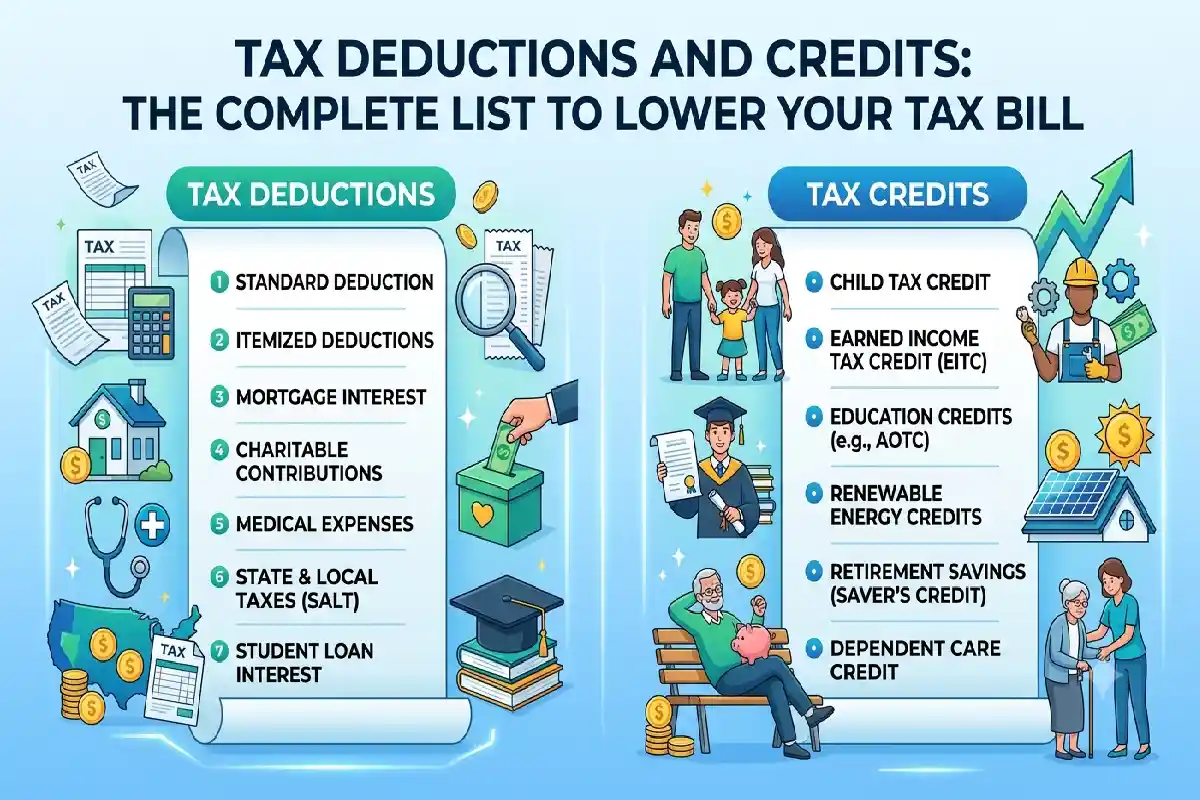
Tax Deductions and Credits: The Complete List to Lower Your Tax Bill
Last Updated: September 21, 2026
Tax credits and tax deductions can really cut down your federal income tax if you are able to claim them. Think about how well each one is suited for your situation you must understand the different rules for each deductions and credit.
In the 2026 U. S. filing season, most people will be filing 2025 tax returns. The rules listed below are for 2025 federal taxes and follow the present IRS guidance.
A tax deduction subtracts from income subject to taxation. A tax credit directly reduces the amount of tax owed. Some credits are refundable, which means they can result in a refund even if the credit itself is larger than the tax owed:.
Tax Tip: Please note the above is just an overall general tax summary, not tax advice. It also does not take into account your eligibility, limits, phaseouts and documentation requirements.
1. Standard vs. Itemized Deductions
The first major deduction decision for many taxpayers is whether to take the standard deduction or itemize deductions.
Standard Deduction
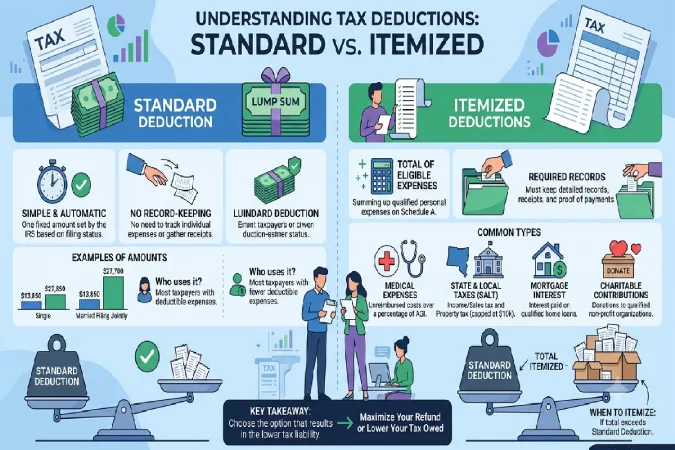
The standard deduction is a fixed amount that reduces taxable income. For tax year 2025, the federal standard deduction is:
| Filing Status | 2025 Standard Deduction |
| Single | $15,750 |
| Married Filing Jointly | $31,500 |
| Head of Household | $23,625 |
| Married Filing Separately | $15,750 |
The IRS generally advises taxpayers to use whichever method provides the larger applicable deduction.
Itemized Deductions
Instead of taking the standard deduction, taxpayers can list qualifying expenses individually on Schedule A.
Potential itemized deductions include:
- Certain medical and dental expenses
- State and local taxes
- Qualified mortgage interest
- Eligible charitable contributions
- Certain casualty or theft losses
- Other qualifying expenses
For 2025, the overall federal state and local tax (SALT) deduction limit increased to $40,000, or $20,000 for married taxpayers filing separately, subject to income-based limitations.
Which Is Better?
Add your eligible itemized deductions together and compare the result with your standard deduction.
For example:
Standard deduction: $15,750
Eligible itemized deductions: $18,500
In this simplified example, itemizing could produce the larger deduction.
Tax software can generally calculate both options and help you determine which produces the lower tax liability.
2. Above-the-Line Deductions Explained
Above-the-line deductions, sometimes called adjustments to income, are items that will lower your income, and are taken before calculating your adjusted gross income.
One advantage is that some adjustments might be available even if you use the standard deduction.
Common examples can include qualifying:
- Traditional IRA contributions
- Health Savings Account (HSA) contributions
- Student loan interest
- Educator expenses
- Self-employed health insurance
- Certain retirement contributions
- Half of self-employment tax
- Certain business-related adjustments
The specific deduction and eligibility requirements depend on the taxpayer’s circumstances.
New 2025 Deductions
Tax legislation enacted in 2025 introduced several deductions beginning with tax year 2025.
These include deductions relating to:
- Qualified tips
- Qualified overtime compensation
- Certain car-loan interest
- An enhanced deduction for qualifying seniors
These deductions can be claimed through Schedule 1-A where applicable, and can also be available to those that choose to itemize.
For example, The exemption for qualifying taxpayers can permit a subtraction of as much as $12,500 in qualified overtime pay, or $25,000 for married filing jointly, subject to all the rules.
Since these provisions are new, a taxpayer should study the current IRS instructions before claiming them.
3. Popular Tax Credits: Child, Education and EV
Tax credits can be particularly valuable because they generally reduce tax liability dollar for dollar, rather than merely reducing taxable income.
Child Tax Credit
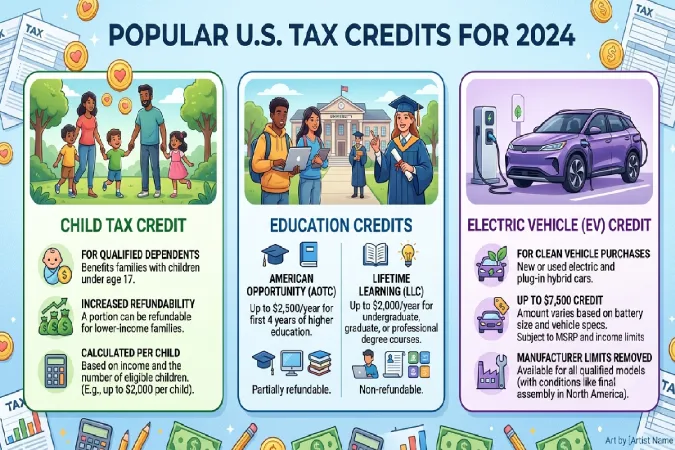
For 2025, eligible taxpayers may receive a Child Tax Credit of up to $2,200 per qualifying child. Up to $1,700 per qualifying child may be refundable through the Additional Child Tax Credit, subject to eligibility requirements.
Requirements can include:
- The child meets the applicable age requirement.
- The child qualifies as your dependent.
- The child has a qualifying Social Security number.
- You meet applicable income and other requirements.
American Opportunity Tax Credit
The American Opportunity Tax Credit (AOTC) covers 100% of the first $2,000 you paid for certain qualified higher-education expenses per eligible student, and then 25% of the next $2,000.
In 2025, at least partially refundable (up to 40%) according to the rules.
The AOTC is in effect for the first four years of post-secondary education.
Lifetime Learning Credit
The Lifetime Learning Credit (LLC) is worth up to $2,000 per return.
However, this can typically apply to qualifying higher education, for a longer time than 4 years, and some types of courses related to 1 improvement in job abilities.
With most students, You most frequently cannot take both the AOTC and the LLC for the same student in the same year.
Electric Vehicle Tax Credit
The federal clean vehicle credits were altered drastically when new laws passed in 2025.
According to the IRS the ‘New Clean Vehicle Credit’, ‘Previously-Owned Clean Vehicle Credit’ and ‘Qualified Commercial Clean Vehicle Credit’ are not available for any vehicle purchased after September 30, 2025. However, some vehicles that were purchased on or prior to September 30, 2025may qualify.
Therefore, taxpayers should not expect that buying an EV in 2026 would automatically entitle him or her to a federal clean-vehicle credit.
4. Business Tax Deductions
Those who own a business or work for themselves would be able to deduct reasonable and necessary business expenses.
Potential deductions include:
- Advertising
- Business software
- Office supplies
- Professional services
- Business insurance
- Utilities
- Business-use vehicle expenses
- Business travel
- Certain employee benefit costs
- Business-use-of-home expenses
- Qualified retirement-plan contributions
- Depreciation
- Certain startup costs
For example, the IRS states that the 2025 standard mileage rate for business use is 70 cents per mile, subject to the applicable requirements.
Home Office Deduction
If you qualify, you may be able to deduct certain expenses associated with using part of your home for business. Specific requirements apply, including rules concerning how and why the space is used.
Section 179
Taxpayers who are eligible can deduct the cost of certain types of property (e.g., moveable equipment) rather than recover it through depreciation.
In 2025, the maximum deduction allowed under section 179 increased to $2.5million. The deduction began to phase out when qualifying property placed in service exceeds $4million.
Keep Business and Personal Expenses Separate
One of the most important bookkeeping practices is maintaining separate records for personal and business expenses.
Save:
- Receipts
- Invoices
- Bank statements
- Mileage records
- Contracts
- Payment records
The IRS emphasizes that taxpayers need documentation supporting expenses or losses claimed as deductions.
5. Common Deductions People Miss
Many taxpayers focus on the most obvious deductions and overlook less prominent opportunities.
HSA Contributions
Eligible contributions to a Health Savings Account may qualify for an above-the-line deduction, subject to the applicable rules and limits.
IRA Contributions
Some of the contributions made to the traditional IRA are deductible based on where you fall in relation to your spouse‘s filing status, income levels, and whether you or your spouse participate in an employer‘s retirement plan.
Self-Employment Tax Deduction
Most often, self-employed taxpayers can deduct the employer-equivalent portion of their self-employment tax as part of their adjusted gross income.
Educator Expenses
Teachers may be entitled to a deduction for some unreimbursed expenses incurred in the classroom depending on the limits and requirements.
Charitable Contributions
Qualifying charitable contributions (can/cannot) be itemized, if appropriate requirements are followed and documentation is present.
Business Expenses
Small business owners sometimes overlook legitimate expenses such as:
- Accounting fees
- Business software
- Advertising
- Bank fees
- Licenses
- Office supplies
- Repairs
- Business insurance
Deduction vs. Credit: What’s the Difference?
Understanding this distinction is essential.
| Feature | Tax Deduction | Tax Credit |
| Reduces | Taxable income | Tax owed |
| Value | Depends partly on tax rate | Generally dollar-for-dollar |
| Examples | IRA deduction, business expenses | Child Tax Credit, AOTC |
| Refundable? | No | Some credits can be |
| Documentation | Usually required | Usually required |
Tax Deduction and Credit Checklist
Before submitting your return, consider whether you should review:
- Standard deduction
- Itemized deductions
- IRA contributions
- HSA contributions
- Student loan interest
- Educator expenses
- Child Tax Credit
- Child and Dependent Care Credit
- Education credits
- Earned Income Tax Credit
- Qualified business expenses
- Home office expenses
- Business mileage
- Retirement contributions
- Charitable contributions
- Applicable energy incentives
- New 2025 deductions on Schedule 1-A
Assess whether or not you are entitled to any items as not all items are available to every taxpayer.
Final Thoughts
Tax Deductions and Credits apply to your federal taxes, but you should only take the ones to which you are entitled.
Begin with a comparison of the standard deduction against the itemized deduction, and then consider the available above the line deductions, family and education credits, business deductions, and other tax breaks.
Looking ahead to the 2026 filing season, taxpayers should be aware of the more recent changes to tax law and their implications for preparing 2025 returns, such as the expanded deductions for qualified tips, overtime, some vehicle loan interest, and seniors. The federal EV credits went through significant changes as well, so determine if you are qualified for the credit based on when you purchased your vehicle.
Have all your supporting documentation in hand. Good record-keeping simplifies the claim of deductions and credits, and can significantly ease the process of filing a return in subsequent years.
If the return is complex for reasons including business, rental, or investment income and losses, international income, large asset purchases, or special deductions, it may be wise to see a tax pro.