

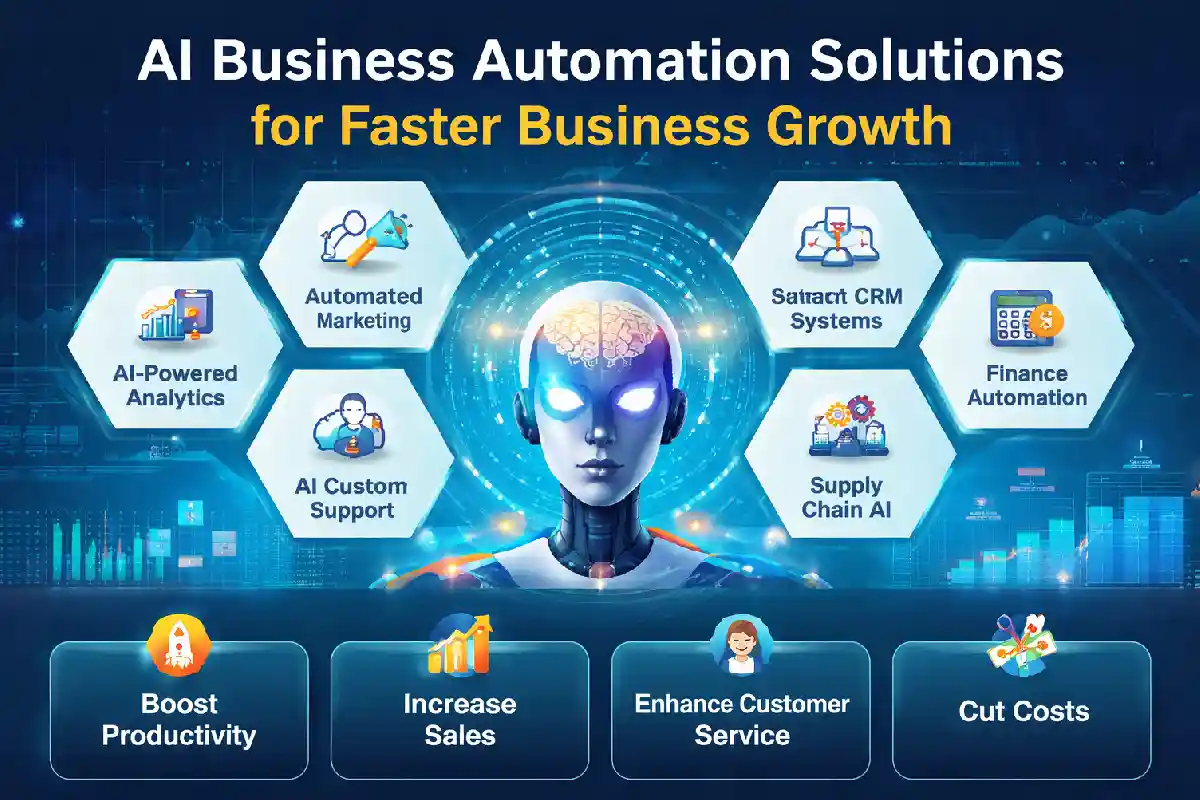
AI Business Automation Solutions for Faster Business Growth
Last Updated: June 17, 2026
Artificial Intelligence (AI) Business Automation Solutions automate repetitive processes in organizations, leading to increased productivity, reduced costs and better decisions. In 2026, Companies, irrespective of their size, apply AI-based automation systems for Sales, Marketing, Customer Support, Finance, and HR functions for full-fledged business process automation.
Regardless of the size of the company, whether it’s a startup or a large organization, automating processes with AI can reduce time-to-market and make the work of your employees.
What Are AI Business Automation Solutions?
AI Business Automation Solutions combine AI technologies along with ML, RPA, and Workflow Automation and automate your business processes with little to no human intervention.
Unlike traditional automation, AI systems can:
- Analyze data
- Learn from patterns
- Make predictions
- Handle complex decisions
- Continuously improve performance
Examples include:
- AI chatbots for customer service
- Automated lead scoring
- Invoice processing automation
- Predictive inventory management
- Intelligent email marketing workflows
How AI Improves Business Efficiency
Artificial Intelligence (AI) is changing the way organizations work by reducing the amount of manual work needed to get tasks done, while assisting in decision-making processes to maximize workforce efficiency. In 2026, companies in a wide range of sectors are leveraging AI-based tools for a variety of tasks.
No matter what size your business is: from a small organization that interacts with many potential and established customers, through to larger organizations with a more complex supply chain and a wider reliance on such interactions to succeed; AI allows organizations to do more with less.
Key Benefits
| Business Area | AI Impact |
| Customer Support | 24/7 automated assistance |
| Sales | Faster lead qualification |
| Marketing | Personalized campaigns |
| Finance | Automated invoice processing |
| HR | Candidate screening automation |
| Operations | Predictive maintenance |
Efficiency Gains in 2026
| Metric | Average Improvement |
| Process Speed | 40%–70% Faster |
| Operational Costs | 20%–45% Reduction |
| Customer Response Time | Up to 90% Faster |
| Data Accuracy | 95%+ Accuracy |
| Employee Productivity | 30%–50% Increase |
As the AI agents are able to automate more cross-department workflows, corporations are investing more in AI-enabled automation projects. Indeed, we are witnessing the upstart of new enterprise applications using autonomous AI agents to perform more elaborate activities with much less supervision.
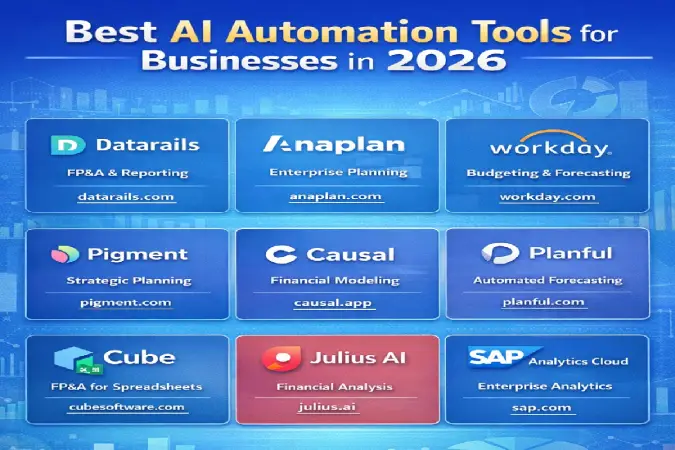
Best AI Automation Tools for Businesses in 2026
Choose the right AI automation platform 1. Company size. 2. Technical requirements. 3. Cost.
Top AI Automation Platforms
| Platform | Best For | Key AI Features | Pricing Model | Learning Curve | Official Resources |
| Zapier AI | Small businesses, startups | AI-powered workflows, AI agents, natural language automation, 8,000+ app integrations | Free + Paid Plans | Easy | Zapier AI Automation |
| Make | Marketing and workflow automation | Visual workflow builder, AI integrations, no-code automation | Free + Paid Plans | Easy | Make AI Solutions |
| n8n | Developers and growing businesses | Open-source automation, AI agents, custom workflows, self-hosting | Free + Paid Plans | Medium | n8n AI Automation |
| Microsoft Power Automate | Microsoft ecosystem users | AI Builder, Copilot integration, document processing, RPA | Per-user licensing | Medium | Microsoft Power Automate |
| UiPath | Enterprise automation | Agentic AI, robotic process automation (RPA), document understanding | Enterprise pricing | Advanced | UiPath Platform |
| Workato | Mid-size to enterprise businesses | Enterprise AI orchestration, workflow automation, low-code integrations | Custom pricing | Advanced | Workato AI Automation |
| Automation Anywhere | Large enterprises | Intelligent automation, AI copilots, process discovery | Enterprise pricing | Advanced | Automation Anywhere Platform |
| HubSpot AI | Marketing and sales teams | AI content creation, lead scoring, customer automation | Free + Paid Plans | Easy | HubSpot AI Tools |
Automating Sales and Marketing Processes
The sales and marketing departments are receiving some of the highest returns on investment from AI automation.
Sales Automation Examples
- Lead qualification
- CRM updates
- Meeting scheduling
- Follow-up email sequences
- Sales forecasting
Marketing Automation Examples
- AI-generated content
- Social media scheduling
- Audience segmentation
- Email personalization
- Campaign optimization
Example Workflow
- Visitor submits website form.
- AI scores the lead.
- CRM updates automatically.
- Personalized email sequence launches.
- Sales team receives qualified leads.
This process eliminates hours of manual work every week.
Reducing Costs with AI Technology
One of the biggest reasons your company might start to use CI Business Automation Solutions is to save expenses.
Major Cost Savings Areas
| Area | Savings Potential |
| Customer Service | 30–50% |
| Data Entry | 60–80% |
| Document Processing | 50–70% |
| Marketing Operations | 20–40% |
| Inventory Management | 15–30% |
Various new AI spending-control technologies are being developed to help organizations control their automation spending and increase ROI as they move up the adoption curve.
Real-World Example
A mid-sized eCommerce business can automate:
- Order processing
- Inventory updates
- Customer support tickets
- Marketing campaigns
Result:
- Faster fulfillment
- Reduced labor costs
- Better customer experience
Future of AI in Business Operations
The next generation of AI automation is heading toward intelligent AI agents instead of workflows.
Emerging Trends for 2026 and Beyond
Agentic AI
AI agent is autonomous, responsible for its own actions and solutions; It can accomplish tasks of its own, other agents’ cooperation, operational decisions.
Autonomous Workflows
Companies are instituting automatic workflows that don‘t require human input.
Predictive Business Intelligence
AI tailors your experience to every customer interaction.
Hyper-Personalization
CVP analysis provides executives with information that they use for strategy.
Intelligent Decision Support
Executives use insights gained from the analysis to make predictions and to predict possible outcomes of their actions.
Investments in AI centers, enterprise AI agents and automation infrastructure by industry is a signal of growing business intelligence at a rapid pace.
Common Challenges and Troubleshooting
Challenge: Poor Data Quality
Solution: Clean and standardize business data before implementation.
Challenge: Employee Resistance
Solution: Provide AI training and communicate benefits clearly.
Challenge: Integration Issues
Solution: Select platforms with native integrations and API support.
Challenge: High Automation Costs
Solution: Focus on high impact workflows and grow over time.
Frequently Asked Questions
What are AI Business Automation Solutions?
AI Business Automation Solutions: the use of artificial intelligence to make business processes more efficient through automating activities/efficiencies and minimize manual tasks.
Which industries benefit most from AI automation?
Some of the top adopters are: healthcare, financial services, retail, logistics, manufacturing and professional services.
Which is the best AI automation tool for business?
Often we favor Zapier AI or Make, as they are easier to use and don’t require much technical skills.
Can AI replace employees?
Artificial Intelligence (AI) automates repetitive tasks. However, unlike other systems that completely replace a human worker, the system may work better when used to help a human worker.
How much can businesses save with AI automation?
Cost reductions of between 20% and 45% are often claimed by organizations, although the amount of reduction is dependent on the level of implementation.
Conclusion
AI Business Automation Solutions are a strategic requirement (2026.) By streamlining business processes through AI-enabled automation, organizations will reduce costs, be more efficient, realize top customer experiences, and beat the competition. Since intelligence agents and smart automation will just continue to improve, companies need to adopt them now.