

Financial Planning for Business Growth
Last Updated: June 13, 2026
Business growth and financial planning are the one mainstream that differentiate a successful business from one that fails. PYMNTS research shows that 82% of failures of small companies link back to poor cash flow management, and that most failures would have been prevented with effective financial planning. When the One Big Beautiful Bill Act takes effect in 2026, and AI-based forecasting tools for businesses will all be available, a strong financial plan will be a must for business growth.
A detailed, practical approach to financial planning for 2026, An Entrepreneur’s Guide to Financial Planning is tailored to everyday business operations and addresses financial matters in their entirety, including cash flow, tax, fundraising, and growth budgeting.
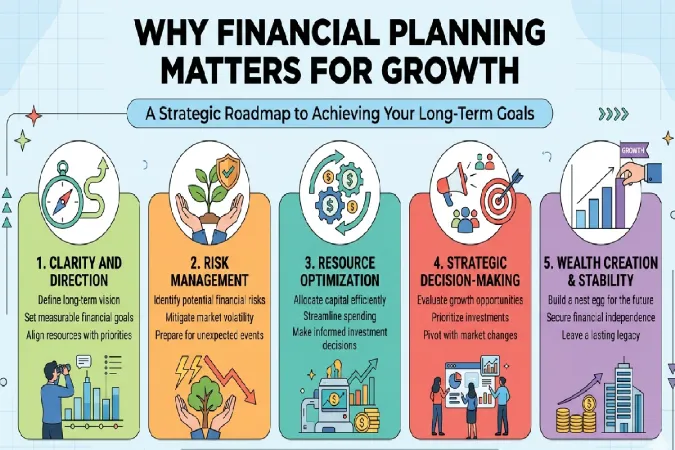
Why Financial Planning Matters for Growth
Financial planning is not a luxury for companies with a CFO on staff. It is the difference between a reactive business and a proactive one. Here’s what the numbers reveal:
| Statistic | Source | Impact |
| 99.9% of all US firms are small businesses (33.3 million) | SBA 2023 Small Business Profile graygroupintl | Massive market opportunity |
| 31% of small business owners cite cash flow as top financial challenge | NFIB National Small Business Survey 2024 graygroupintl | Primary pain point |
| Businesses with formal financial plans are 2x more likely to secure growth funding | Kauffman Foundation State of Entrepreneurship graygroupintl | Critical for scaling |
| 30% more likely to reach 5-year survival benchmarks | Kauffman Foundation graygroupintl | Long-term viability |
Setting Realistic Financial Goals
Strategic financial planning begins with clarity. Ask yourself:
- Where do we want to be in 3–5 years?
- Will we plan to scale, to expand locations, or to launch a new service?
- What are our revenue and profit goals?
Fundamental principle: Ensure that your financial plan is tied into your mission and your targets for growth. Use multi-scenario projections to illustrate the impact of growth at different levels: optimistic, typical, and conservative.
GOS6-Limitation: goal-setting framework used in 2026.
- Be specific: Set deadlines and quantify what you want to achieve
- Differentiate needs vs. wants: Recognize the difference between what you need and what you want
- Base on data: Use past performance and market trends for revenue projections
- Avoid overoptimism: Stay realistic to maintain cash flow stability
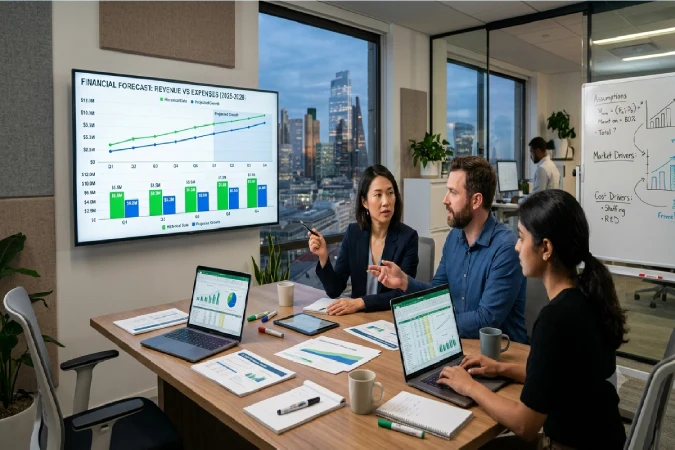
Forecasting Revenue and Expenses
Profit and cash are not the same thing. A business can be making money on paper, but still run out of cash. This occurs when slow cash receipts, big costs arriving in advance of income, or to fund expansion.
The 13-Week Rolling Cash Flow Forecast
Begin with a 13-week rolling cash flow forecast for short-term visibility. Weekly track all anticipated inflows and outflows as follows:
- Payments of the client (markets, loans)
- Suntream hardware vendor bills.blk files and service costs.
- Paid dates (e.g. 4 weekly jobs or monthly)
- Loan payments
- Applying tax regulations:
Weekly update on the forecast. The idea is pattern recognition: identify a need for additional cash 2– 3 weeks earlier.
Three-Scenario Financial Model
Build three scenarios for 12–24 months:
| Scenario | Description | When to Use |
| Base Case | Most realistic expectations | Standard planning graygroupintl |
| Downside Case | Revenue drops 20–30% or major customer leaves | Risk mitigation graygroupintl |
| Upside Case | Marketing campaign outperforms or new product gains traction faster | Opportunity planning graygroupintl |
Top Forecasting Tools for 2026:
- Float:2nd best method but best for cash flow automated forecasting
- Agicap: Appeal for rolling forecasts with scenario modelling
- Cube- Advanced three way financial modelling
Managing Growth-Related Risks
Strategic planning isn’t just about growth; it’s about mitigating threats. Key areas to evaluate:
| Risk Category | Mitigation Strategy | 2026 Priority |
| Data security | Finance & customer info protection | High wilsoncpa |
| Legal/tax compliance | CPA-led quarterly reviews | Critical wilsoncpa |
| Succession planning | Document key processes | Medium wilsoncpa |
| Economic resilience | 6–12 months reserve for downturns | High graygroupintl+1 |
| Supply chain | Tariff strategy & supplier diversification | High graygroupintl |
CPAs can perform stress tests and give you an idea of what the effect of proposed tax rules or audit regulations will be on your business model.
Emergency Fund Best Practices for 2026
The suggested recommendation is 3–6 months of operating costs in a liquid reserve. During these volatile economic times, most advisors are recommending 6–12 months for cyclical industries.
How to build your reserve:
- Set up a dedicated high-yield business savings account (separate from operating)
- Automate monthly transfers (consistency matters more than size)
- Audit budget for non-essential spending to redirect
- Adjust target annually as business grows
Monitoring Financial Performance
You cannot control what you don’t measure. Concentrate on 5–10 financial KPIs that are critical to your stage of business and set meaningful objectives for them.
Essential KPIs for Every Business
| KPI | Formula | What It Tells You | Healthy Range |
| Gross Profit Margin | (Revenue − COGS) / Revenue | Production/delivery efficiency | Industry varies (2–3% grocery, 20%+ software) graygroupintl |
| Net Profit Margin | Net Income / Revenue | True profitability after all expenses | Industry benchmark graygroupintl |
| Operating Expense Ratio | Operating Expenses / Revenue | Cost creep detection | Track quarterly graygroupintl |
| Current Ratio | Current Assets / Current Liabilities | Short-term liquidity ability | 1.5–2.0 graygroupintl |
| Revenue Growth Rate | (Current − Previous) / Previous | Expansion pace | Month/quarter/year-over-year graygroupintl |
| Accounts Receivable Days | (Avg AR / Revenue) × 365 | Customer payment speed | Set target, monitor monthly graygroupintl |
Building a KPI Dashboard
Combine in one dashboard, which should be looked at weekly or biweekly at a minimum. Most bookkeeping tools generate these on their own (QuickBooks, Xero, FreshBooks); it is just discipline to consistently look at them, block out calendar time, examine numbers, and pose questions on direction.
Recommended Dashboard Tools:
- Fathom: Financial visualization with KPI monitoring
- Power BI: Data visualization at another level
- QuickBooks Online: Built-in metrics
Tax Strategy: Maximizing What You Keep in 2026
Tax planning is year-round, not just in March. The year 2026 has a lot of potential because of the One Big Beautiful Bill Act ( OBBBA).
Key 2026 Tax Provisions
| Provision | 2025 Rate | 2026 Rate | Impact Example |
| Qualified Business Income (QBI) Deduction | 20% | 23% | $200K income = $6K additional deduction graygroupintl |
| Section 179 Expensing | $1.1M | $2.5M | Full equipment/software deduction year-of-purchase graygroupintl |
| Bonus Depreciation | 60% (phasing) | 100% (permanent) | Write off entire asset cost immediately graygroupintl |
| Employer Childcare Credit | 25–35% | 40–50% | Max credit $500K–$600K graygroupintl |
| SALT Deduction Cap | $10K | $40K | Significant state tax relief graygroupintl |
| 401(k) Contribution Limit | $23K | $24,500 | Higher retirement deduction graygroupintl |
Funding Options: SBA Programs and Beyond (2026)
Whether capital is necessary to start, stabilize or grow, it is important to have knowledge of funding options that prevent you from giving away control and paying too much for money when you do not have to.
SBA Loan Programs for 2026
| Program | Max Amount | Best For | 2026 Special Benefits |
| SBA 7(a) | $5M | Working capital, equipment, real estate | Rates 5–7%; Manufacturing: upfront fees waived for loans ≤$950K graygroupintl |
| SBA 504 | $5.5M | Fixed assets (machinery, facilities) | Manufacturing: zero upfront + annual service fees graygroupintl |
| Microloan | $50K (avg $13K) | Startups, very small businesses | Modest capital for those not qualifying larger graygroupintl |
| Working Capital Pilot | $150M total | U.S. manufacturing | Asset-based + transaction-based financing graygroupintl |
Be sure to match the type of funding to the need. If you have long-lived assets like equipment or real estate, use long-term low-rate financing, such as SBA. If you have short-term needs like inventory or seasonal gaps, use a line of credit or invoice
Growth Budgeting: Scaling Without Breaking
Growth is costly. Bringing on people before the revenue is there. Spending on marketing. Investing in inventory. Upgrading systems.
The 70-20-10 Framework
A useful starting framework for growth budgeting:
| Allocation | Percentage | Purpose | Examples |
| Daily Operations | 70% | Run business at current level | Payroll, rent, software, insurance graygroupintl |
| New Opportunities | 20% | Enter new markets, launch products | New market entry, marketing channel ramp graygroupintl |
| Long-term Investments | 10% | High-risk, high-reward | R&D, strategic partnerships, experiments graygroupintl |
Scaling vs. Growing
- Expansion: grow revenue through proportional expansion (hiring more, buying more inventory)
- Scaling: The ability to grow revenue much faster than costs & head count (SaaS added 1,000 without hiring)
Your plan should highlight where you can run faster: What to automate, where technology allows to shrink headcount, what will be a huge leverage, what will be a quantum leap over linear scale, and escape linear growth investments.
Your 2026 Financial Planning Checklist
1: Foundation
- Check that three main financial statements (Income, Cash Flow, Balance Sheet) up-to-date;
- Provide bank reconciliation.
- cleaning up chart of accounts
- Link accounting program with bank, payroll, payment systems.
2: Cash Flow and Reserves
- Build/update rolling cash flow forecast for the next 13 weeks
- Determine operating costs; identify reserve goal (min 3month)
- Open dedicated savings account; set up auto transfer on monthly basis
- Trigger automated notification reminders for outstanding invoices
3: Tax and Funding
- Schedule CPA meeting for 2026 tax position (QBI, Section 179, bonus depreciation)
- Calculate quarterly estimated tax payments
- Research SBA programs + alternative funding matching your needs
4: Modelling and KPIs
- Build 3-scenario financial model (base, downside, upside)
- Define 5–10 core KPIs; set up dashboard
- Schedule recurring weekly cash flow reviews + monthly financial statement analysis
- Share key metrics with partners/advisors
FAQ
Which three financial statements does a business always have to provide?
All businesses require an income statement (profit or loss), cash flow statement (actual cash flows in or out) and balance sheet (a ‘snapshot’ of assets and liabilities and shareholders’ equity) which are three parts of a three-way financial model providing full visibility.
What is an emergency fund? How much should I have in mine?
Liquid Reserve: Method 1: 3–6 months of operating expenses in liquid reserve for stable industries; 6–12 months for cyclical/vulnerable industries. Method 2: 10% of yearly income. Particularly high-yield savings; automated deposits; re-evaluate each year.
What are the leading tax changes for businesses in 2026?
The OBBBA delivered: QBI deduction increased 20%-> 23% (Thank you!), section 179 increased to 2.5M, 100% bonus depreciation permanently, 40–50% child care credit, and SALT cap increased to 10K->$40K. All of these greatly decrease tax liability for strategic planners.
Final Thoughts
The process of financial planning when embarked upon in a medium to long-term perspective, is always ongoing ‘practice – and not a one off event. But the companies that safely navigate through uncertain situations are those who by their nature had created the financial foundation to: anticipate problems before they appear, seize the opportunity when it presents itself, reconfigure swiftly and without fuss when the landscape changes.