
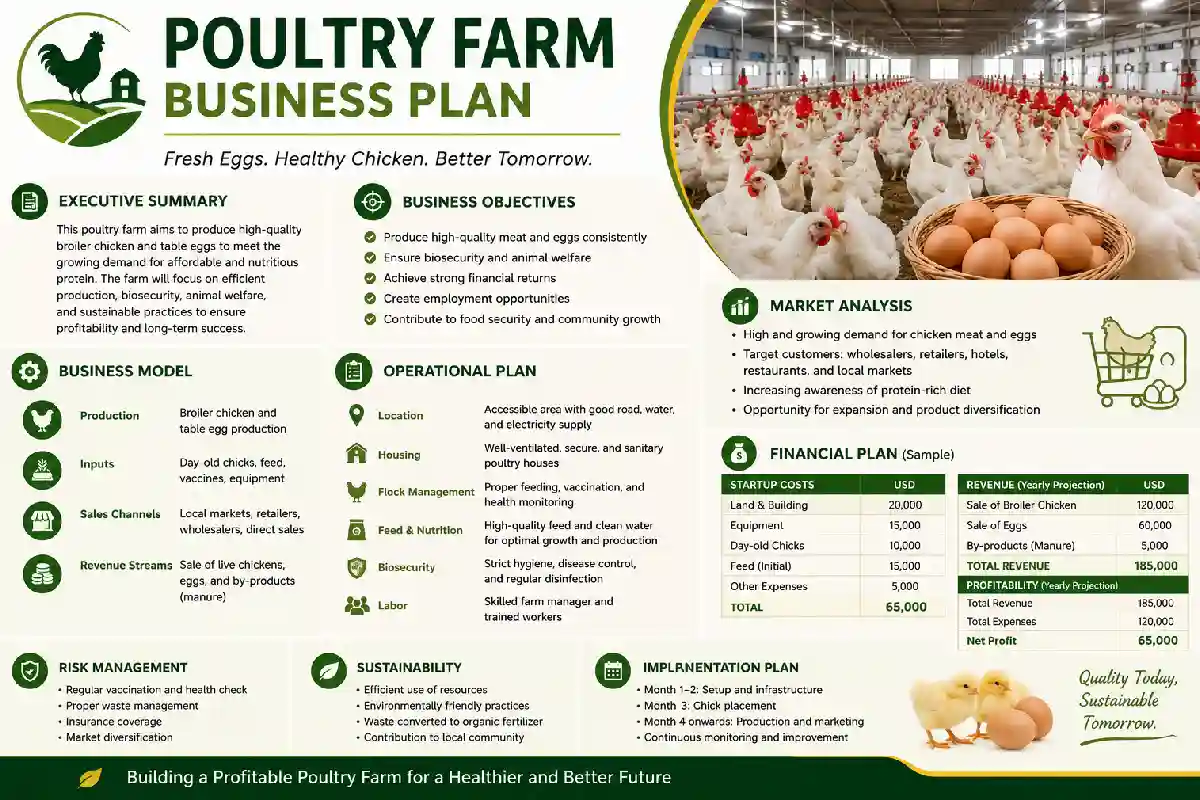
Poultry Farm Business Plan: Complete Guide for Profitable Poultry Farming
Last Updated: September 21, 2026
Introduction
A poultry farm business plan for chicken farm enterprises, eggs or broiler production is the plan for starting, funding, operating, and expanding a successful business. Must be a simple step-by-step advice in clear simple language that makes it very easy to decide what type of poultry farm to go into, how much to invest, what farm equipment to purchase, how to deal with mortality and feed management and, therefore, to know when your poultry farm is in profit. It is a simple guide to get entry into this successful business.
Chickens are very profitable to keep as long as there is a steady requirement to eat eggs and chicken, but profit margins are very dependent on feed prices, biosecurity, disease control measures, and the price you can sell at the right time; hence, a business plan is essential to safeguard margins and prevent avoidable losses.
Poultry Farming Overview
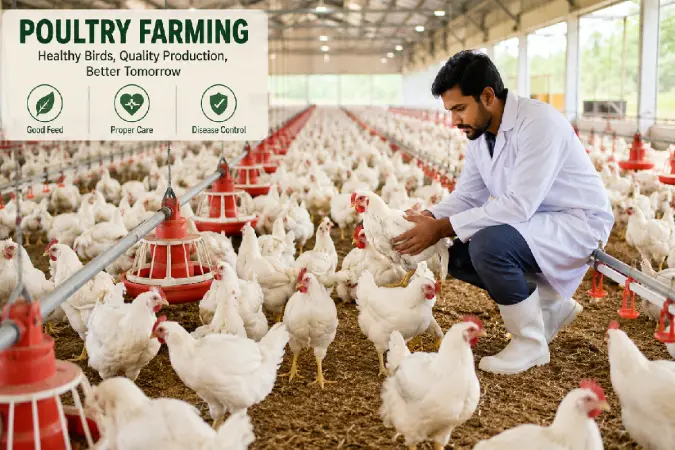
Poultry rearing can generally be divided into two types that offer a reasonable return. The meat type, where the birds are broiler-fed, and the egg-laying, or layer, type. The former tends to provide a faster cash cycle, while the latter is a more regular income return over a longer period of time. Which of these entrepreneurs, in the form of an introductory article, the reader should aim to follow can be explained in the beginning.
| Model | Main income | Best for | Cash cycle | Risk profile |
| Broiler farm | Meat sales | Faster turnover and batch-based income | Short | Higher feed-price sensitivity in poultry farms |
| Layer farm | Egg sales | Steady recurring sales | Long | More long-term management and housing needs extra |
How To Start
Transitioning to doing a poultry farm business is quite simple if you approach it as a process rather than a purchase decision. Decide first your farm type, market, and size. Later, firms plan their land, shed design, birds, feed plan and vendor agreements. Without planning, almost all your losses will result from overprojecting revenue and underprojecting costs.
A beginner-friendly launch sequence looks like this:
- Choose broiler, layer, or backyard/desi poultry.
- Estimate land, shed, equipment, feed, and working capital.
- Check local demand, buyer network, and transport distance.
- Obtain basic registrations and local permits.
- Build biosecure sheds and install equipment.
- Buy quality chicks from a reliable hatchery.
- Set up feeding, watering, health, and waste routines.
- Track mortality, weight gain, feed conversion, and sales.
Setup Costs
Current 2026 market content shows a wide setup cost range depending on scale, housing system, and whether the farm is semi-automatic or manual. For a realistic article, give readers a scale-based cost view instead of one flat number.
| Farm size | Approx. purpose | Indicative setup range |
| Small farm | Entry-level pilot unit | Low to moderate investment |
| Medium farm | Commercial small business | Moderate to high investment |
| Large farm | Scalable commercial unit | High investment with better economies of scale |
A strong section should break costs into:
- Land or lease.
- Shed construction.
- Feeders, drinkers, brooders, and lighting.
- Chicks or pullets.
- Feed inventory.
- Vaccination and veterinary care.
- Labour.
- Electricity, water, and transport.
- Emergency reserve.
Equipment And Infrastructure
Modern poultry farms use simple but vital infrastructure; equipment quality impacts mortality, hygiene and growth rate. According to current catalogue listings the availability of poultry equipment is wide spread in India through farm suppliers and equipment marketplace which ease in the benchmarking of input costs.
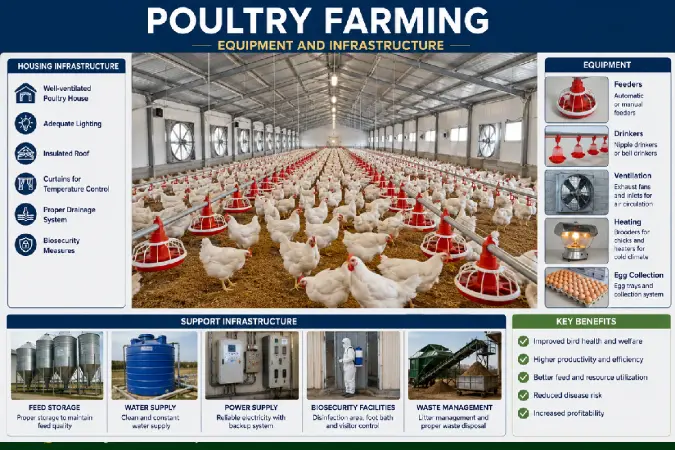
| Equipment | Purpose | Why it matters |
| Feeders | Feed delivery | Reduces waste and uneven intake |
| Drinkers | Water supply | Helps prevent dehydration and stress |
| Brooders | Warmth for chicks | Critical in early-stage survival |
| Ventilation system | Air movement | Reduces heat stress and ammonia buildup |
| Litter material | Floor hygiene | Controls moisture and disease risk |
| Lighting | Growth and productivity | Supports feeding behavior and egg production |
You can also add a product-comparison subsection, such as manual vs automated feeders, open shed vs controlled-environment shed, and plastic vs galvanized drinkers. That comparison format helps both SEO and user decision-making.
Revenue And Profit
Revenue in poultry farming depends on bird count, mortality, feed conversion, market price, and selling discipline. Recent market coverage shows egg and chicken prices can rise when demand increases and supply tightens, which means a good plan must include price volatility, not fixed assumptions. The best article should show profit as a range, not a guaranteed number.
- Input costs include chicks, feed, medicine, labour, and transport.
- Output revenue comes from bird sales or egg sales.
- Net profit is revenue minus all operating costs.
A better profit section should include:
- Revenue per batch.
- Gross margin.
- Net margin.
- Break-even point.
- Sensitivity to feed price changes.
Financial Projections
This section is where your article can outperform most competitors. Many current pages mention profit but do not show structured projections or risk scenarios. Add 12 months projection table, assumptions by batch and three scenario model conservative, expected and aggressive
Use this structure:
- Month 1: setup and investment.
- Months 2–3: operational ramp-up.
- Months 4–12: repeat production batches and sales.
- Include assumptions for mortality, feed cost, and selling price.
A useful table format:
| Scenario | Revenue outlook | Cost pressure | Risk level |
| Conservative | Lower sales realization | Higher feed and mortality impact | High |
| Expected | Stable market sales | Managed input costs | Medium |
| Aggressive | Better pricing and faster turnover | Lower wastage | Lower |
Loans And Subsidy
Funding is a huge search term for this keyword. Articles on the current 2026, however, are often talking about Mudra-style loans, super-specifics of loans attached to NABARD, or talking about subsidies, which shows there is an appetite for startup funding with a business plan. If your article does this section, keep it practical and advise readers to watch how schemes are shaped by location and eligibility.
A useful paragraph should say that financing options may include:
- Bank term loans.
- Working capital loans.
- Government-linked subsidy programs.
- Agriculture or animal husbandry development schemes.
Avoid overpromising fixed subsidy amounts unless you are citing official scheme documents. The goal is to help the reader understand the funding path and verify eligibility before applying.
Growth Strategy
To become a topical hub, your pillar page should explain how poultry farms scale over time. Start with a small commercial unit, then expand in phases once feed conversion, mortality control, and buyer relationships stabilize. This is important because scaling too early can destroy profit even when demand is strong.
Good growth levers include:
- Improving hatchery and chick sourcing.
- Upgrading ventilation and biosecurity.
- Negotiating feed and medicine supply contracts.
- Building repeat buyers in retail, wholesale, hotels, and local markets.
- Tracking batch-level data for better forecasting.
| Problem | Likely cause | Fix |
| High chick mortality | Poor brooding, cold stress, disease | Improve temperature control and hygiene |
| Slow weight gain | Low-quality feed, poor water access | Check feed formulation and drinker placement |
| Bad odor | Wet litter, poor ventilation | Dry litter and improve airflow |
| Feed loss | Wrong feeder height, spillage | Adjust feeder setup |
| Lower egg output | Stress, lighting issue, nutrition gap | Review light schedule and feed balance |
FAQ Section
Is poultry farming profitable in 2026?
Yes, poultry farming can be profitable in 2026 if feed cost, mortality, and selling price are managed well.
Which is better for beginners, broiler or layer farming?
Broiler farming is usually simpler for batch-based income, while layer farming is better for long-term recurring egg sales.
What is the highest cost in poultry farming?
Feed is typically the highest recurring cost, so profit depends heavily on feed efficiency and wastage control.
Do I need a loan to start a poultry farm?
Not always, but many beginners use loans or working capital because shed construction, chicks, feed, and equipment require upfront capital.
Conclusion:
Poultry provides an avenue for enterprise expansion, production of additional food, and additional lucrative income. But an enterprise does not thrive by luck. Good management practices, healthy stock, appropriate infrastructure, good quality feed, control and prevention of diseases and market access are required.