

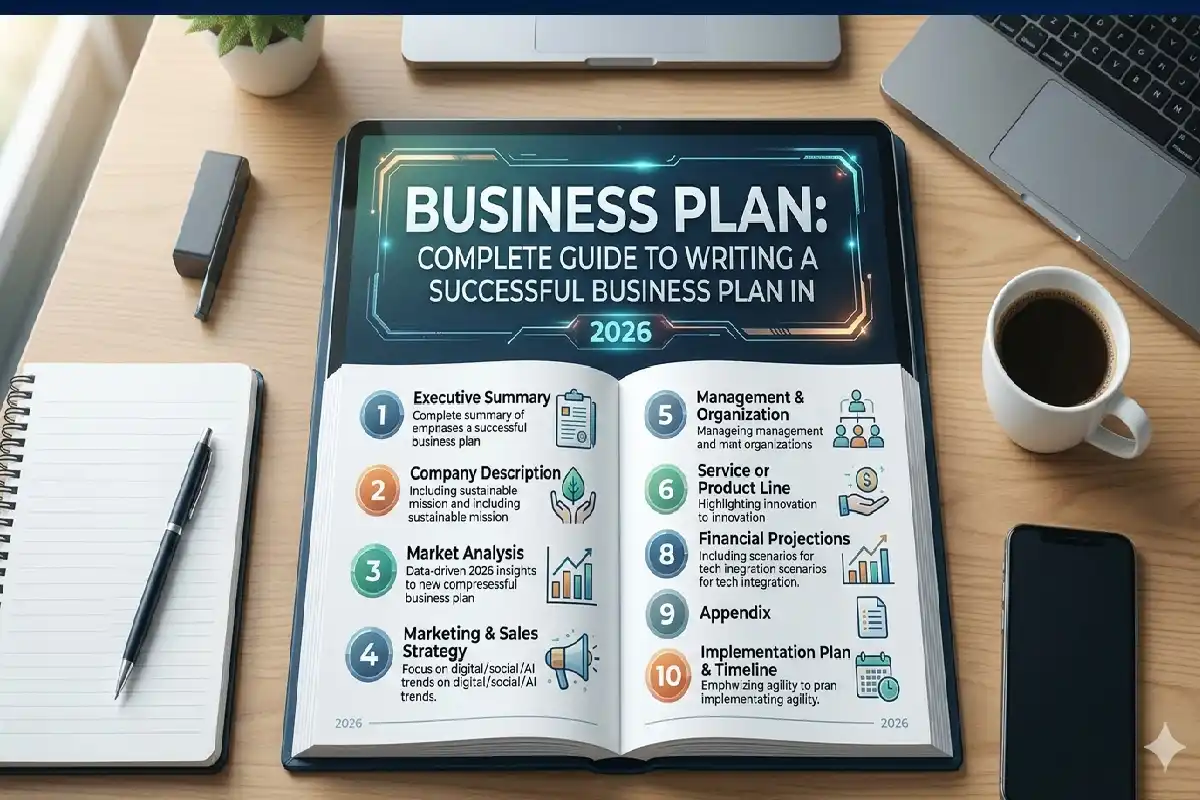
Business Plan: Complete Guide to Writing a Successful Business Plan in 2026
Last Updated: September 20, 2026
What is a Business Plan
A business plan is a document that describes everything about your business: what it does, who it is for, how it makes money, and how it is going to grow. It helps entrepreneurs to think through issues, persuade investors and keep on track when the business goes off the rails.
A well-crafted business plan should not sound impressive. Instead, it should thoughtfully address the difficult questions: What problem are you addressing? Why before? Who will buy and how much? What evidence do you have?
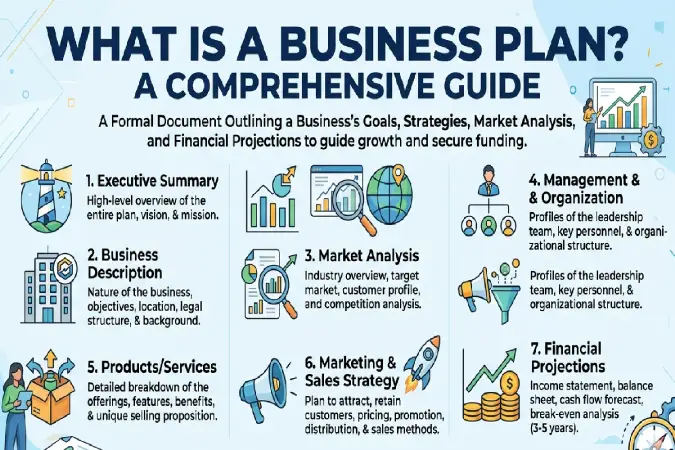
What is a business plan used for?
Business plan is a document with the details of the way the business will be launched, run and expanded. It is used by the founders in determining the viability of an idea, to set goals, to projected costs and revenues, and to convince investors or creditors of the viability of this business.
Main use
- For articulating the business idea and strategy.
- To guide monthly decisions and growth.
- To enable forewarning of risks and plan solutions earlier.
- To get funding from bank/investors.
- To get teams, partners, and stakeholders to cohere around the same objectives.
If a person plans to start up a skincare brand or an AI automation agency, all of this information is given on the business plan; it shows who the customers will be, how the service would be marketed, the amount of capital required and how long it would take for the business to make a profit.
Simply stated: a business plan serves as a guide, a sound basis for decisions, and a financial document for a single business.
Purposes of a Business Plan
Business plan objectives: To serve as a business guide, to test the concept’s validity, and to communicate the strategy.
Main purposes
- Set the goals and ambitions of the marketing department.
- Describe how the business will run and expand.
- Assist the founder in making better choices and keep to the right path.
- Will the idea work? This tests if the concept is actually workable.
- Support funds requests for banks, investors and partners.
- Dig a hole explaining the business to employees, stakeholders, and outside parties.
Why it Matters
A business plan is perhaps the single most important thing as it provides clarity before money is spent. It aids founders in testing if the idea is saleable, the market sizable and if the business is financially viable. For lenders and investors, it demonstrates that the founder has a clear grasp of the customer, competition and accounts.
It also guides internal alignment, so with your team understanding your target market, the pricing framework, the funnels of growth, and appropriate milestones, executing is easier and far less emotional. That is one reason so many great plans still count even in the AI age.
Essential Components
A successful business plan usually includes these sections:
- Executive summary.
- Business description.
- Problem and solution.
- Market analysis.
- Competitive analysis.
- Products or services.
- Marketing/sales strategy.
- Operations plan.
- Management team.
- Financial plan & projections.
- (If necessary) Funding request, if any.
The executive summary should be at the beginning of the working document, but composed last, as it should offer a snapshot of the complete plan. It should be brief, concise and teaser-like, yet concrete enough to offer a clear opportunity without excessive detail.
Formats for business plans.
| Format | Best for | Strengths | Weaknesses |
| Traditional plan | Funding, banks, investors | Detailed, formal, widely accepted | Takes longer to write |
| Lean plan | Startups, early validation | Fast, flexible, easier to update | Less detailed for lenders |
| One-page plan | Idea stage, internal use | Simple, fast, highly focused | Not enough for formal funding |
Choose the format based on the audience. If you are pitching investors, use a traditional structure. If you are validating an idea, a lean version may be enough at the start.
How to Conduct Market Research
Market research is the section of your plan that can demonstrate that there is a demand. It must identify your customer, its size, competitors’ actions, and how your idea is distinct. Good plans demonstrate use of both primary research and secondary research not just general statements or opinion.
A bottom-up perspective: Build a picture of your ideal customer, an estimate of the size of the market, and a reasonable annual spendper-customer figure. Then map your product or service against existing solutions, including current competitors and the workaround used today.
Research Methods Comparison
| Method | What it tells you | Best use case |
| Customer interviews | Pain points and buying triggers | Early-stage validation |
| Surveys | Pattern across a larger group | Testing demand at scale |
| Competitor analysis | Pricing, positioning, gaps | Market differentiation |
| Search analysis | What users are actually looking for | SEO and content planning |
| Pilot sales / MVP | Real purchase intent | Pre-launch proof |
Financial Planning Explained
Financial planning: many business plans just go off the rails at this point, and every effort must be made to lay out a detailed, realistic and well-researched financial projection. Revenue figures, estimated costs, assumptions for gross margins, analysis of cash flows, break-even analysis and funding requirements for the future should all be included. Anything too optimistic will be visible to the investor straight away.
Begin with the revenue model. Then project the number of customers you may acquire, the revenue value of each customer, and the elapsed time to recover acquisition costs. Early-stage projections will be directional and should be labeled assumptions.
Revenue model comparison
| Model | Example | Pros | Risks |
| Subscription | Monthly software fee | Predictable revenue | Churn can hurt growth |
| Transaction fee | Marketplace or payment platform | Scales with volume | Requires high usage |
| Service retainer | Consulting or agency work | Easier to start | Growth can depend on founder capacity |
| Product sales | E-commerce or physical goods | Simple to understand | Inventory and logistics pressure |
When presenting financials, show 12-month monthly projections and a 3-year summary if possible. For funding plans, include how much money is needed and exactly how it will be used.
Financial outputs to be included
- Total sales forecast.
- Show forecast of costs.
- Projected cash flow.
- Break-even analysis.
- Gross margin estimate.
- Tab.
- Funding use statement.
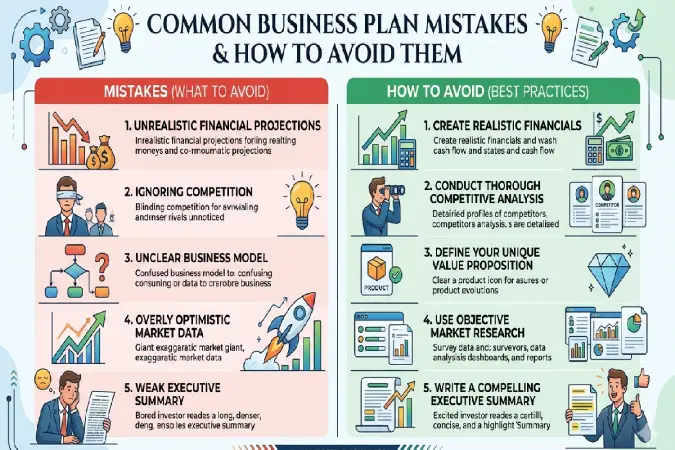
Common Business Plan Mistakes and How to Avoid Them
Typical business plan errors tend to follow certain patterns: shoddy research; unrealistic financials; amorphous strategy; and writing the plan as if for the wrong audience. The best remedy is to make sure the plan is concise and based on facts and real indicators of customers and financials.
Other common mistakes and their corrections
- Unrealistic financial projections: correct them with conservative, fact-based numbers for revenue and a cash flow table.
- Lack of Market Research: the function of market research should be carried out before making a point by knowing consumers, rivals, and demand.
- If you are ignoring your competition, it is time to start fixing your positioning. Show one or more who your competitors are, why they are your competition, and what makes your business different.
- When the plan gets out of hand or too complicated, use the ‘cut fluff’ approach: focus on the decision-useful information and cut the excess.
- Confusing the business plan with an operating plan; do so by segregating strategy, market, and financial rationale from the everyday tactics of execution.
- Hiding risks and weak points; fix it by including a big risks section and contingency plans.
- Writing for you, not the reader; solve it by making the plan suitable for investors, lenders, or internal use.
For example: If I prune the 8-4 and then cut the 5-8, I will not get more than 25 pieces of glass in one layer. Therefore, the simple rule is: Accept after establishing I will do the test, as I will not get more than 25 glasses.
A good business plan will be clear and concise, with everything backed up by solid facts and optimistic enough that others would be willing to rely on it. If any part of the business plan appears uncertain, glib, or superfluous, that is normally when it needs revising.
Business plan important points and best approach
Here are the major points and most effective business plan strategies: be clear, keep it simple and practical, tailor it for the audience, keep it evolving as your business evolves. The most effective plans seem to link strategy, market research and numbers rather than overwhelm the audience with numbers and jargon.
Important points to note.
- Financials include real numbers for income, budgets, and income forecasts.
- Ensure the plan is appropriate for the targeted readership, for example, loan investors, banks, staff, consultants, advisors, or internal planning.
- Remember to revise and update the plan periodically as the business develops and market conditions change.
Best practices
- Stick to neutral and accessible language. Use simple, plain vocabulary that is clear and easy to understand.
- Use facts, research, and business assumptions that can be defended.
- Pay close attention to the business model and revenue-generating methods.
- Solicit for feedback and edit the weaknesses as you prepare to show it to somebody else.
- The main plan should document only what is relevant; supporting material could be put in an appendix.
Digital Resources and Templates to Create a Business Plan
Digital tools and templates can also bring speed to the process, especially if you know that you need structure, financial forecasting or a professionally finished, investor-ready business plan. In 2026, some of the best options are a combination of free templates, step-by-step software, or presentation tools, depending on which route you are taking (internal planning, funding application, partnership pitch).
Best Tool Categories
- Examples of Templates, ideal for rapid drafting or straightforward plans
- Business plan software good for guiding you through writing and financial pro formas.
- Presenter tools, recommended for pitch decks, visual abstracts.
- Database and cloud tools, great for research, notes and collaborations
Strong options in 2026
| Tool | Best for | Strength |
| SBA business plan template | Loan-ready traditional plans | Free, formal, widely accepted |
| SCORE templates | Startup and nonprofit planning | Free download, practical structure |
| LivePlan | Guided business planning | Strong all-in-one planning software |
| Upmetrics | AI-assisted business planning | Fast drafting and forecasting |
| Canva | Polished visual plans and pitch decks | Easy design and presentation |
| Notion | Internal planning and collaboration | Flexible and lightweight |
| Bplans samples | Reference and industry examples | Useful for structure and benchmarking |
Template formats to use
The most valuable template formats in 2026 are one-page plans, regular business plans, lean canvas formats, industry-specific templates (ex SaaS or service-business plans). If you are fundraising, then the templates with assumptions and financial projections are the most critical. If you are still validating your idea, then lean canvas or one-page formats are faster and easier to update.
How to Make Your Business Plan Scalable
Develop a business plan to be scalable, including systems, repeatable processes and growth assumptions that begin to scale without scaling costs at the same rate. The reason you want to scale your system is to show you can grow profitability, not just be a small, surviving business.
What is meant by scalability
A scalable business plan means your offer, your operations, your team, and your money can support more clients, sell more, handle more volume without collapsing. In reality, this means your plan should articulate a means by which that growth occurs through structure- not extra effort:
How to build it
- Define a targeted offer that does one specific thing exceptionally well.
- The workflows should be documented so that the business will be able to run without relying solely on the founder.
- Automate repetitive tasks such as: marketing automation, accounting, CRM, reporting.
- Implement a scalable architecture for onboarding, delivery, customer support and quality assurance.
- Create financial projections that show growth with reasonable assumptions, not overly optimistic assumptions.
- Track KPI like revenue growth, customer retention, acquisition cost, and margin so you can make quick changes.
Proven to work
Start simple, then grow. Creating a repeatable and scalable plan often begins with a tight market with proven demand and a clear step-by-step repeatable sales process. It further entails a monthly, quarterly or at least a 90-day closing review cycle so that the plan can adapt with real data.
Business Plan Trends in 2026: What Investors Now Expect
In 2026, investors will be seeking realistic, fact-based, scalable, and AI-ready business plans, not inflated puffery. They will want to see indicators of customer demand, reasonable financials, robust operational controls, and a believable route to growth.
What investors are expecting
• Scalability, the extent to which the business can expand without costs increasing proportionately.
• How capital efficient the company is so that they can operate more with the same or less investments.
• Realistic financials (assumptions, cash flow & break-even logic)
• Flexibility because, since the markets are dynamic, the plans have to be flexible.
• Digital innovation: in particular how new digital technologies, such as the use of AI, automation, analytics and new systems, are being used.
• Supply chain risk, economic pressure risk, security risk and execution risk.
• Quantifiable results such as performance in traction, retention, margin and customer acquisition.
Best way to position the plan
• Clean problem presentation and a well-defined customer.
• Say why now is the time. Demonstrate traction or proven demand.
• Ensure all projections are as conservative and transparent as possible.
• Write a call to action that demonstrates how the AI/automation reduces the time, cost, or improves accuracy.
• An authentic funding usage and steps toward growing milestones.
FAQ Section
What does a business plan mean and why is it so important?
A business plan is a document that outlines how a business intends to operate, expand and generate profit. A business plan is motivated by the series of benefits it provides, namely: enhanced clarity, increased funding, and more informed profit maximization decisions.
What is a suitable length of a business plan?
While there is no optimal length, most schemes are short enough to remain valid and long enough to validate the concept of them. Lean schemes can be one or two pages long; traditional schemes are, of course, longer.
What should the financial projections consist of?
Provide revenue, expenses, cash flow, break-even point and main assumptions. Provide the amount of funding you need to seek and where it will be used.
Does a startup still need a business plan in 2026?
Yes, but it shouldn’t be too formal; rather, something more practical, which is also useful in the early days of the start-up.
What is the ideal format for business plans for first-time users?
Beginner founders can probably utilize a lean/simplified traditional format, which would improve their flexibility and primarily stay close to customer problems, solutions, and market numbers.
Conclusion
By 2026, a good business plan is well-defined, well-supported with data, and applicable in actual business decisions. By including business market analysis, accurate financial projections, reader-friendly copy, and relevant, recent business examples, you can develop a cornerstone page that ranks well and can assist users. The most comprehensive information on this topic doesn‘t describe the plan but explains the process of building one.