

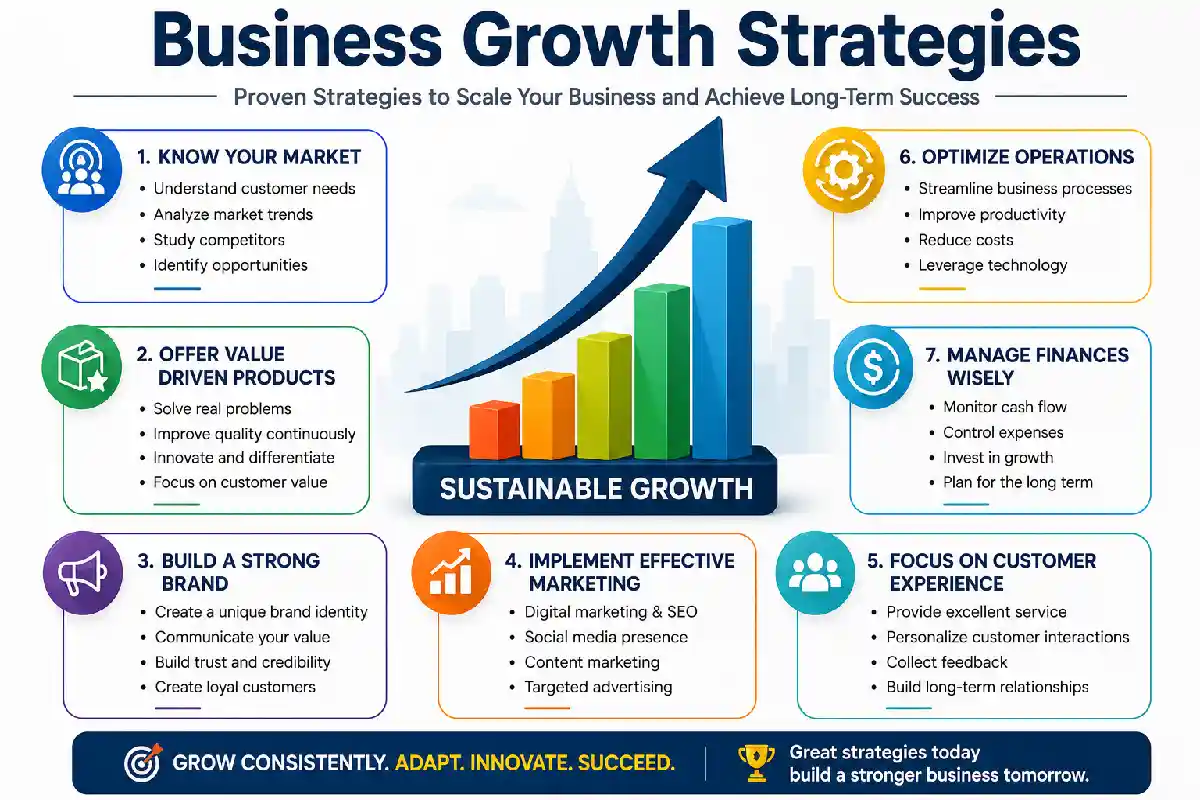
15 Proven Business Growth Strategies That Actually Work in 2026
Last Updated: July 12, 2026
Growing a company isn’t a matter of chance-it begins with selecting effective business growth strategies. No matter where you are in your business journey-trying to start a new business, grow your existing business, or grow an established business-a clear plan for growth enables you to develop new revenue streams, generate new customers, and build a competitive advantage.
Based on the latest market research, organizations that are putting effort into digital transformation, customer retention, and strategic partnerships will still be successful in beating their competitors in 2026. Instead of using only one approach, most of the market leaders are applying many growth strategies at the same time, depending on their objectives, business nature, and customer profile.
Discover in this guide the most powerful techniques for business growth, real examples, comparison tables, implementation, and pitfalls to avoid.
What are Strategies for Business Growth?
Business growth strategies are plans or methods undertaken to expand a company in the course of time by increasing revenues, customer base, market share, profitability, or overall operational efficiency.
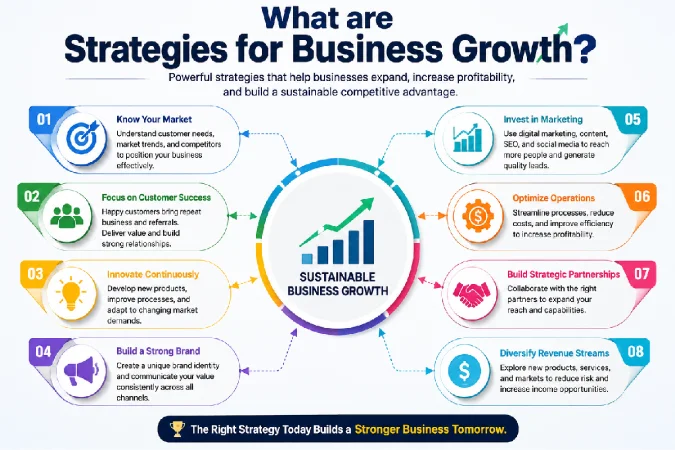
Growth can happen by:
- Boosting sales
- Implementing marketing expansion.
- To market new products
- Enhance customer loyalty
- Building strategic partnerships
- Utilisation of digital marketing
- Investing in innovation
An effective strategy satisfies business needs, resources, and customer demand.
Why Business Growth Matters in 2026
Nowadays, companies are facing more and more competition, evolving customer demands, and more rapid technological developments. Those companies that will be adapting all the time will be more likely to succeed in the long run.
Benefits include
- Increased sales
- Improved brand awareness
- Improved Customer Loyalty
- More profitable
- Has higher market share
- Enhanced ability to adapt to fluctuations in the economy
Comparison of Popular Business Growth Strategies (2026)
| Strategy | Cost | Risk | Best For | Growth Speed |
| Organic Growth | Low | Low | Startups | Medium |
| Market Penetration | Medium | Low | Existing businesses | Fast |
| Product Diversification | High | High | Growing companies | Medium |
| Strategic Partnerships | Medium | Low | Small & medium businesses | Fast |
| Geographic Expansion | High | Medium | Established businesses | Medium |
| Digital Marketing | Low-Medium | Low | Almost every business | Fast |
Resources
- SBA Business Guide: https://www.sba.gov/business-guide
- OECD SME Reports: https://www.oecd.org
- World Bank Business Resources
Organic Business Growth Strategies
Organic growth considers the expansion of income by means of internal resources without mergers and acquisitions.
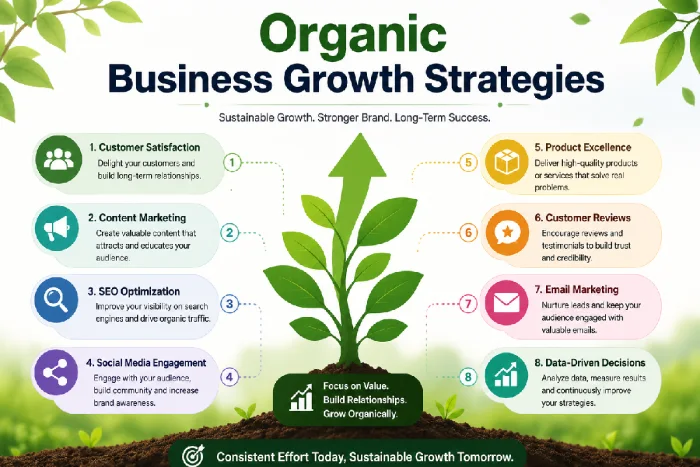
Popular methods include:
- Content marketing.
- SEO
- Customer referrals
- Email marketing
- Customer retention.
- Use of social media
- Customers’ better experience
Advantages
- Sustainable
- Cost-effective
- Customer trust is built
- Lower risk of financial future
Most appropriate for
- Startups
- Small businesses
- *SaaS Companies
- Service providers.
Market Penetration Strategy
Penetrate markets to sell more of your existing product to your existing market.
Businesses often achieve this by:
- Competitive price
- Promotional campaigns
- Loyalty programs
- Improved distribution
- *Referral incentives
Example
A café launches a rewards application, bringing increased repeat visits to the shop and fostering repeat business with customer loyalty points and discounts.
Product Diversification Strategy
Diversification. Revenue is increased through offering existing products and/or services in new ways.
Examples include:
- Software companies releasing AI features
- Restaurants that have a catering service
- Fitness centres providing online coaching
- Retailers are venturing into subscription-based services
Benefits
- Lowered business risks
- Diverse income streams
- *Greater customer lifetime value
Challenges
- Higher investment
- Market research needs
- Operational complexity
Strategic Partnerships for Growth
Strategic Alliances allow companies to grow in partnership with other companies.
Examples include:
- Technology integrations
- Affiliate partnerships
- Partnering with influencers
- Co-branded marketing campaigns
- Distribution agreements
Benefits
- Cheaper acquisition costs
- *Enhanced ability to reach broader audiences
- Shared marketing costs
- Fewer regulatory hurdles
Business Growth Strategy Examples
Amazon
It started as an online bookshop that later developed into cloud computing, logistics, entertainment, and AI services.
Apple
Both combined premium product innovation and ecosystem to leverage customer loyalty and recurrent revenue.
Netflix
Moved from DVD rentals, streaming & original content production to develop a scalable subscription model.
Airbnb
Employed referral program and global partnerships, which allowed to break into foreign markets very fast.
Business Growth Channels Comparison
| Growth Channel | Investment | ROI Potential | Difficulty |
| SEO | Low | High | Medium |
| Paid Ads | Medium | Medium | Easy |
| Email Marketing | Low | High | Easy |
| Partnerships | Medium | High | Medium |
| Social Media | Low | Medium | Easy |
| Product Innovation | High | Very High | Hard |
Business Growth Framework
A practical framework for sustainable growth:
Step 1
Examine your marketplace and competitors.
Step 2
Have an understanding of customer needs.
Step 3
Define measurable growth objectives.
Step 4
Select one or more growth strategies.
Step 5
Measure KPIs such as:
- Revenue
- Customer acquisition cost is
- Customer lifetime value
- Conversion rate
- Retention of your customers
- Net profit margin
Step 6
Keep optimising based on customer feedback and analytics.
Business Growth Trends in 2026
| Trend | Business Impact |
| AI Automation | Faster operations |
| Personalized Marketing | Higher conversions |
| Subscription Models | Predictable revenue |
| First-Party Data | Better customer insights |
| Sustainability | Improved brand trust |
| Omnichannel Selling | Higher customer engagement |
Estimated Business Growth Investment vs Expected Results
| Strategy | Initial Investment | Typical Time to Results |
| SEO & Content | Low | 6–12 months |
| Email Marketing | Low | 1–3 months |
| Paid Advertising | Medium | 1–4 weeks |
| Product Expansion | High | 6–18 months |
| Strategic Partnerships | Medium | 3–9 months |
FAQ
What is the best Growth Model for a business?
The most effective approach varies based on your business objectives, industry, and resources. Most companies get the greatest ROI from a mixture of organic marketing, market share penetration, strategic alliances, and product development.
What is truly sustainable business growth?
Organic business growth is achieved through better utilization of the existing resources, an increasing number of customers, and sales volume, without any mergers or acquisitions.
What Market Penetration strategy?
Market Penetration A market penetration strategy involves increasing the sales in your existing market for your existing products, through pricing, promotions, better distribution or customer retention activities.
How is the divergence in the product?
Diversification provides additional sources of income, provides market and production flexibility, and also reduces the reliance upon one product.
Conclusion
Successful business growth? You can’t just launch a great product; you need to select appropriate business growth strategies and refine them as your business grows and develops. Organic business growth strategies, market penetration strategy, product diversification strategy or strategic partnerships for growth– business development strategies should be used in conjunction with your business objectives, customer requirements and market opportunities.