

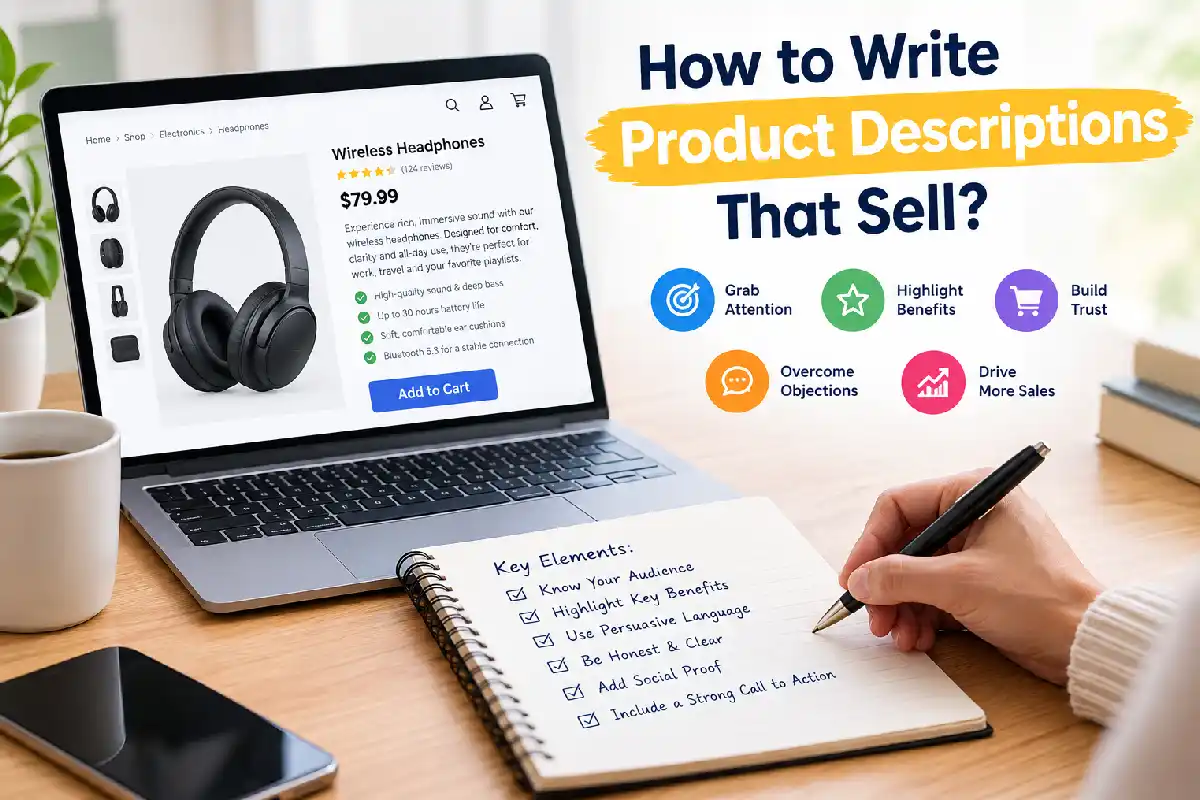
How to Write Product Descriptions That Sell?
Last Updated: September 15, 2026
Product Descriptions. A product description should not be seen as a catalog of information for customers to refer to. Instead, it should be looked at as a tool for conversion that convinces customers to choose a product based on their capacity to respond to the product’s functionality, importance, and relevance to themselves.
A product description good enough for an online store can effectively deal with many kinds of queries a buyer can present, enhance customers’ confidence, illustrate the advantages of that particular product, and make the item sound like an essential part of customers’ personal life.
No matter what product type is advertised on an online store (it could be anything ranging from clothing and cosmetics to hardware and home furnishings, as well as digital items), the general strategies remain the same: get to know their intended audience well, put much emphasis on its advantages for the customer, use simple phrases and words for the copy, and make it easy for anyone to read.
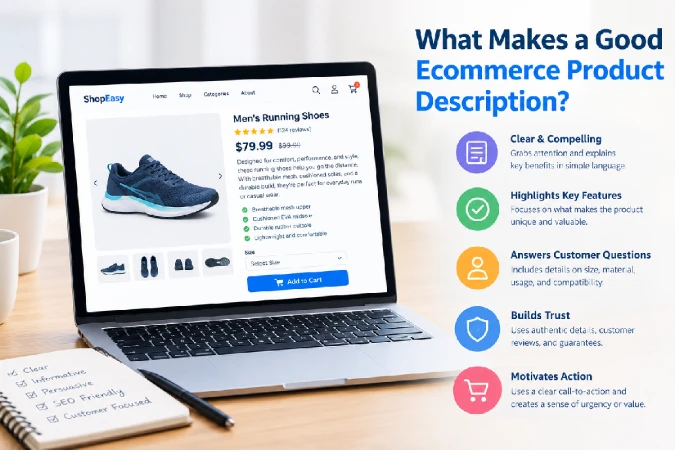
What Makes a Good Ecommerce Product Description?
Every ecommerce product description should also be: descriptive, functional, convincing, and geared towards the customer. Product descriptions should inform the product’s purpose very briefly and allow the customers sufficient room to decide whether or not to make a purchase.
Rather than a generic statement: “this is a 100% quality cotton shirt,” the writer could write: it is made of breathable organic cotton with stretch; its classic fit guarantees comfortable, loose wear; this shirt is designed to be worn in a more smart-casual look.
Key Elements of a Strong Product Description
| Element | What It Should Do | Example |
| Product name | Identify the product clearly | Women’s Cotton Summer Shirt |
| Main benefit | Explain the primary value | Keeps you comfortable in warm weather |
| Features | Provide important specifications | 100% breathable cotton |
| Target customer | Make the product relevant | Ideal for everyday summer wear |
| Use case | Explain when or where to use it | Suitable for work, travel, and casual outings |
| Product details | Reduce uncertainty | Available in S–XXL |
| Call to action | Encourage the next step | Add to Cart |
Remember to also make it scannable. Large paragraphs don’t have to remain; bullet points, subheadings, and bold wording would also make it easier to read.
Start With the Biggest Customer Benefit
These first few sentences are critical, as it’s unlikely that most customers will read to the bottom of the description. Lead by explaining why the customer should take particular notice of this item.
For example:
‘Stay cool and comfortable on a summer day with a lightweight cotton T-shirt made for a relaxed look and everyday wear.’
This sentence quickly informs the customer what this product is and why they should notice it.
How to Write Product Descriptions for Your Target Customer?
Determine who it’s most likely to sell to, and then make your description based on their interests, worries, language, and expectations. The type of language you use for teenagers would be different than what you use for business purchasers.
Understand Your Target Customer
Ask questions, for example, about::
- For whom is this product being purchased?
- What pain point are they hoping to remedy?
- What benefits are of highest value to them?
- What might deter them from purchasing?
- In what contexts will they be using the product and where?
- What knowledge is needed prior to purchase?
For instance, a person who purchases the same shoe for running may be primarily interested in cushioning, stability, weight, and durability, while a person who buys it to wear casually would likely value aesthetics, comfort, and versatility more highly.
Match Your Language to the Buyer
Speak in language your customers will understand. Stay away from overly technical terms unless you know your customers will be receptive to them.
| Customer Type | What They May Care About | Description Focus |
| Budget shoppers | Price and value | Affordable, durable, practical |
| Professionals | Performance and quality | Reliable, efficient, premium |
| Parents | Safety and convenience | Easy to use, comfortable, durable |
| Fitness customers | Performance | Support, flexibility, breathability |
| Fashion shoppers | Appearance and style | Design, fit, color, versatility |
The goal is to make the shopper think, “This product is exactly what I need.”
How to Turn Product Features Into Customer Benefits?
Learning how to turn features into benefits is one of the more significant techniques of product description.
A feature is something the product has or is. A benefit is why your customer cares.
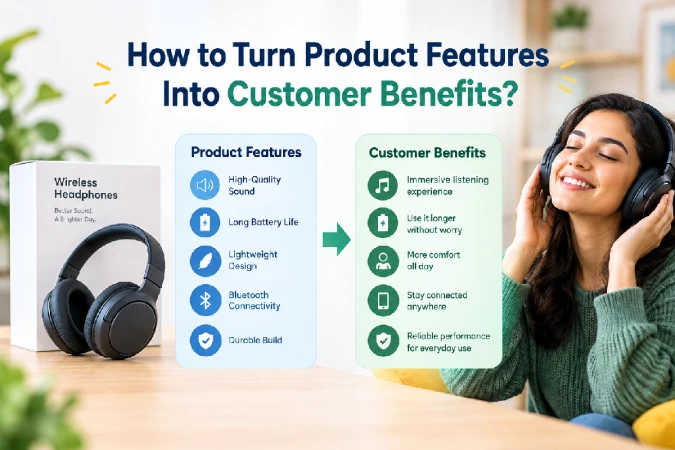
Features vs. Benefits
| Product Feature | Customer Benefit |
| 100% cotton fabric | Feels soft and breathable |
| Water-resistant exterior | Helps protect belongings from light rain |
| Lightweight design | Easier to carry throughout the day |
| Adjustable straps | Allows a more comfortable fit |
| Long battery life | Reduces the need for frequent charging |
| Multiple storage pockets | Keeps essentials organized |
For example, instead of saying:
“Backpack has 3 outer pockets.”
Say:
“Three outside pockets allow for quick and easy access to your cell phone, keys, and more!”
This sentence ties the feature of three outer pockets directly to a real customer want and benefit.
Use the Feature-Benefit-Value Formula
A simple formula is:
Feature → Benefit → Customer Value
Example:
Feature: Moisture-wicking fabric
Benefit: Moves perspiration from the skin’s surface to the fabric’s exterior
Value: Keeps you more comfortable during a workout
This makes the description very compelling without overselling the product.
How to Optimize Product Descriptions for SEO?
SEO assists in ensuring that products are found by customers when they search on the internet for it. Nevertheless, the SEO copy should still maintain its natural feel while also being helpful. Begin by listing the main search term a shopper could possibly use when trying to find the product. For a page trying to sell a moisturizer, the keywords could include:
- face moisturizer
- moisturizer for dry skin
- hydrating face moisturizer
- daily face moisturizer
Make sure the necessary keywords appear naturally within the product title, description, headings, image alt tags, and other page elements:
SEO Product Description Checklist
| SEO Element | Best Practice |
| Primary keyword | Use naturally |
| Product title | Clearly describe the product |
| Secondary keywords | Include relevant variations |
| Headings | Use descriptive headings where appropriate |
| Product details | Provide original, useful information |
| Internal links | Link to relevant categories or guides |
| Image alt text | Describe the product accurately |
| Readability | Keep copy clear and easy to scan |
Don’t over-stuff with keywords. Using a specific term too often in the description may reduce the reader’s ability to read the text smoothly.
Write for People First
They key words. How much more can search engines be trained to work out if a piece of writing is actually helpful, then? Don’t just whip something out in order to stuff in keywords. Answer what a potential shopper wants to know.:
- What is the product?
- Who is it for?
- What does it do?
- What makes it useful?
- How should it be used?
- What are its important specifications?
- What should customers know before buying?
- Good info helps with shopping experience and organic searches.
Product Description Mistakes That Can Reduce Sales
Even a decent product won’t do well in sales if its description is poorly written, vague, or not comprehensive enough.
1. Featuring specifications without any benefits listed in a long copy:
A sheer listing of specs doesn’t help a customer to buy a product. Rather, relate important specs and features to their benefits for a customer.
2. Using extremely general marketing copy and terminology:
Terms like “amazing,” “premium,” and “best” hold no value for customers without providing support and references. Instead of “an amazing premium bag: the best you can ever get,” use “the amazing premium bag comes with durable outer material and a padded laptop compartment: good for both daily work and traveling needs.”
3. Writing a general product description:
Aiming at all kinds of people can make the descriptions vague and insignificant. Better focus on defining the most relevant primary customer for this product and their needs.
4. Exaggerated, untestable product claims:
Unsupported product claims, whether in terms of performance, health, safety, endurance, or effects, should be genuine and suitable for the product they describe.
5. Disregard of customers’ questions:
Address consumers’ queries on dimensions, materials, compatibility, care and maintenance instructions, availability of product shipment, and how the product should be applied, and mention this information in a comprehensive description of the product’s specifics.
6. Repetitive listing of certain keywords:
keyword stuffing. Repetition of terms could result in non-human-readable copy. It makes the copy look awkward. It should be presented in a more humane approach, with relevant terms used in fluent sentence structures.
7. Having overly lengthy descriptions of the product:
Longer descriptions aren’t equated to larger sales. The amount of detail should be limited to help a customer reach a reasonable conclusion.
Product Description Writing Formula
A simple framework should make product-copy writing easier:
| Section | Purpose |
| Opening | Introduce the product and biggest benefit |
| Key benefits | Explain why customers should care |
| Features | Give important specifications |
| Use cases | Show how and where it can be used |
| Target customer | Explain who it suits |
| Product details | Cover size, material, compatibility, care, etc. |
| Buying reassurance | Address common concerns |
| CTA | Encourage the shopper to take action |
Final Product Description Checklist
Before publishing, ask:
- Is the product immediately clear?
- Does the opening communicate a strong benefit?
- Are features connected to customer benefits?
- Is the language appropriate for the target customer?
- Are important specifications included?
- Are customer questions answered?
- Are keywords used naturally?
- Is the description easy to scan?
- Are claims accurate and supportable?
- Does the page give shoppers a clear reason to buy?
When your product descriptions educate, engage, and allay customers’ fears, they can actually do far more than just showcase what you’re offering. By knowing your audience and plainly stating the benefits of what you’re selling, your descriptions naturally become more compelling.