
How to Reduce Ecommerce Shipping Costs: Complete 2026 Guide
Last Updated: September 17, 2026
How to Lower Ecommerce Shipping Costs Ecommerce companies are constantly trying to limit shipping costs to maintain margins and still make shipping appealing to consumers. It turns out pricing isn’t the only thing that determines the cost of ecommerce shipping. Packaging, volume, carrier, checkout flow, valuation, location, and more can all add to the price.
In 2026, ecommerce shipping is more critical than ever. Carriers have announced changes to rates and services, resulting in some variations in ups and downs of what is considered the cheapest. What’s more, UPS announced a major overhaul to how its published India rates and services will be calculated and USPS made 2026 pricing increases for several popular shipping options.
Why Are Ecommerce Shipping Costs So High?
Your actual shipping expense is usually more than the price printed on a shipping label.
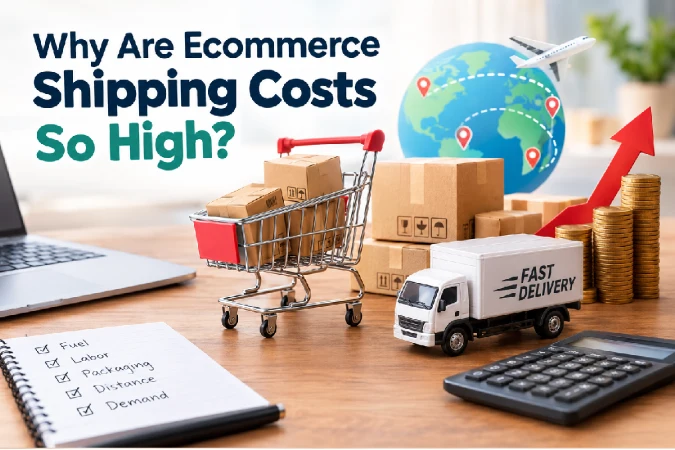
A useful way to calculate your true shipping cost per order is:
True shipping cost = Carrier fee + Packaging + Fulfillment labor + Surcharges + Returns/RTO costs
Several factors can increase this number:
- Package weight
- Package dimensions
- Dimensional weight
- Shipping distance
- Shipping zones
- Carrier and service level
- Fuel or residential surcharges
- Address corrections
- Failed deliveries and returns
- Packaging materials
- Warehouse location
Dimensional weight can be a hidden cost
That products still can be costly to ship, however, if they are large boxes, even if they are lightweight. UPS explains: The dimensional weight is a comparison of the amount of space a package takes up and its weight; the larger of these two measurements is used for charging. Its India guidance states that:
Dimensional weight = L × W × H ÷ 5,000
for measurements in centimeters.
For example, a 40 × 30 × 20 cm package has:
40 × 30 × 20 ÷ 5,000 = 4.8 kg
If the product actually weighs only 2 kg, the dimensional weight can therefore become the relevant billing weight under the applicable carrier rules.
That is why simply reducing product weight is not always enough.
How to Reduce Packaging Weight and Shipping Costs
Packaging is one of the easiest areas to audit because you control it before the package reaches the carrier.
1. Use right-sized boxes
Avoid placing small products in oversized cartons filled with unnecessary void material.
Create packaging specifications for your highest-volume SKUs and choose boxes that protect the product without leaving excessive unused space.
2. Reduce unnecessary packaging material
Review:
- Bubble wrap
- Foam
- Void fill
- Tape
- Inner cartons
- Oversized inserts
- Heavy packaging materials
However, do not remove protective packaging simply to save a few cents. A damaged product can create a much larger cost through replacement shipping, refunds and customer-service work.
3. Standardize packaging sizes
Rather than keeping dozens of packaging options, identify the sizes that cover most orders.
A simple packaging audit can look like this:
| SKU type | Potential improvement | Current package |
| Small/light product | Small carton or mailer | Oversized box |
| Clothing | Poly mailer | Large carton |
| Multiple small items | Consolidated shipment | Separate packages |
| Fragile product | Right-sized protective carton | Excessive void fill |
| Medium product | SKU-specific carton | One universal box |
4. Measure before changing
For your top-selling products, record:
- Product weight
- Package weight
- Length
- Width
- Height
- Actual shipping cost
- Billed shipping weight
UPS specifically recommends entering accurate dimensions and weight to reduce shipping charge corrections.
How to Compare Shipping Carriers and Rates
There is rarely one carrier that is cheapest for every order.
The best carrier can change according to:
- Destination
- Shipping zone
- Package weight
- Package dimensions
- Delivery speed
- Residential/commercial address
- COD or prepaid status
- Product category
- Surcharges
Instead of comparing only advertised base rates, calculate the total delivered cost.
| Cost factor | Carrier A | Carrier B | Carrier C |
| Base shipping | $ | $ | $ |
| Fuel surcharge | $ | $ | $ |
| Residential surcharge | $ | $ | $ |
| Handling fee | $ | $ | $ |
| COD fee | $ | $ | $ |
| Expected return cost | $ | $ | $ |
| Total estimated cost | $ | $ | $ |
This is especially important because the cheapest headline rate may not produce the lowest final cost.
FedEx, for example, notes that rates can vary according to actual weight, dimensions and other shipment details.
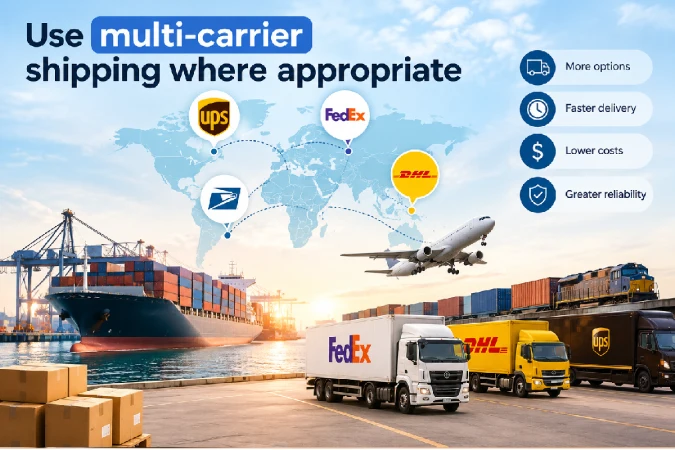
Use multi-carrier shipping where appropriate
A multi-carrier strategy allows you to assign different carriers according to the characteristics of each order.
For example:
Carrier A: low-cost regional shipments
Carrier B: faster metro deliveries
Carrier C: remote-area coverage
Carrier D: specific heavy or oversized products
Shipping software can automate these rules so employees do not have to manually compare every order.
Review your invoices regularly
Do not optimize shipping once and forget about it.
Review monthly:
- Average shipping cost/order
- Shipping cost by zone
- Shipping cost by SKU
- Shipping cost by carrier
- Surcharges
- Return shipping
- Failed-delivery costs
This helps identify where money is actually being lost.
How to Use Shipping Zones to Reduce Costs
Typically, the farther your shipment gets from the parcel’s fulfillment point, the more it will cost to ship. This is why inventory location is a cost-saving shipping strategy. As an illustration, if the majority of your customers are in the West, you would not want to send all of your fulfillment from a warehouse on the East Coast.
Instead:
- Analyze customer locations.
- Identify your largest demand clusters.
- Compare shipping costs from different fulfillment locations.
- Consider regional warehouses or 3PL facilities.
- Place high-volume inventory closer to customers.
FulfillmentEZ’s 2026 analysis similarly emphasizes reducing shipping zones and positioning inventory closer to demand rather than focusing only on carrier negotiations.
Zone optimization example
| Fulfillment strategy | Likely effect | Average distance |
| One central warehouse | Higher zone exposure | Longer |
| Two regional warehouses | Lower average distance | Moderate |
| Multiple demand-based locations | Potentially lower delivery cost | Shorter |
The exact savings will depend on your customer distribution, inventory costs and carrier contracts, so calculate the total fulfillment economics before opening additional locations.
When Should You Offer Free Shipping?
Free shipping can improve the customer experience, but it does not mean shipping is actually free for your business.
The cost is simply absorbed somewhere else.
Possible approaches include:
Free shipping above an order threshold
For example:
Free shipping on orders over $75
This encourages customers to increase their basket value.
Before setting the threshold, compare it with your:
- Average order value
- Gross margin
- Average shipping cost
- Product weight
- Return rate
Flat-rate shipping
A fixed shipping fee can be easier for customers to understand.
For example:
$5 flat-rate shipping
This works particularly well when your products have relatively similar shipping profiles.
Free shipping on selected products
You do not necessarily need to offer free shipping across the entire catalog.
You could apply it to:
- High-margin products
- Lightweight products
- Products with low return rates
- Products with predictable shipping costs
- Orders above a certain value
Show shipping costs early
You don’t want shipping to be a shocking surprise at the very end. According to Baymard’s 2026 study, among lost carts, 40% of shoppers said they left at the last moment because of additional costs (shipping/tax/fees) – after removing browsers. Thus lowering shipping is not just a margins question. Transparent shipping info can also boost conversion.
Final Takeaway
The easiest way to lower your ecommerce shipping cost is to stop looking for a cheap carrier. Begin by determining your real cost per order. Next, optimize package dimensions, rates and surcharges; compare carriers; eliminate expensive shipping zones; monitor surcharges; manage returns; and define free-shipping thresholds with real order data.
For most ecommerce companies, the single greatest opportunity isn’t a single big thing, but rather the integrated impact of dozens of small ones, spanning packaging, shipping, carrier choice and checkout.
And that’s the plan that will cut unneeded shipping costs while delivering great service.