

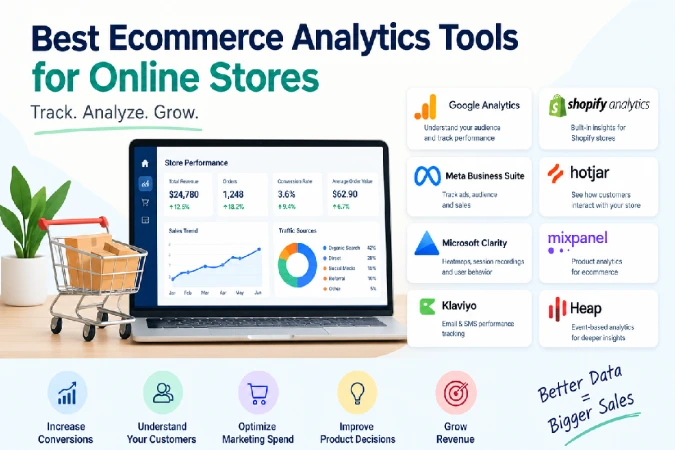
Best Ecommerce Analytics Tools for Online Stores
Last Updated: September 18, 2026
Ecommerce analytics enables web shops to analyze the behavior of the customers before, while buying and after buying. Rather than just assumptions, entrepreneurs can use information to see what products sell best, who are the customers, how well the marketing strategies work and if they can improve sales.
Ecommerce analytics tools can help us get this information more effectively. There are various tools for website metrics, customer metrics and behaviors, product analysis, marketing attribution, and reporting, fitting for a small business or large enterprise, based on their needs.
This guide tells you what ecommerce analytics is, which tools if any small businesses can use, what indicators to follow and how they can help improve ecommerce decisions.
What is Ecommerce Analytics?
Ecommerce analytics is the process of collecting and analyzing data from an online store to understand business performance and customer behavior.
It can provide insights into areas such as:
- Website traffic
- Product views
- Add-to-cart activity
- Checkout behavior
- Purchases
- Revenue
- Customer acquisition
- Conversion rates
- Customer retention
- Marketing performance
For example, analytics might show that hundreds of people are viewing the product, but hardly anyone is actually buying it. This might make the store owner decide that he should test different prices, product descriptions, images, reviews, shipping charges or checkout procedures.
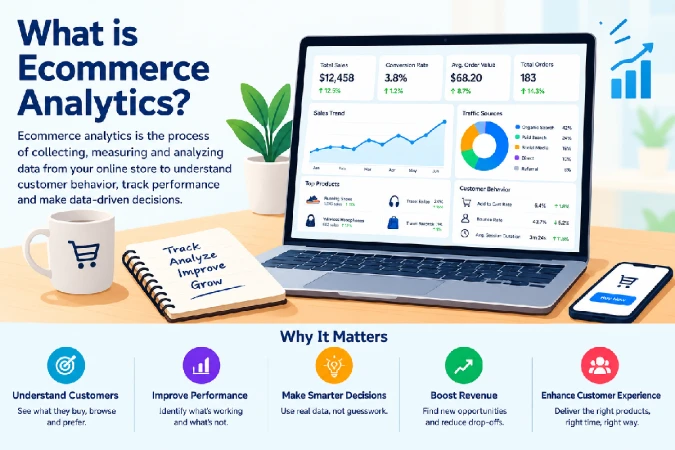
Ecommerce analytics can help to identify those traffic sources which generate customers and not just visits.
Best Ecommerce Analytics Tools for Small Businesses
Small business manufacturers require analytics software that is cost effective and easy to set up and integrate with their ecommerce platform.
Google Analytics 4
GA4 on website provides traffic, user engagement, events, conversions, acquisition sources, customer journey information, etc. ECommerce business can set up ecommerce event data to count product views, shopping cart activity and purchasing revenue.
Might serve well in giving significant reporting flexibility, especially for those organizations that are not yet ready to purchase an enterprise analytics platform.
Shopify Analytics
In terms of infrastructure analytics, a Shopify store has reports and dashboards available ranging from Sales, Orders, Customers, Website and store performance
As the data is all integrated directly to the Shopify store, this can be very useful for small businesses that wish to have ecommerce focused reporting without having to use multiple different analytics tools.
Microsoft Clarity
How does this relate to analytics and conversion? Microsoft Clarity has a strong focus on customer behavior. With session recordings, heatmaps etc., it allows businesses to analyze how customers behave on websites.
For example, clicking repeatedly on a non-clickable element can let a store owner find a usability issue, which would not have been so obvious in a normal traffic analysis.
Hotjar
Hotjar offers behavior analytics tools including heatmaps, session recordings, surveys and feedback. These give ecommerce teams insights into how visitors interact with product pages, navigation and checkout experiences.
Looker Studio
Looker Studio converts data from supported sources into flexible dashboards and reports. Ecommerce companies should consider using dashboards to roll up KPIs and support ongoing reporting.
The right tool depends on your store platform, what kind of reporting you need, how much money you can spend and your own technical skill. Many businesses use multiple tools because no single platform provides every type of insight.
Ecommerce Metrics and KPIs You Should Track
Analytics becomes useful when you focus on metrics connected to specific business goals.
Important ecommerce metrics and KPIs include:
| Metric | What It Shows |
| Conversion rate | Percentage of visitors who complete a purchase |
| Average order value | Average amount spent per order |
| Revenue | Total sales generated |
| Add-to-cart rate | How frequently visitors add products to carts |
| Cart abandonment rate | Percentage of carts that do not result in purchases |
| Customer acquisition cost | Cost associated with acquiring customers |
| Customer lifetime value | Estimated value generated by a customer over time |
| Return rate | Percentage of orders or products returned |
| Repeat purchase rate | How often customers purchase again |
| Revenue per visitor | Revenue generated relative to visitor volume |
“Don‘t bog yourself down with monitoring tons of metrics that don‘t matter. Instead, develop a short KPI dashboard that aligns with your business.
For example, can also be tracked by a growth-oriented store (conversion rate, revenue, cost per acquisition, average order value) or by a subscription business (retention, CLV).
How to Track Ecommerce Customer Behaviour
We need to look deeper into the final buy.
A typical customer journey might look like:
Analytics can highlight where this journey ends.
For example, if you get a lot of traffic to a product page but not many conversions maybe there‘s a problem on that page. If many customers add to cart but don‘t actually proceed to pay then maybe it‘s worth investigating the shipping costs, payment options, additional charges or form completion process.
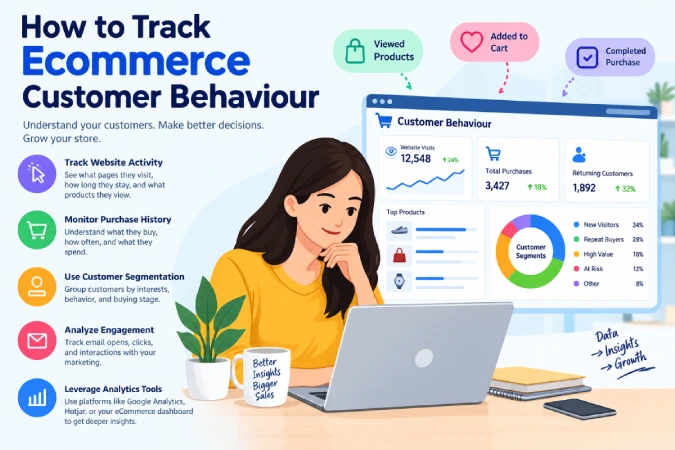
To put it in more natural language, behavior analytics enables you to see heatmaps or session recordings to give you further context.
Customer behavior can also be segmented by:
- New vs returning customers
- Mobile vs desktop users
- Geographic markets
- Traffic source
- Product category
- Purchase history
- Customer value
This segmentation helps businesses avoid treating every visitor as the same type of customer.
How to Use Ecommerce Analytics to Increase Sales
Collecting data is only the first step. The real value comes from turning insights into improvements.
Improve Underperforming Product Pages
Identify products with high traffic but low conversion rates. Review their product photography, descriptions, pricing, reviews, delivery information, and calls to action.
Find High-Value Traffic Sources
Compare traffic sources based on purchases and revenue, not just visitor numbers. A smaller traffic channel may produce more valuable customers than a channel with significantly higher traffic.
Reduce Checkout Friction
Examine the checkout funnel to see at which step people are leaving. If there is a large bounce at a particular step then think of reasons such as hidden costs, confusing forms, a small choice of payment options, technical issues etc.
Increase Average Order Value
Utilize product analytics and encourage customers that buy one of your products to also buy the associated item. Test bundles, cross-sells, upsells or related-product suggestions.
Optimize Mobile Shopping
Merchandising. Compare mobile and desktop conversions. If mobile conversions are dramatically lower, look at page speed, navigation, product images, buttons, forms and checkout usability.
Test Changes Instead of Guessing
Analytics can identify a potential problem, but testing can help determine whether a proposed solution actually improves performance. Use controlled experiments where appropriate and compare results against a defined baseline.
Final Thoughts
The most suitable ecommerce analytics tools for online shops vary according to what kind of data you require and what systems your business is running on. GA4 can give overall website and ecommerce measurement, ecommerce platforms can give store-specific reporting, and behavior analytics tools can show how visitors behave on a given page.
Begin by identifying your most significant business objectives and monitoring the KPIs associated with them. Next, analyze customer behavior and funnel metrics to diagnose issues, experiment with enhancements, and evaluate the results.
Once Analytics is integrated into your regular planning and decision processes, your ecommerce business will be able to take more informed decisions on products, marketing, experience and conversion.