

Best Ecommerce Payment Solutions for Small Businesses
Last Updated: September 21, 2026
For an online shop the selection of an suitable payment system is one of the most decisive decisions. A dependable ecommerce payment solution enables buyeres to pay securely, enables shop owners to authoritatively accept the money and it can even lower friction at the checkout. For small enterprises the selection additionally requires weighing transaction fees, available payment methods, security, integrations and the quick setup.
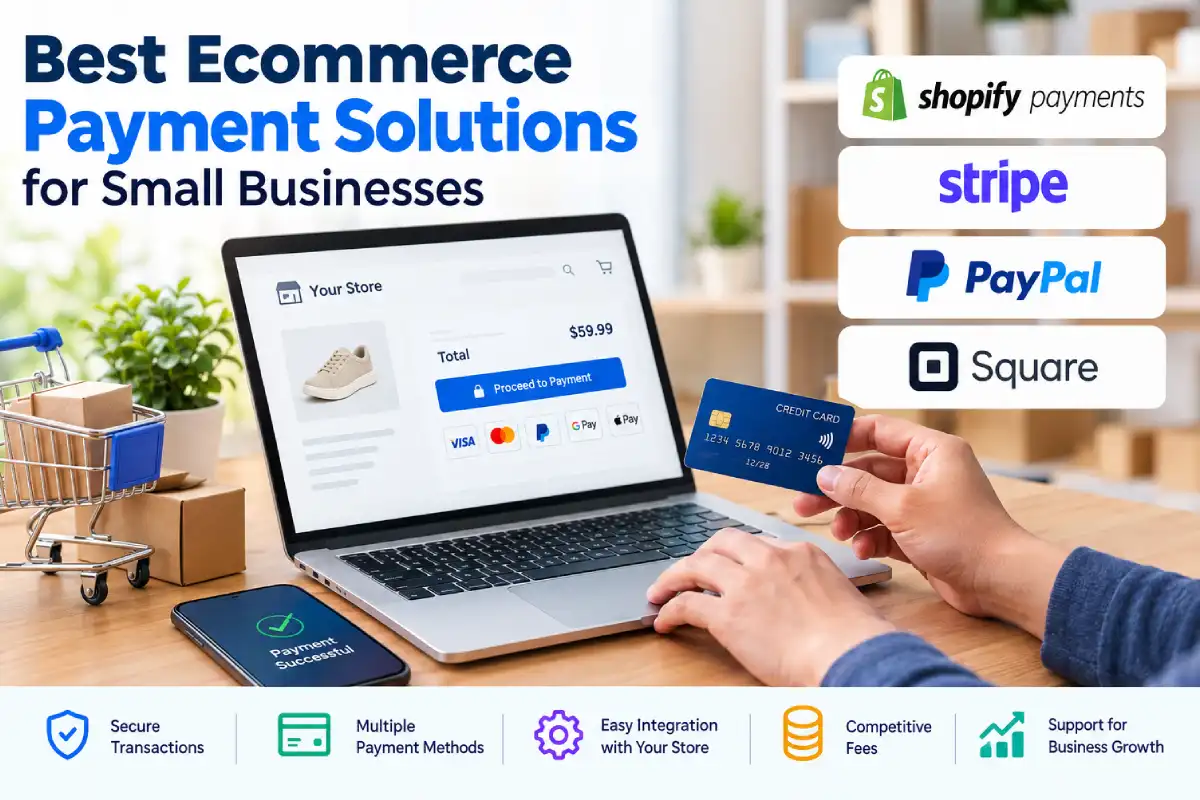
Common choices are Shopify Payments, Stripe, PayPal, Square and other payment service providers. There is not one best choice for all stores. It is a matter of what suits your ecommerce platform, your location, volume of sales, customers’ preferred form of payment and plans for growth.
What is an Ecommerce Payment Solution?
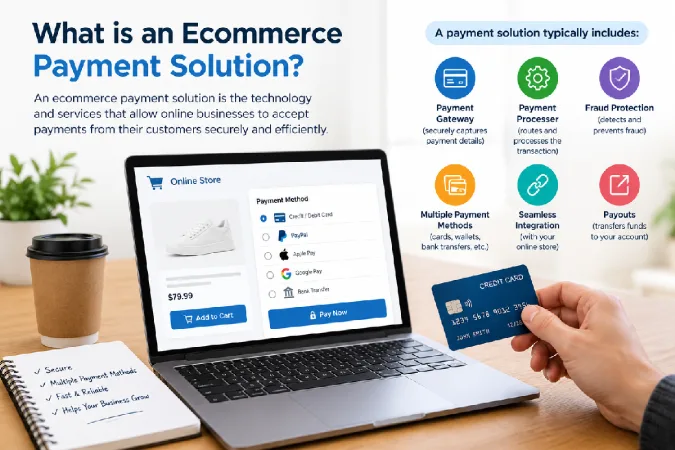
An ecommerce payment solution is the online technology and services enabling a website to accept payment from its customers. Some of the solutions offered will support and integrate with credit and debit cards, online wallets, bank transfer, buy now pay later, and local payment methods.
Today‘s payment service providers tend to offer a platform with multiple elements built into it. Instead of setting up different systems for authorisation, anti-fraud, checkout 2.0 integration and payouts, a small business can often run most of these services through one provider.
Common ecommerce payment solutions include:
- Shopify Payments: This is built into the platform of a store working with Shopify.
- Stripe: Payment infrastructure that is flexible with a great set of API‘s and several supported payment methods as well as currency flexibility.
- PayPal: The most common payment method available, enabling your customer to pay via PayPal or by supported card methods.
- Square: ideal for businesses trading on the web and off, providing online payment platforms and point of sale facilities.
For example, the pricing on Cards in India for Stripe is 2% for Indian issued cards and 3% for non-Indian issued cards with custom pricing for business with high payment volumes or special circumstances.
How Ecommerce Payment Processing Works
An online payment may look instantaneous to the customer, but several systems work together behind the scenes.
A typical transaction follows these steps:
- Customer enters payment information: The buyer enters card, wallet, or another payment method at checkout.
- Payment gateway securely captures the information: The gateway encrypts and transmits payment details.
- Payment processor routes the transaction: The processor communicates with the relevant card network and financial institutions.
- Issuing bank authorizes or declines the payment: The customer’s bank checks available funds and transaction information.
- Payment response returns to the store: The ecommerce platform receives the approval or decline.
- Settlement occurs: Approved funds are transferred through the payment system and eventually paid out to the merchant.
A payment gateway simply manages the secure transmission at checkout – transaction processing is the back-end routing of the transaction.
However, this process is quick usually within 10 seconds for customers to receive confirmation instantly after ordering.
Payment Gateway vs Payment Processor
Many people use the phrases payment gateway and payment processor as synonyms; however, they actually refer to distinct concepts.
| Feature | Payment Gateway | Payment Processor |
| Main role | Securely captures and transmits payment information | Routes and processes the transaction |
| Customer-facing role | Often interacts directly with checkout | Mostly works behind the scenes |
| Security | Encryption and secure transmission | Transaction authorization and routing |
| Example function | Sends payment details for authorization | Communicates with banks and card networks |
A gateway acts as the secure connection between the checkout and the payment processing system. The processor handles the communication required to authorize and settle the payment.
However, modern payment service providers frequently combine gateway and processor functionality. Stripe, for example, provides both payment processing infrastructure and developer tools, while Shopify Payments is integrated directly into Shopify’s ecommerce platform.
For a small business, using an integrated provider can simplify setup and reduce the number of systems that need to be managed.
Ecommerce Payment Fees and Security Explained
Payment costs are an important consideration when comparing ecommerce payment solutions. Providers may charge a percentage of each transaction, a fixed fee, monthly fees, currency-conversion fees, chargeback-related fees, or additional fees for certain payment methods.
As a general example, Shopify’s 2026 payment-processing information notes that online processing fees can vary by plan and market, while third-party providers can introduce additional transaction fees on Shopify plans.
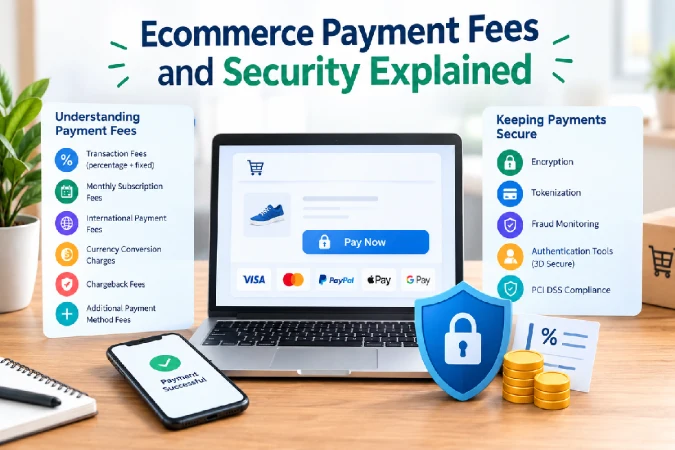
Don’t compare providers based only on the headline transaction rate. Consider the total cost of accepting payments, including:
- Percentage transaction fees
- Fixed per-transaction charges
- Monthly subscription costs
- International payment fees
- Currency conversion charges
- Chargeback fees
- Third-party platform transaction fees
- Costs for additional payment methods
Security is equally important. Look for providers that use encryption, tokenization, fraud monitoring, authentication tools, and appropriate PCI DSS compliance practices.
For example, Shopify states that its platform is Level 1 PCI DSS compliant, while its payment infrastructure includes built-in fraud analysis when Shopify Payments is used.
A secure checkout protects both the customer’s payment information and the merchant’s reputation.
How to Choose a Payment Solution for Your Online Store
The right payment solution depends on how your business operates. Before choosing a provider, evaluate these factors.
Ecommerce Platform Compatibility
Choose a payment solution that integrates easily with your website or ecommerce platform. Native integrations can simplify setup, order management, refunds, and reconciliation.
If you operate a Shopify store, Shopify Payments may provide a more integrated experience. If you operate a custom ecommerce website, Stripe may provide greater development flexibility.
Payment Methods
Your customers should have convenient ways to pay. Depending on your market, you may need cards, digital wallets, bank transfers, local payment methods, or installment options.
Review which payment methods are supported in the countries where you sell.
Total Fees
Calculate the expected monthly payment-processing cost based on your actual sales volume and average order value.
A provider with a slightly higher percentage rate may still be more suitable if it has fewer additional charges or better integration with your store.
Security and Fraud Protection
Payment security should never be treated as an optional feature. Check whether the provider supports encryption, fraud detection, authentication, secure tokenization, and PCI-related requirements.
International Selling
If you sell internationally, check supported currencies, international cards, cross-border fees, and currency conversion charges. Shopify, for example, notes that currency conversion fees can apply when the customer’s payment currency differs from the merchant’s payout currency.
Payout Speed and Support
Look at how quickly funds become available in your business account and what support options are provided when payments fail or disputes occur.
Scalability
The payment solution needs to scale with your store. Think about transaction volume limits, APIs, subscriptions, recurring billing, global expansion, analytics and more payment methods.
Final Thoughts
The ideal ecommerce payments solution for a small business will be determined by its platform, customers, country, number of sales, and growth plans. For instance, merchants using Shopify as a platform will benefit from easy integrated payments via Shopify Payments, others might prefer the flexibility of Stripe, especially regarding the customisation of the payment experience, or the established level of security of PayPal. Square could also be a good option for a small business since its payments solution is well equipped to support online and offline selling.
Compare the overall offering – checkout methods, security, integration, payout experience, international billing capabilities, customer service, overall pricing rather than just transaction fees. If a payment system can streamline checkout and make it secure then a small ecommerce business can perform better while having a better checkout experience for its customers.
Frequently Asked Questions
Which is the preferable payment solution for a small ecommerce business?
It varies according to your ecommerce platform, country, the available payment methods, number of sales, and your back-end requirements. The most popular payment methods are: Shopify Payments, Stripe, PayPal, Square.
What‘s the cost of ecommerce payment solutions?
Depending on provider and market, payments may involve transaction fees (a percentage of the transaction), transaction fees (a fixed amount per transaction), a monthly fee, international fee, conversion fees etc.
What is a payment gateway? Do I need one? Is this a payment gateway the same as a payment processor?
Incorrect. While a gateway encrypts and securely passes the payment details, a processor directs the payment to the correct sources and authorizes the transaction. The majority of present day providers will have both these processes.
What considerations should a small business take into account before choosing a payment provider?
Pay attention to security, methods of payments, compatibility between platforms, total fees involved, timescale of payouts, availability of Customer Support and it is a good practice to wonder about how scalable the system is. Don‘t look how many transactions there are!