

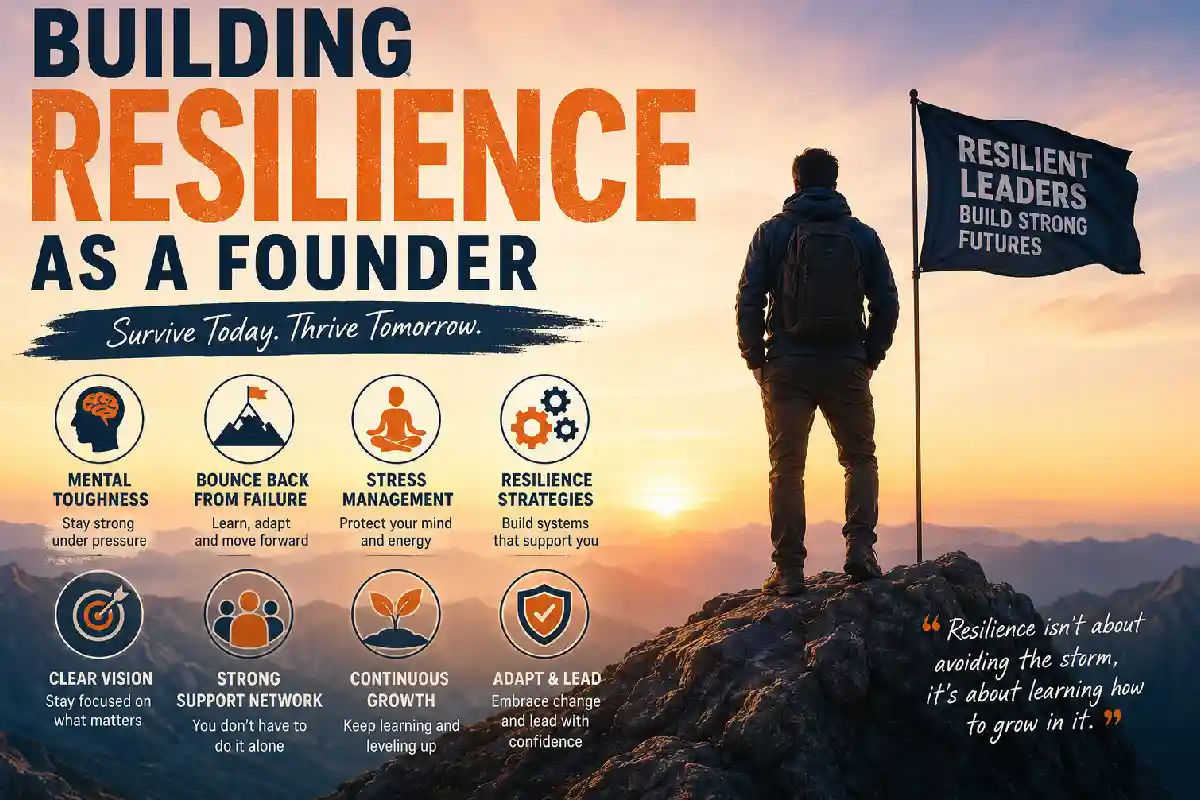
Building Resilience as a Founder: Survive & Thrive in 2026
Last Updated: September 21, 2026
Launching a business in 2026 isn‘t just about having a great idea, access to capital, or even excellent execution. today‘s entrepreneurs are jumping into a rapidly evolving landscape defined by technological innovation, changing customer demands, economic turmoil, fierce competition, and an increased drive to do more with less.
The founders ability to cope with adversity, manage stress, recognize lessons learned from failures, learning to adapt to environment, and keep giving wise decision and actions that lead him/ her from short term success to only survive.
This isn‘t about blowing off the stress or hardening into a cold machine. It‘s about strong founders build systems of behavior, habits, relationships, and mindsets that enable them to bounce back and spring ahead.
What is Founder‘s Resilience?
Founder Resilience refers to the persistence and resilience of entrepreneurs who, despite facing significant setbacks, failures, or life crises, continue to persevere.
Founder resilience it is the ability to keep perspective, agility, and sound decisions when growing a business through uncertain or adverse times.
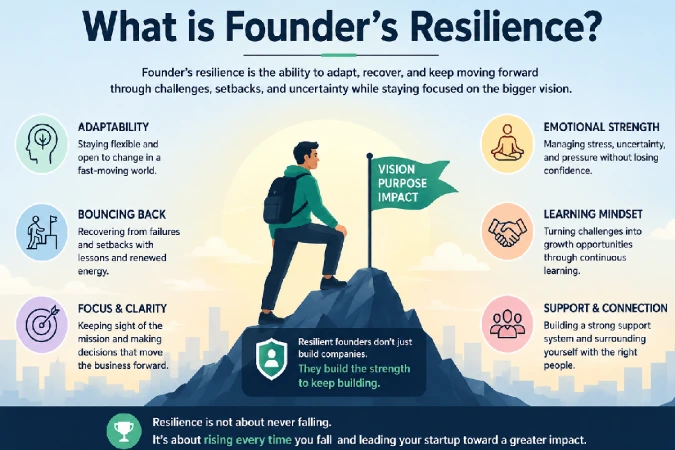
A resilient founder can:
- Respond to setbacks without immediately panicking
- Learn from failures and not failures.
- Not allow stress to build up and impair judgment.
- Adapts to changes in market conditions
- Where needed, seek assistance
- Independence of personal identity from business results
- Bounce back from challenging times
- Continue pursuing meaningful goals without constantly operating in crisis mode
Resilience is thus no longer about working harder.
Trying harder may assist you in solving a short-term problem. Resilience allows you to be able to solve problems over and over again long-term.
Why Resilience Matters More for Founders in 2026
The nature of risks undertaken in entrepreneurship has always included a degree of uncertainty; the problem today is that the dynamics are moving much faster.
The way work operates is changing. AI is enabling this, competitors are launching products more quickly, customers are constantly evolving. Digital businesses are being disrupted by new technology or platforms almost immediately.
This generates a number of common pressures.
| Founder Challenge | Potential Impact | Resilience Response |
| Market uncertainty | Anxiety and indecision | Scenario planning |
| Cash-flow pressure | Chronic stress | Financial visibility and contingency planning |
| Failed launches | Loss of confidence | Structured post-mortems |
| Rapid competition | Fear of falling behind | Continuous learning |
| Long working hours | Founder burnout | Sustainable work systems |
| Team problems | Emotional exhaustion | Delegation and communication |
| Business setbacks | Self-doubt | Cognitive reframing |
| Constant digital connectivity | Mental fatigue | Deliberate boundaries |
I don‘t aim to remove the difficulties; I aim to help us develop the ability to face them.
Founder Burnout: The Resilience Warning Sign
One of the greatest threats to the sustai…eptness of entreprenuership is the founders of any entreprenuer become exhausted.
Burnout is more than just feeling exhausted after a hard week. Continuous work-related stress can lead to emotional depletion, inefficiency, emotional distancing and an inability to provide usual performance.
Founders can be particularly vulnerable because they often combine several roles:
- CEO
- Strategist
- Salesperson
- Recruiter
- Pre-trading finance decision taker
- Product manager
- Customer support
- Representative public
When everything seems to matter, entrepreneurs may struggle to turn off.
Common Signs of Founder Burnout
Watch for patterns such as:
- Relentless fatigue You are exhausted, even after resting or sleeping.
- Decision fatigue – Everyday choices are suddenly a lot harder.
- Irritability Minor annoyances lead to intense feelings.
- Loss of motivation Work that once thrilled you begins to feel futile.
- Lowered focus Thinking becomes more difficult.
- Detachment you pull away from working with your team, customers or business.
- Always-on behavior You have a guilty feeling when you‘re not working.
Do not turn burnout into a mark of entrepreneurial devotion.
A business which, by the way, relies on a founder functioning at peak performance each and every day is not resilient, only fragile.
Resilience Strategies for Founders
1. Build a Strong Personal Operating System
Has your company established processes, dashboards and operating procedures? You also need your own personal operating system.
Define:
- Most important work to you.
- The number of hours you work.
- Your recovery time
- Your decision-making principles
- Your communication boundaries
- Your non-negotiable personal commitments
Having a predictable operating rhythm helps to minimize the cognitive load.
2. Separate Urgency from Importance
Founders often regard incoming requests as priorities.
Use three categories:
Urgent: Less routine.
Crucial: Has a major impact on long term goals.
Noise: Appears to be true, has limited strategic value.
Not all emails, alerts, customer questions, or internal issues actually warrant the founders’ immediate attention.
3. Create Financial Resilience
Uncertainty in finance is among the top causes of stress for entrepreneurs.
Build visibility into:
- Monthly operating cost.
- Cash runway
- Concentrations of revenues
- Costs associated with acquiring the customers
- Major upcoming expenses
- Best-case and worst-case situations
Having a picture of where you stand financially does not eliminate the uncertain effects of future events, but the effects of uncertainty are more manageable when they are measurable.
4. Develop a Support Network
Resilience is not all about facing everything by ourselves.
Build relationships with:
- Mentors
- Fellow founders, Having Come new;
- Industry constituents
- Consulted guides and advisors; trusted 6.1 sources.
- Coaches
- Relatives and friends
- Professional mental health support, as required
A founder requires places where they don‘t always have to be “the person with the answers”.
5. Practice Strategic Detachment
Your company can take on a vital role in your life without being all-consuming.
Try to distinguish:
I can‘t sell my company.
from:
I‘m a failure.
The first one is a business problem.
The second turns an business issue into an identity dilemma.
That difference can make a huge impact for better or for worse on decision performance under pressure:
Stress Management for Founders
Stress control for founders is not setting up entirely stressfree life of an entrepreneur, some amount of pressure cannot be avoided.
The aim is to prevent stress from becoming chronic, overwhelming or destructive.
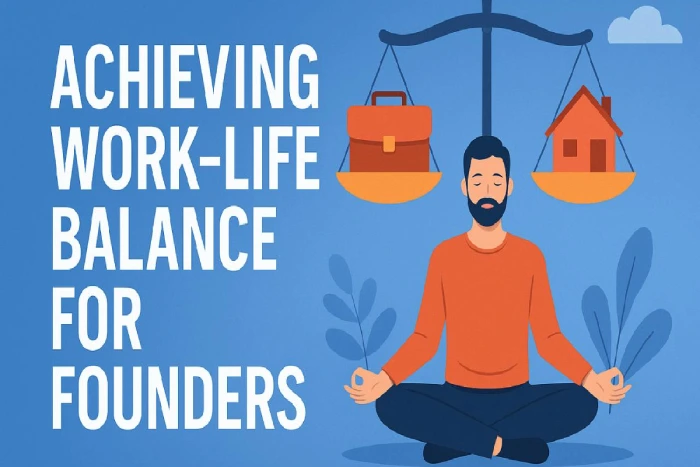
A Simple Founder Stress Management Framework
Learn toKnow->minimize->treat->Check How-to.
Recognize
Find out where the pressures are coming from.
Is it:
- Money?
- Team performance?
- Looking to attract customers?
- Workload?
- Uncertainty?
- Personal expectations?
Reduce
Ask which stressors are modifiable.
You might:
- Set aside your repetitive tasks
- Reduce the number of low-value meetings.
- Automate processes
- Do not make excessive commitments.
- Dividing team duties.
Recover
Allow your mind and body the time to settle back to normal.
Review
After the pressure drops, identify the root cause and design a improved system.
How to Build a Resilience Culture in Your Startup
Founder resilience ought not to be isolated.
Your behavior as a leader creates the culture in the company.
If founders display constant panic, workaholism and finger-pointing to solve every problem, the employees might copy it.
Instead:
Set up reasonable problem solving
Discuss errors and don‘t always jump to finding a scapegoat.
Promote achievable expectations:
Sustainable performance is more worth wile than short sprints of brilliant performance.
Reward learning
When the experiment is failures only record what the organization learned from the experience.
Allow for self-regulation.
The founder‘s workload is increased while presenting fewer opportunities for team development.
Communicate in times of uncertainty.
The employees needing the founders to act as if everything is under control. The employee, themselves, simply needs to be communicated to in a relaxed manner, with honesty, what is known, what is unknown and what is being done next.
Conclusion
A resilient founder is not one who can shrug off stress, failure, and uncertainty. It means one who can get through hard times while maintaining your own judgment, health, business, family and image.
Resilience can and should (if it isn‘t already) be a true competitive advantage in 2026.
Enterprises require founders who can make sound decisions in chaotic conditions, pick themselves up after setbacks, be flexible, and set up resilient systems rather than just putting in the hours.