

Contactless Payments (NFC): How Tap-to-Pay Works and Why It’s Safe
Last Updated: September 21, 2026
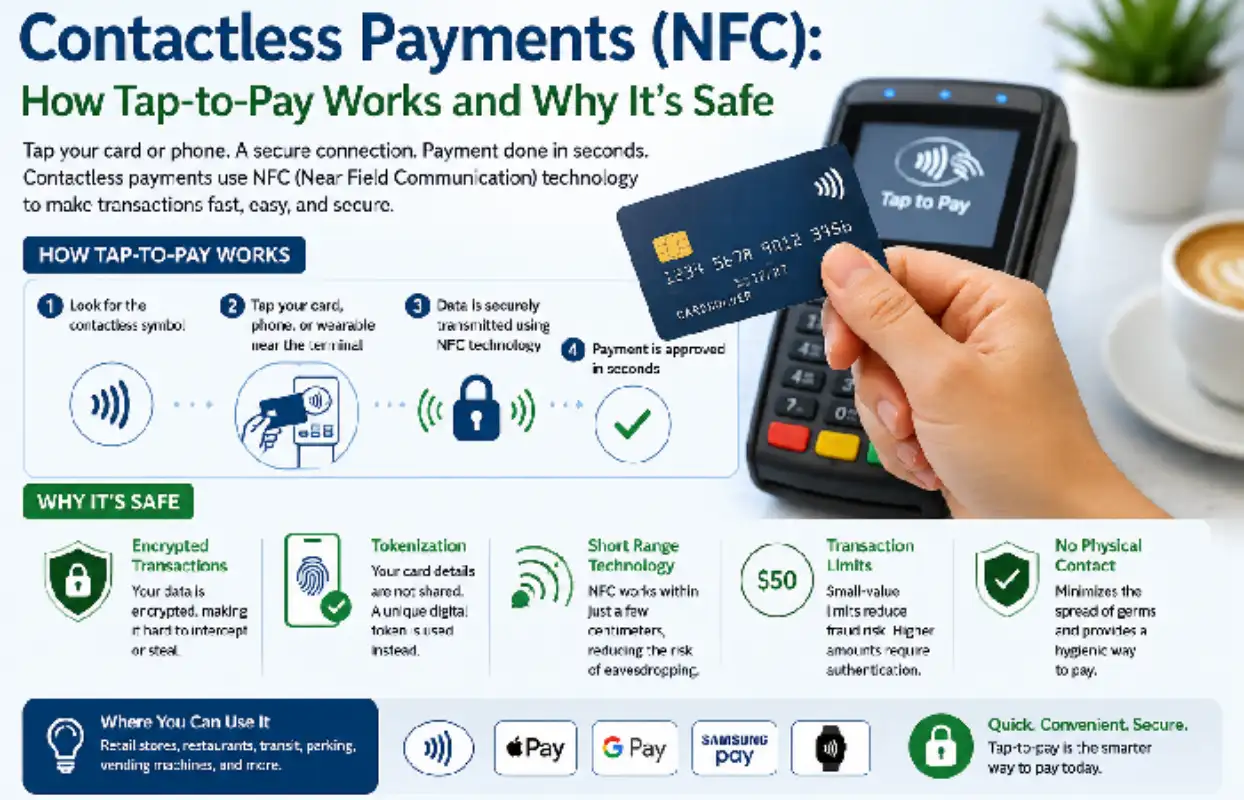
Contactless payments give you another way of paying for day-to-day things. You just tap your card or smartphone or smartwatch against a specially fitted payment terminal rather than the card-swiping or cash-fumbling process you’re more used to. Contactless payments normally involve transmitting very small amounts of data wirelessly over a very short distance, usually via “near field communication” (NFC). So how does it actually work?
How NFC Contactless Payments Work
NFC is a short-range wireless technology. When it’s used for payments, it enables a mobile device or contactless card to talk to the point-of-sale terminal while kept extremely close to it.
Although, like Wi-Fi and Bluetooth, it doesn’t require cables for transmission, NFC is engineered specifically for quite short distances and operates over a range of only a couple of centimeters. This is also a factor that benefits tap-to-pay transactions.
What Happens When You Tap?
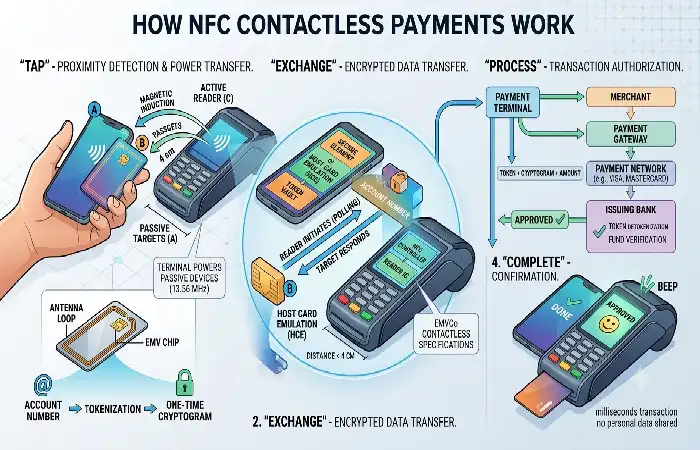
The standard flow for an NFC payment occurs in these stages:
Here’s a more natural and human-like version of your text, preserving the meaning:
- You place your card, phone, or wearable near an NFC payment device.
- Your card/phone or wearable’s NFC chip reads the contactless device.
- Information for the transaction is passed encrypted between the card, your phone or wearable, and the terminal.
4. The payment scheme and bank receive notification of a purchase; the funds are approved or declined, and then it goes back. - Whether you have paid or not is shown.
Everything combined typically takes just a few seconds.
Contactless Payment vs. Traditional Card Payment
| Feature | Contactless Payment | Chip-and-PIN Payment |
| Connection | NFC | Physical card chip |
| User action | Tap | Insert card |
| PIN required | Sometimes | Usually |
| Speed | Very fast | Fast |
| Physical contact | No | Yes |
| Encryption/security | Yes | Yes |
It’s also worth mentioning that NFC will not blast your card number to whoever happens to be around you; the new generation of contactless payment systems employ security measures that help keep the payment information safe.
Apple Pay, Google Pay, Samsung Pay Compared
Smartphones and smartwatches have also facilitated much easier contactless payments. Among major available mobile payment services are the following: Apple Pay, Google Pay, and Samsung Pay. The ways in which this is done may differ slightly, depending upon the available service. However, essentially, payments can be made at participating terminals using both the available smartwatch as well as smartphone.
| Feature | Apple Pay | Google Pay | Samsung Pay |
| Main ecosystem | Apple devices | Android devices | Samsung devices |
| Contactless NFC | Yes | Yes | Yes |
| Device authentication | Face ID, Touch ID, or passcode | Screen lock/biometric authentication | Biometric authentication or PIN |
| Physical card needed at checkout | No | No | No |
| Smartwatch support | Apple Watch | Wear OS watches | Galaxy Watch models |
| Tokenization | Yes | Yes | Yes |
Apple Pay
Apple Pay can be utilized through devices running on the Apple platform, which includes iPhones and Apple Watches. Users can conveniently add their accepted debit/credit cards to their wallet app and authorize the payments through the security mechanisms inherent within the Apple devices.
Google Pay
Using Google Pay with enabled Android phones and other supported devices allowing contactless payment would require the user to unlock or otherwise authenticate the phone or device first before performing the payment transaction
Samsung Pay
Part of the broader wallet offering on Samsung devices, Samsung Pay allows contactless payment with compatible Galaxy models. It can be secured using fingerprint, face recognition, or PIN, depending on the device.
Country, bank, card issuer, and device-specific features or limitations may apply.
Contactless Card Security Features
One of the main drawbacks to “tap to pay” is security. What if someone reaches their terminal over the shoulder of the person in front of them and near your card at a payment terminal? Contactless cards include several security features to mitigate the risks of fraudulent use of their cards.
Encryption and Secure Transaction Data
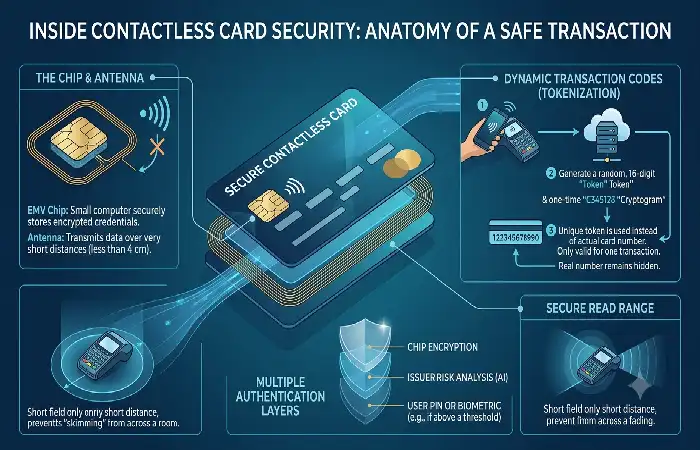
The card and payment terminal exchange information protected using secure measures over what would appear to be ‘nothing’, hence contactless payments. Modern payment systems can also issue information that has been prepared specifically for a transaction, therefore making the misuse of stolen data relating to that transaction much more difficult.
Tokenization
It is likely that your mobile wallet relies on tokenization. If you have given your card number to a merchant, they will know this if a transaction-specific or device-specific token is being generated.
Hence, what is used to make the payment could differ from what your bank actually has stored.
Device Authentication
Mobile payments add another layer of protection because the phone or watch can require authentication.
Depending on the device, this may involve:
- Fingerprint recognition
- Face recognition
- Device passcode
- PIN
- Other supported authentication methods
Short Communication Range
NFC operates over a very short distance. Normally, a payment terminal has to be close to the card or to the device to allow them to communicate.
| Security Feature | Purpose |
| NFC short range | Limits communication distance |
| Encryption | Protects payment data |
| Tokenization | Reduces exposure of actual card details |
| Dynamic transaction data | Helps prevent reuse of payment information |
| Device authentication | Helps prevent unauthorized mobile payments |
| Bank monitoring | Detects suspicious transaction patterns |
No method is truly entirely risk-free. There can still be issues that occur from lost cards or phones, or compromised accounts and fraudulent merchants. One thing is to keep an eye on the activities in their accounts and report any unknown transactions as soon as possible.
Contactless Payment Limits
Many countries and banks place limits on contactless transactions. These are intended to limit the risk of loss through loss or theft of a physical card.
The exact rules aren’t universal.
One might not need a PIN to make a small payment using a contactless system; however, it may be needed to authorize an expensive transaction. Some systems may require a PIN to be presented, or they might prompt for an alternate authentication factor every once in a while despite the value of a payment falling within the standard authorization limit.
Why Are There Limits?
The contactless limits also balance ease and safety.
| Situation | Possible Requirement |
| Small purchase | Tap may be enough |
| Larger purchase | PIN or authentication may be required |
| Multiple contactless purchases | Additional verification may be triggered |
| Mobile wallet transaction | Device authentication may be required |
| Unusual transaction | Bank may request additional verification |
Your real limit varies by nation, network scheme, bank, shop terminal, and issuing bank. See what your bank’s policy is rather than assume a general limit.
Setting Up Contactless Payments
The process of using contactless payments is pretty simple to get the hang of.
Using a Contactless Card
If you see the contactless symbol on the front of your debit or credit card, tap-to-pay might already be set up.
At checkout:
- Wait until the terminal shows “Please wait”.
- Hold your card near the symbol above.
- Wait for the sound or message saying “Card accepted” and the confirmation number.
- Enter your PIN at the terminal if prompted
For contactless payment, you usually don’t have to swipe or insert the card.
Using a Smartphone
How to use a mobile wallet:
- Open your device’s supported wallet.
- Add an eligible debit or credit card.
- Confirm your bank’s validation process.
- Allow payments in NFC/contactless when you’re in these situations.
- Identify yourself when making a purchase using the phone.
- Place your device at a small distance from the device of payment.
Using a Smartwatch
Compatible smartwatches can also store supported payment cards. After it’s been set up you can then authorize the watch and tap it against a suitable payment reader
Are Contactless Payments Safe?
Overall, security measures that are in place when purchasing ordinary items using contactless payments are extremely useful for users. The small range at which NFC technology can be active, along with encryption, tokens, and authentication of the device and transactions, are very useful in protecting transactions and lowering fraud risk.
However, it is important for users to develop good habits and security measures when purchasing goods, such as ensuring that the phone cannot be easily accessed through passwords or biometric authentication, activating payment notifications, and informing your bank immediately of transactions you do not recognize.
FAQs
Can someone steal my card information by standing near me?
NFC works over very short distances, and contactless payments nowadays implement sophisticated security features to safeguard the payment transaction information. You shouldn’t ordinarily be able to make a payment with your card simply due to physical closeness.
Do contactless cards always require a PIN?
No. Smaller transactions may not need one, but larger or unusual ones will be subject to more verification depending on the issuer and location.
Is Apple Pay safer than a physical card?
Mobile wallets offer further security measures like authentication of your device and tokenization. Nonetheless, your overall security will come down to how well you secure your device and your account.
Does NFC work without the internet?
The payment terminal needs a connection to process or authorize transactions according to the payment system’s rules. Your phone itself doesn’t necessarily need a conventional mobile-data connection at the exact moment of every payment.
What should I do if my contactless card is lost?
Get in touch with the bank or card provider urgently; ask the issuer to freeze/block the card if possible and check your account for new/suspicious transactions.