

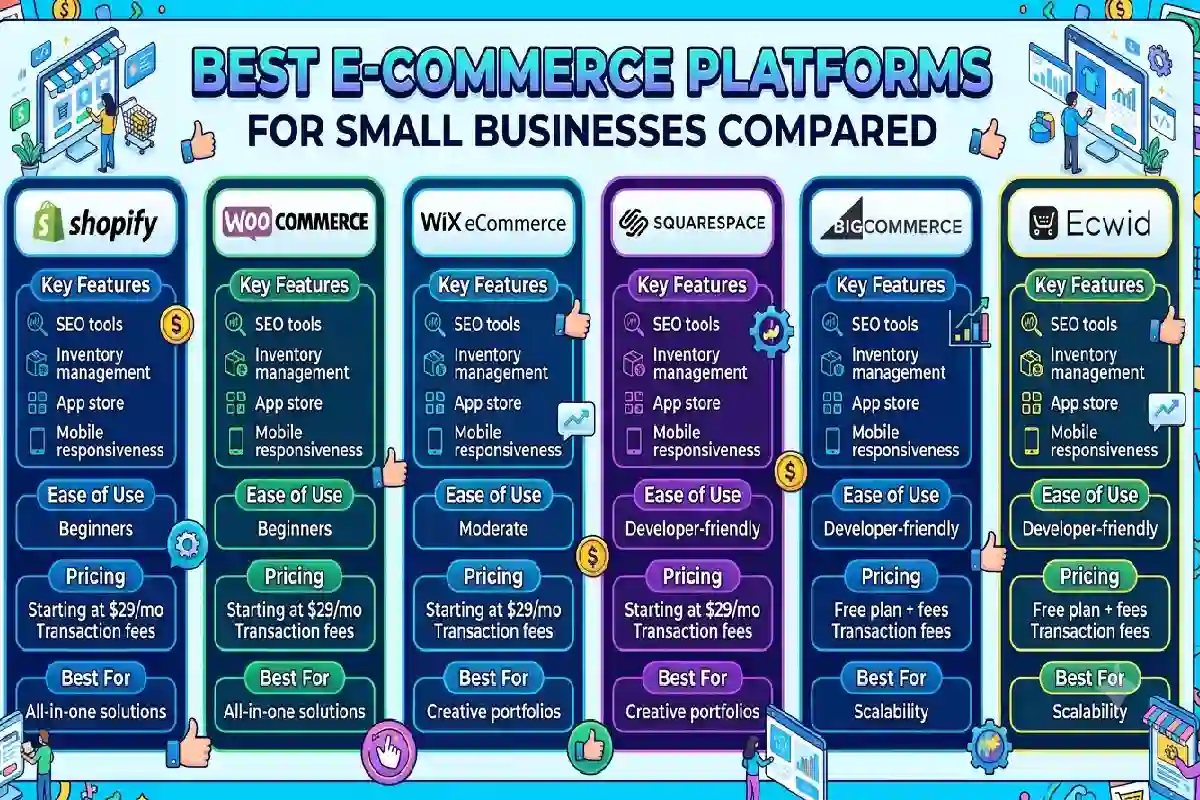
Best Ecommerce Platforms for Small Businesses Compared
Last Updated: September 10, 2026
Ecommerce Platforms. Picking the best ecommerce platform can be a huge step for a small business. The platform has an impact on your time to deployment, how much you spend, how easy it is for customers to buy, and how much control you have.
The best platform is not you have most features, but you have the right features that can fulfill your budget, skill, the types of the products you sell, customer base and future plans.
What should a small business expect from an Ecommerce solution?
First, determine what your company truly requires before you compare websites;
1. Ease of Use
Small companies are likely to have a few members of staff. A site should be as easy to update as it is to add products, deal with orders, change pages and take payments, without the need for lots of complicated code.
2. Pricing
Look beyond the advertised monthly subscription. Your total ecommerce costs can include:
- Monthly platform fees
- Payment processing fees
- Transaction fees
- Apps and plugins
- Hosting
- Domain registration
- Themes
- Shipping tools
- Marketing software
A platform with a low starting price can become expensive if you need numerous paid add-ons.
3. Payment Options
Allow for easy methods of payment. You should check that your web site features the right currencies, payment methods and gateways for the market you are aiming at.
4. Design and Customization
Make sure your store represents who you are. Find themes that are customizable, mobile-optimized, has undo-able product page layouts, and allow you to change up the navigation and checkout options.
5. SEO and Marketing
The best ecommerce system should be you to attract customers through search engines and marketing channels. The features should include: customizable URLs, metadata, blogging tools, analytics, e-mail integration, and social-media integration.
6. Scalability
Perhaps your requirements evolve as sales grow. Select a platform capable of importing extra items, customers, orders, payment options and marketing needs without having to move away too fast.
Best Ecommerce Platforms for Small Online Stores
There are many different solutions that suit small businesses.
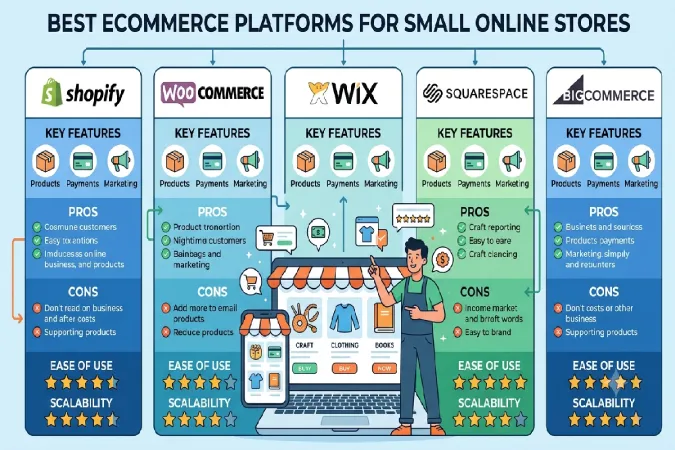
| Ecommerce Platform | Best For | Main Advantage | Potential Drawback |
| Shopify | Beginners and growing stores | Easy all-in-one solution | Costs can increase with apps |
| WooCommerce | WordPress users | High flexibility and control | Requires more management |
| Wix | Small stores wanting easy design | Simple website builder | Less specialized for complex stores |
| Squarespace | Design-focused brands | Attractive templates | Fewer advanced ecommerce options |
| BigCommerce | Growing businesses | Strong built-in ecommerce features | Can be more complex for beginners |
Shopify
Shopify is undoubtedly one of the well known e-commerce tools for small enterprises.
The main advantage is that it is convenient. EC functions including hosting, safety, shop management, checkout are all performed on the system. Shopify is a good option for entrepreneurs can start-up quickly without operating the technical back-end.
Good for: Total beginners, product brands, quickly growing online businesses, and anyone looking for a one-stop-shop.
Be aware of: Other applications and costs of transactions can add to your cost.
WooCommerce
WooCommerce. A free wordpress plugin that allows you to sell anything. If you have a WordPress website, it is built for you.
In fact, the WooCommerce tool provides you a lot of freedom for your business. You are free to select hosting, themes, plugins or even payment gateways.
This is a highly advantageous property of Wocommerce, and it is the reason why it can be attractive for certain business that needs specific customization.
Ideal for: WordPress websites, information and content online, business owners.
Watch out for: You may need to manage hosting, updates, security, backups, plugins, and technical maintenance.
Wix
Can be a good option for a small business that requires a visually attractive website with a fairly simple online shop.
What it‘s good for: Small to medium catalogs, service-only companies putting themselves online, creative businesses, beginners.
Squarespace
One of its major features is highly refined website templates.
It can be beneficial for a visual-driven brand such as fashion, photography, art, food and lifestyle.
Appropriate for: Small (or small-ish) ecommerce businesses that need a ‘beauty’ shop, tackling design as opposed to technical problems.
BigCommerce
BigCommerce offers a much more comprehensive area of built-in ecommerce functionality, and one that is meant to grow with the business.
May be more appropriate for businesses with larger product ranges, multiple channels of selling or more advanced ecommerce needs.
Designed for: Medium-sized, fast-growing businesses that require a more sophisticated ecommerce platform.
Shopify vs WooCommerce for Small Businesses
Few decisions in ecommerce are as crucial as the comparison of Shopify with Woo Commerce when starting a new store.
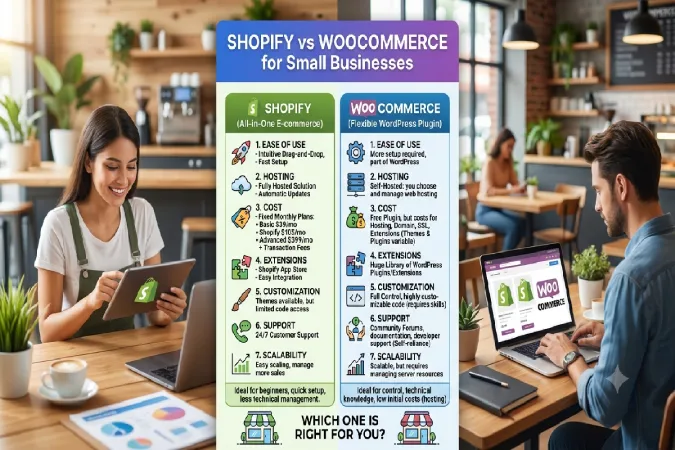
| Feature | Shopify | WooCommerce |
| Setup | Easier | Requires more configuration |
| Hosting | Included | Purchased separately |
| Technical management | Lower | Higher |
| Customization | Strong | Very high |
| WordPress integration | No | Native |
| Plugins/apps | Extensive | Extensive |
| Maintenance | Mostly handled by platform | Owner/host dependent |
| Control | More managed | Greater control |
| Beginner friendliness | High | Moderate |
| Best suited to | Fast launches | Flexible WordPress stores |
Choose Shopify if you prioritize simplicity, speed, and having most technical elements managed for you.
Choose WooCommerce if you already use WordPress or want extensive control over your website’s infrastructure and functionality.
Neither is universally better. The right option depends on how much technical management you are comfortable handling.
Ecommerce Platform Costs and Transaction Fees Compared
Cost is one of the biggest considerations for a small business.
Instead of comparing only monthly subscription prices, calculate your total cost of ownership.
For example:
Total ecommerce cost = platform + hosting + payment fees + transaction fees + apps/plugins + theme + maintenance + marketing tools
Hosted platforms generally bundle more services into one subscription, while open-source solutions can provide greater control but may require you to pay separately for hosting and other services.
Payment processing costs can also have a major impact on profitability. Even a small percentage difference becomes significant as sales increase.
Example
Let‘s say your store has a monthly revenue of $20,000.
A 1% variance in the cost of the payment or transaction related costs could mean approximately $200/month, $2,400/year.
So, don‘t opt for a platform just because it cheaper monthly subscription.
How to Choose the Right Ecommerce Platform for Your Business
Lets start with some questions to answer.
1. What Are You Selling?
A shop selling 10 products has different requirements from a shop selling 10,000.
2. What Is Your Budget?
Figure out what you can reasonably spend on technology, marketing, inventory, and operations.
3. How Technical Are You?
If you prefer not to have to administer hosting, security, upgrades and troubleshooting, a fully integrated hosted platform might be more suitable.
4. How Much Customization Do You Need?
If your business necessitates specific functionality, explore the range of apps, plugins, APIs and customization options available prior to signing up.
5. Where Are Your Customers?
Take into account Currencies, taxes, forms of payment, shipping needs and any other relating to local regulations of e-commerce applicable to your customer base.
6. How Do You Plan to Grow?
Think outside of your launch. Think about when you will be launching on other channels, introducing additional products, opening a new market, selling wholesale, or launching a subscription.
Final Thoughts
However, the most appropriate ecommerce platform for your small business really would depend on what you value.
Shopify is great for a turnkey admin system for entrepreneurs. looking for a simple, managed ecommerce platform. WooCommerce will be a very appealing solution to those who require high levels of customization and wish to develop their services on a WordPress site. Those running a small, aesthetically beautiful shop may well look to Wix or Squarespace. BigCommerce could also be a possibility for a business about to move towards a more complex ecommerce model.
Before you subscribe, compare the total cost of ownership not just the monthly subscription. try the product management, checkout, payment, marketing, customize, reporting functionalities of the platform.
Selecting the right software: Above all, select software that fulfills your immediate requirements while also avoiding inherent restrictions as your business develops.