

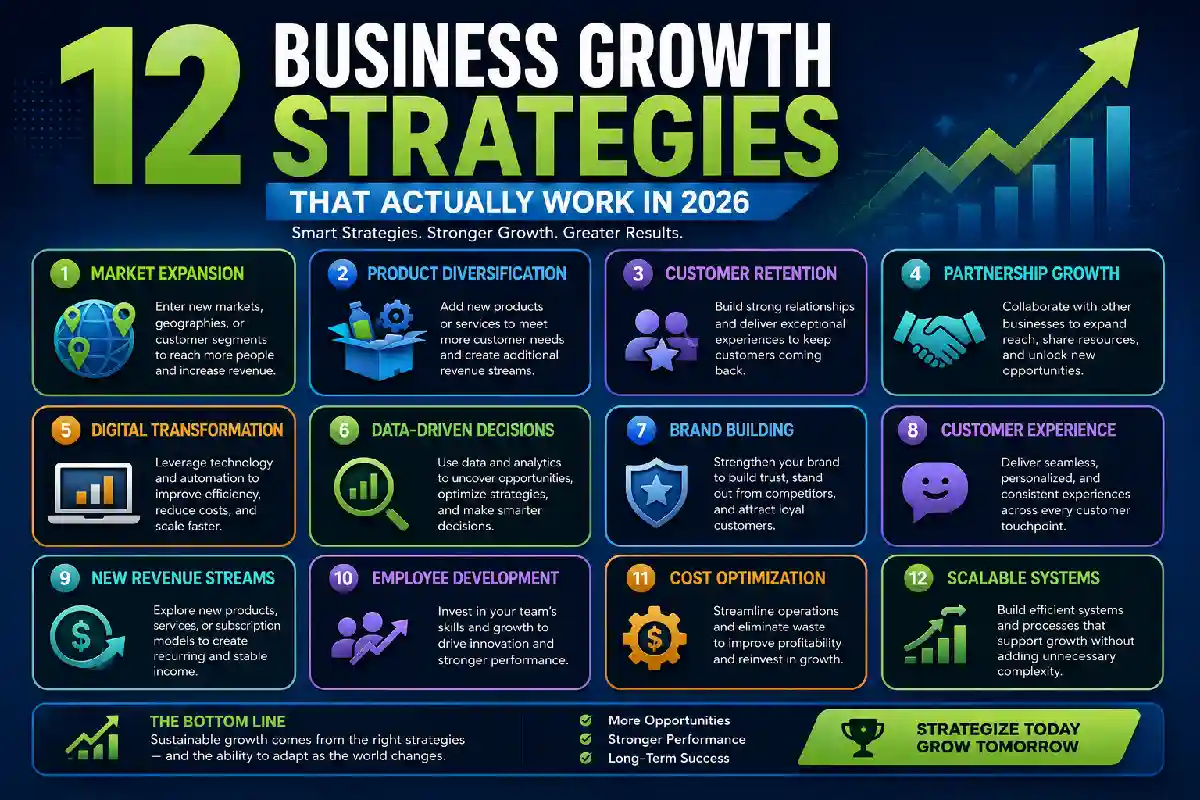
12 Business Growth Strategies That Actually Work in 2026
Last Updated: September 15, 2026
Introduction
Expanding a Business in 2026: As a business leader in 2026, how do you grow your business? Growing a business in 2026 isn‘t just about sales and profits. It is about building a strategy to grow your business by changing the way customers engage with your company. It is about using new technological and economic trends; understanding how the new generation of consumers shop and communicate with brands. It‘s about providing an innovative experience to today‘s consumer. Whether you are an entrepreneur or a mature business, today‘s growth strategies help you grow and develop new markets, acquire new revenue streams and create strong and lasting customer relationships.
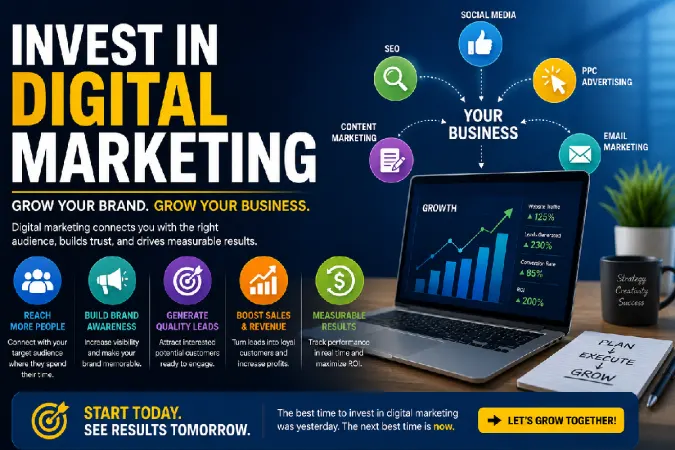
01. Invest in Digital Marketing
You need more people to know about your business in order to really maximize your business’s growth, so use SEO, content marketing, social media, email marketing and paid advertising to reach the right customer. Use a marketing automation solution with AI to optimize your marketing campaigns.
02. Focus on Market Expansion Strategy
Going into new markets is one of the most successful ways of increase sales. This way it can be done, for instance, by exploring new geographical territories, new customer zones, or outside national frontiers. Some market research should be made, to analyze the particular conceptions of each case: needs, competitors, legislation, for instance.
Tips for Successful Market Expansion:
- Investigate the extent of the market demand and competition.
- Localise products and marketing campaigns.
- Network with local businesses.
- KOD Identify and test new markets with pilot launches.
03. Product Diversification
Launching new Products or services. Adding new products and services can help eliminate reliance on one particular source of income, and attract new customers to the site. The business could add various other products that complement those currently sold, offer a premium version of the existing products, or introduce a subscription service.
Benefits of Product Diversification:
- Provides an additional source of revenue.
- Decreases the risk of an enterprise.
- Increases customer base.
- Adds value to your brand.
04. Strengthen Your Customer Retention Strategy
Adding new customers is great, but keeping current ones is usually more economical. Invest in outstanding customer service, catering to individual desires, and incentive schemes.
Effective Customer Retention Tactics:
- Provide offers or loyalty awards.
- Run targeted, personalized email campaigns.
- Gather and utilize customer feedback.
- Offer exceptional after-sales support.
05. Build Strategic Partnership Growth Opportunities
Work with other compatible businesses to expand your reach and drive down marketing costs. You could form strategic alliances with business offering the same or complementary products or services through co-marketing efforts, referral arrangements, affiliate partnerships or joint product launches.
06. Optimize Revenue Growth Tactics
Evaluate your pricing model. Offer upsells and additional products, provide cross-sells for related services, and establish a recurring revenue model such as a membership or subscription program. Analyzing your key performance indicators (KPI) allows you to discover profitable potential and improvement.
07. Improve Customer Experience (CX)
A positive customer experience is a higher customer satisfaction, repeat business and referrals. Make it as simple and straightforward as possible, provide a rapid response to customers’ concerns and inquiries, and deliver a smooth experience through every online channel.
08. Embrace AI and Automation
Automating repetitive tasks using AI tools, bringing efficiency to customer services with chatbots, selecting the right audience for marketing campaigns and business understanding being achieved through analyzing data. All these activities could be done automatically and with benefits increasing efficiency and decreasing operation costs.
09. Expand Through E-commerce and Omnichannel Sales
Sell through all of your channels (your website, online marketplace‘s, social media, etc.). This means you need to provide the same smooth shopping experience for your customers no matter where they shop with you.
10. Build a Strong Brand
Build a professional, consistent and trusted brand will differentiate your business from other competitors. Establishing brand consistency, content, customer testimonials and thought-leader positioning will foster leadership in your industry.
11. Make Data-Driven Decisions
Track business metrics such as CAC, CLV, conversions and revenue growth. Analytics tools give data which can be used to monitor trends, and optimize marketing and sales.
12. Encourage Innovation and Continuous Improvement
To love your business and the way you do business is crucial, however all successful business must change and develop to the market. Regularly survey your clients to determine what they need, monitor industry trends and test new products, new technology and innovate new methods of working.
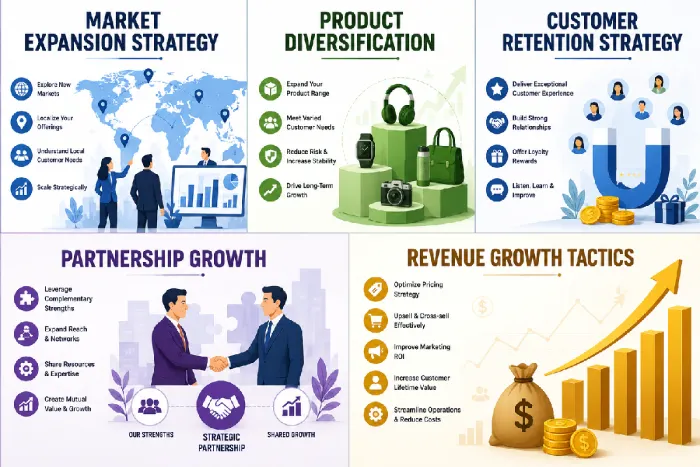
Market Expansion Strategy
A strategy for growing business that entails bringing to new markets, customer segments, geographies or distribution channels an existing offering. Rather than designing new products or services, companies try to exploit new opportunities using current offerings.
To grow sustainably a company might expand to new markets. The expansion into new markets might generate more revenue, make the company reach a customer segment that is not targeted by current products, enhance the overall brand image and decrease its market dependence.
What does this as strategy intends to?
Market expansion is one of the classic approaches to business growth. The basic idea is simple:
Current product + New market = Market development
A company might expand by:
- Arriving in a new city, state, or country
- Different Customer Segments.
- Obtaining a new demographic.
- Selling through a new distribution channel
- Transitioning from B2C into B2B markets
- Diversifying from Internet business to traditional shop-based business
- Introducing an existing product to a new customer base
For instance, a fitness provider currently selling gym equipment directly to consumers could potentially move into corporate wellness programs and provide companies with equipment bundles.
Product Diversification
Product diversification A business growth strategy whereby a business enhances revenues by offering new products or services or offering current products to new target markets in an effort to enlarge the firm‘s scope or reduce reliance on a single product.
Businesses will not have one core offering, but rather expand their product range to adapt to evolving customer preferences and obtain new sources of growth.
Why Is Product Diversification Important
Product diversification can help businesses:
- Develop new (additional) streams of income
- Build new ways to sell your products and/or services.
- Tap into various customer segments
- Enhance customer lifetime value
- Avoid dependence on one product.
- Adapt to evolving market trends.
- Increase the competitive edge.
Utilize or expand the use of current technologies or skills: Ensure the best use of the technology or skills already available.
For example, a fitness company that initially trades physical equipment can diversify into applications, online coaching, fitness regimes or nutritional products.
Types of Product Diversification
- Related Diversification
The company launches a new product that is a logical extension of its current range of products.
For example, a coffee company might sell coffee machines, cups, coffee making bits and subscriptions.
- Unrelated Diversification
Here, the business will be in a entirely different product category.
This can provide new avenues for growth but is usually more risky as the company might not have experience in the new industry.
- Product Line Expansion
The business introduces a new form of an already existing product.
Examples include:
- New sizes
- New flavors
- Premium versions
- Budget versions
- New features
- New packaging
How to Build a Product Diversification Strategy
- Determine what the customer needs.
- Market gaps. Find out what is missing in the current market.
- Research competitors.
- Assess your internal capacity.
- Come up with a brand new product idea.
- Try to make the product available to a narrower audience.
- Quantify demand and profitability.
- Make the product better.
- Scale the offering that successful.
Customer Retention Strategy
Customer retention strategy is a set of systematic actions applied by a company to retain customers.
Acquire customers is bringing people into your business. Retain them is converting them into frequent buyers and advocates.
Why Customer Retention Matters
Retaining customers can help businesses:
- Increase customer lifetime value
- Minimize reliance on continual purchase.
- Encourage more repeat purchases
- Build brand loyalty.
- Give referrals
- Enhance profitability
- Increase profitability
- Create predictable revenue.
A business shouldn‘t focus only on acquiring new customers. It should also ask:
Effective Customer Retention Strategies
- Improve Customer Experience
Ensure the ease of all stages during the customer‘s journey from buying to support.
- Personalize Communication
This is how we use our customer data. Deliver. Use customer data responsibly so that we only provide relevant recommendations, offers, and content.
- Create Loyalty Programs
Rewards could help automate people‘s repeat purchases.
Examples include:
- Points
- Discounts
- Memberships
- Exclusive products
- Early access
- Referral rewards
- Provide Excellent Customer Support
Quick, efficient support can be a real life-saver.
- Use Email and Lifecycle Marketing
Businesses can send useful communications based on customer behavior,
- Welcome emails
- Product education
- Reorder reminders
- Personalized recommendations
- Loyalty offers
- Win-back campaigns
- Ask for Feedback
What customers say and the listening device reveals what is attractive about the organization and can uncover: why people stay, why people leave and what require modifying.
Customer Retention Metrics
Track:
- Customer retention rate
- Customer churn rate
- Repeat purchase rate
- Customer lifetime value
- Average order value
- Renewal rate
- CustomerSatisfaction
- Net Promoter Score
Partnership Growth
Partnerships Growth is about partnering with other companies or organizations, creators, distributors, technology providers, or any third party for new customers, additional capabilities, increased distribution, or incremental revenue.
By outsourcing capabilities that you do not possess, you can form strategic alliances with other firms to gain access to new skills or to reach new markets.
Why Partnership Growth Works
Strategic partnerships can provide:
- Access to new customers
- New modes of distribution
- Higher brand awareness
- Opportunities to coordinate marketing efforts.
- Modern technology
- Experience with the relevant industry
- Lower expansion costs
- Additional income
Types of Business Partnerships
Co-Marketing Partnerships
Two companies cross-promote each other‘s products or content.
Distribution Partnerships
A firm‘s distribution channel is a third party business that exists in its supply chain to deliver product to the customer.
Technology Partnerships
Companies combine their products and services to add value for their customers.
Affiliate Partnerships
In this scenario, partners are paid for sales or leads that can be drove.
Strategic Alliances
The work for companies working towards a same business goal, but still independent companies.
Joint Ventures
Two or more companies establish a common venture and operate it shares the investment, responsibility, risk, and profit.
Revenue Growth Tactics
The revenue growth tactics are the immediate and realizable means by which existing and new customers can be cultivated to produce more revenue.
Gaining 1000 new customers isn‘t always the answer. A business can often increase revenue by doing a better job of pricing, converting, increasing customer lifetime value, average order value, and recurring revenue.
1. Increase Average Order Value
Upsell customers. This involves persuading customers to buy more at each point of sale.
Methods include:
- Product bundles
- Volume discounts
- Cross-selling
- Upselling
- Premium packages
2. Improve Pricing
Review whether your pricing accurately reflects the value you provide.
Possible approaches include:
- Premium pricing
- Tiered pricing
- Value-based pricing
- Annual plans
- Bundled pricing
Price increases should be supported by customer value rather than implemented randomly.
3. Introduce Recurring Revenue
Repeatability of income.
Examples include:
- Subscriptions
- Memberships
- Definitions for software plans.
- Coaching programs
- Content subscriptions
4. Improve Conversion Rates
Even more money can be made on the same amount of traffic if the number of customers increases.
Improve:
- Landing Pages
- Product pages
- Checkout processes
- Calls to action
- Product demonstrations
- Testimonials
- Customer reviews
5. Upsell Existing Customers
An upsell is the process of getting the customer to buy a higher-priced product.
For example:
Basic -> Premium -> Enterprise
In each levels there are more functions/services that can be used.
Conclusion
Your business should grow during 2026 by integrating different strategies and not just one approach. Market expansion strategy, product diversification, customer retention strategy, partnership growth, revenue growth strategy can work together to generate continuous successful performance. You need to set the right achievement measurement, be innovative and flexible to change your business to be successful in 2026.