


How to Scale Your Startup in 2026 Without Breaking It
Last Updated: September 15, 2026
Every founder wants to go viral. The idea of a surge in customers, a flood of revenue, an expanding team or growing markets, it’s addictive. The catch is, grow before you’re ready, and you will often create more pain than you alleviate.
A shocking number of startups fail not because of a failure to land clients, but a failure to build systems that can handle the success.
The modern way to scale a Startup: It’s 2026 – the landscape has changed for businesses. AI, automation, cloud technology, globalized competition, increasing customer expectations have dramatically altered the process of business scale. The modern entrepreneur has come to embrace a practice called Sustainable Scaling that requires businesses to continue to attract customers in a way that builds stronger – not just larger – operations.
To scale effectively, entrepreneurs must consider long-term processes that serve businesses a multitude times more users while continually driving greater – not diminished – products, services, consumer satisfaction, and economic impact.
This document will show founders the right way to scale their business during 2026 without hurting team culture, overworking staff or diluting your focus.
What Does Startup Scaling Mean?
Scaling in startup means that the costs, systems, and resources will all be efficient at every point. It also involves revenue, customers, market reach and the operations will also rise with the other key metrics that define a start up.
Basically, all the essential components in a startup should grow with a minimal effect to your expenses. However, a startup could be on scale, it cannot sustain thousands of new customers in its platform without putting an effect on its resources.
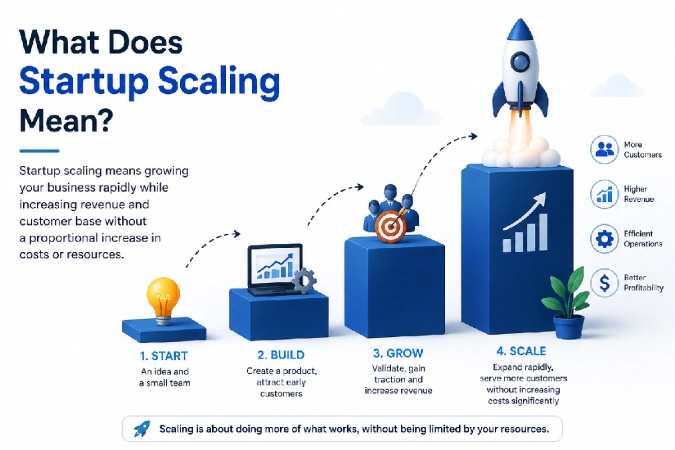
For example:
- For that growth maybe hire ten more. 500 more clients.
- Scaling maybe use AI automation, bigger systems, same team, same time, 500 more clients.
The difference lies in efficiency.
Growth vs. Scaling
| Business Growth | Startup Scaling |
| Expenses increase with revenue | Revenue grows faster than expenses |
| More people required | Better systems reduce manual work |
| Short-term expansion | Long-term sustainable growth |
| Operations become more complex | Operations become more efficient |
| Often limited by resources | Designed for continuous expansion |
Scaling is about system creation and elimination rather than re-inventions.
Why Scaling Matters More Than Ever in 2026
The startup ecosystem has become more competitive than ever.
Customers expect:
- Faster support
- Personalized experiences
- High-quality products
- Continuous innovation
- Affordable pricing
Startups are also supposed to deliver healthy unit economics instead of hyper-growth without the profit.
AI customer service bots, predictive analytics, workflow automation software, cloud technology, and tools for remote working enable contemporary startups to scale significantly faster compared to businesses that existed before the technology revolution.
Companies or teams in a startup that integrate both sophisticated tech stacks and sound leadership are on an extremely advantageous path.
Startup Scaling Stages
Few companies make the jump overnight; rather, nearly all successful ventures will move through several foreseeable stages in their ascent to the ranks of respected businesses.
Stage 1: Validation
At the current stage, the main job at hand is to demonstrate the fact of customer desire.
Characteristics include:
- Small customer base
- Frequent product improvements
- Founder-led sales
- Testing pricing models
- Collecting customer feedback
This is where you have validation of people wanting to purchase the solution you built or created for them
Stage 2: Product-Market Fit
Finally the startup starts consistently gaining customers.
Signs include:
- Strong customer retention
- Positive referrals
- Increasing organic demand
- High customer satisfaction
- Repeat purchases or subscriptions
This is arguably the most critical before moving to scale, according to many specialists
Stage 3: Process Optimization
Instead of just acquiring and selling for customers founders refine internal process.
This includes:
- Documenting workflows
- Automating repetitive tasks
- Building customer support systems
- Improving onboarding
- Measuring key performance indicators
Efficient processes reduce future bottlenecks.
Stage 4: Expansion
We explore new regions but our operations are not impacted by doing so.
Expansion may involve:
- International customers
- New sales channels
- Additional product lines
- Strategic partnerships
- Enterprise clients
Stage 5: Mature Scaling
By the end of this stage, the startup has become a grown-up company ready to experience self-sufficient development.
Leadership focuses on:
- Innovation
- Profitability
- Customer loyalty
- Organizational culture
- Long-term strategy
Understanding Product-Market Fit
Product-market fit is when your product has found to be useful for real customers. Demand will become obvious.
For a company with no product-market fit, scaling is more losses.
A startup should not attempt aggressively until its value prop is obviously something users want.
Indicators of Strong Product-Market Fit
A company with product-market fit typically experiences:
- High customer retention
- Increasing referrals
- Positive online reviews
- Low customer acquisition resistance
- Strong engagement
- Predictable recurring revenue
Feedback from the clients should be as much treasure for you at this time since it determines the changes for future improvement.
How to Improve Product-Market Fit
Successful founders iterate on their product because:
- Interviewing customers
- Tracking usage data
- Measuring churn
- Testing new features
- Simplifying onboarding
- Removing unnecessary complexity
The goal isn’t adding more features.
The goal is solving the customer’s problem better than anyone else.
Hiring for Scale
People determine whether scaling succeeds or fails.
Startups often make too many mistakes, adding unwanted costs and making it harder for people to do their jobs effectively.
The right answer is to let each new hire enable bigger ambitions.

Build Roles Before Filling Them
Clearly define responsibilities before recruiting.
Each position should answer:
- What business problem does this role solve?
- Which KPIs will measure success?
- How does this role support growth?
Well-defined positions reduce confusion.
Hire Adaptable Employees
Scaling environments change rapidly.
Look for people who:
- Learn quickly
- Solve problems independently
- Collaborate effectively
- Accept feedback
- Embrace technology
Often it’s worth more than experience!
Maintain Company Culture
As teams expand, culture can weaken.
Founders should preserve values through:
- Transparent communication
- Clear expectations
- Leadership accessibility
- Recognition programs
- Regular feedback
- Low turnover and high productivity due to strong culture
With high-impact cultures, employee turnover rates decrease and productivity rates improve.”
Invest in Employee Development
Continuous learning benefits both employees and the company.
Training may include:
- Leadership development
- AI productivity tools
- Communication skills
- Technical certifications
- Customer success strategies
More effectively, those employees continuing to learn will become more so over time.
Operational Scalability
“Operational scale means building systems that will continue to scale along the size of the company.
Many startups do fail where the founders of a company are involved in decision-making from the earliest days.”
True scalability requires systems rather than constant supervision.
Standardize Processes
Document repeatable activities such as:
- Customer onboarding
- Sales workflows
- Product releases
- Marketing campaigns
- Employee training
Doing things a certain way all the time reduces waste and human error to ensure quality.
Automate Repetitive Tasks
Automating reduces the man hours and human errors.
Examples include:
- Invoice generation
- Customer support chatbots
- Email campaigns
- Lead qualification
- Reporting dashboards
Thanks to automation, people have more capacity for more value add work.
Use Cloud Infrastructure
Current cloud services add versatility for accelerated periods of expansion
Benefits include:
- Better security
- Faster deployment
- Lower infrastructure costs
- Global accessibility
- Reliable backups
Cloud services eliminate many traditional scaling limitations.
Measure Performance Continuously
Reliable increase to the working’s working efficiency only after the impact measured.
Useful metrics include:
- Customer response time
- Revenue per employee
- Customer acquisition cost
- Lifetime customer value
- Monthly recurring revenue
- Churn rate
- Employee productivity
Data-driven decisions reduce unnecessary risk.
Scaling Revenue
Revenue growth is the biggest reason companies invest in scaling; however, meaningful and sustainable revenue growth is far more important than a fleeting rise.
Diversify Revenue Streams
Relying on one income source creates unnecessary risk.
Many startups expand through:
- Subscription plans
- Premium features
- Enterprise packages
- Consulting services
- Affiliate partnerships
- Digital products
Diversification improves long-term stability.
Increase Customer Lifetime Value
Existing Customers are Cheaper Than New Customers It typically costs more to acquire new customers than retaining existing ones.
Strategies include:
- Upselling
- Cross-selling
- Loyalty programs
- Better onboarding
- Personalized recommendations
- Exceptional customer support
And a lot of the time your satisfied customer is the ambassador of your brand.
Improve Pricing Strategy
Pricing should evolve as the company matures.
Common pricing models include:
- Monthly subscriptions
- Annual plans
- Usage-based pricing
- Freemium models
- Enterprise licensing
Pricing Reviews The business will continue to regularly review business pricing strategies to maintain competitiveness and protect profitability.
Expand into New Markets Carefully
Massive benefits of expanding abroad
Before entering a new market, evaluate:
- Local regulations
- Customer behavior
- Payment preferences
- Competition
- Language requirements
- Marketing costs
Thoughtful expansion reduces unnecessary risk.
Common Scaling Mistakes to Avoid
Certain issues frequently arise for startups as they grow quickly.
Avoid these mistakes:
- Scaling before achieving product-market fit
- Hiring too many employees too quickly
- Ignoring customer feedback
- Expanding into too many markets simultaneously
- Poor financial planning
- Weak internal communication
- Neglecting company culture
- Failing to automate repetitive work
- Tracking vanity metrics instead of business KPIs
Recognizing these issues early can save both time and capital.
Technology That Helps Startups Scale in 2026
Technology is one of the strongest growth drivers out there.
Some favoured ones :
- AI-powered customer support
- CRM platforms
- Marketing automation
- Cloud infrastructure
- Business intelligence dashboards
- Project management software
- Cybersecurity solutions
- Workflow automation platforms
Founders will be able to save time and invest that extra hour in strategizing as the manual tasks can be done by the tools.
Leadership During Startup Scaling
As your business grows, founders have to stop being a single contributor or a superman to becoming a delegator.
Effective leaders:
- Delegate responsibility
- Build trust
- Communicate clearly
- Encourage innovation
- Make decisions using data
- Stay close to customer feedback
Leadership keeps pace with a changing organisation.
Financial Planning for Sustainable Scaling
Growth requires careful financial management.
Key financial priorities include:
- Maintaining healthy cash flow
- Monitoring burn rate
- Forecasting revenue
- Building emergency reserves
- Measuring profitability
- Controlling customer acquisition costs
It helps founders get a much more breathing room for unexpected markets or economic turbulence.
Building a Scalable Business Culture
Culture often determines whether rapid expansion succeeds.
Strong startup cultures prioritize:
- Accountability
- Transparency
- Continuous learning
- Collaboration
- Customer obsession
- Innovation
Employees who believe in what the organization is about have clearer thinking for making better decisions independently.
Key Metrics Every Scaling Startup Should Monitor
| Metric | Why It Matters |
| Monthly Recurring Revenue (MRR) | Measures predictable revenue growth |
| Customer Acquisition Cost (CAC) | Evaluates marketing efficiency |
| Customer Lifetime Value (CLV) | Estimates long-term customer value |
| Churn Rate | Shows customer retention performance |
| Gross Margin | Indicates operational profitability |
| Burn Rate | Tracks cash usage |
| Net Revenue Retention (NRR) | Measures revenue expansion from existing customers |
| Employee Productivity | Evaluates operational efficiency |
These metrics gave a fair view of growth and profitability, including customer care as well.
Future Startup Scaling Trends in 2026
Several trends are reshaping how startups grow:
- AI-assisted business operations
- Remote-first global hiring
- Hyper-personalized customer experiences
- Low-code and no-code automation
- Predictive analytics for decision-making
- Vertical SaaS solutions
- Sustainable business practices
- Embedded finance and digital payments
- Privacy-focused customer data strategies
Founders who embrace these trends are better positioned for long-term success.
Final Thoughts
Scaling the startup: The rewards and the challenge – Jan. 19 2023 David Hsieh “The nature of entrepreneurial existence. And its great satisfactions are just such that it may demand anything that is human of them.” – Howard Stevenson From startup to the growth stage In 2026, success for a startup won’t be measured on how fast your company is growing but how it managing their growth. Scalable growth …
Scaling at the highest levels-and sustainably- involves proactively designing operations to cope with increased demand, building strong processes and protecting brand identity and customer trust along the way.
Be open to automation where applicable, actively solicit customer input, and make more data-backed decisions. The startups that succeed in 2026 are going to be the smart scale, not fast scale ones.