

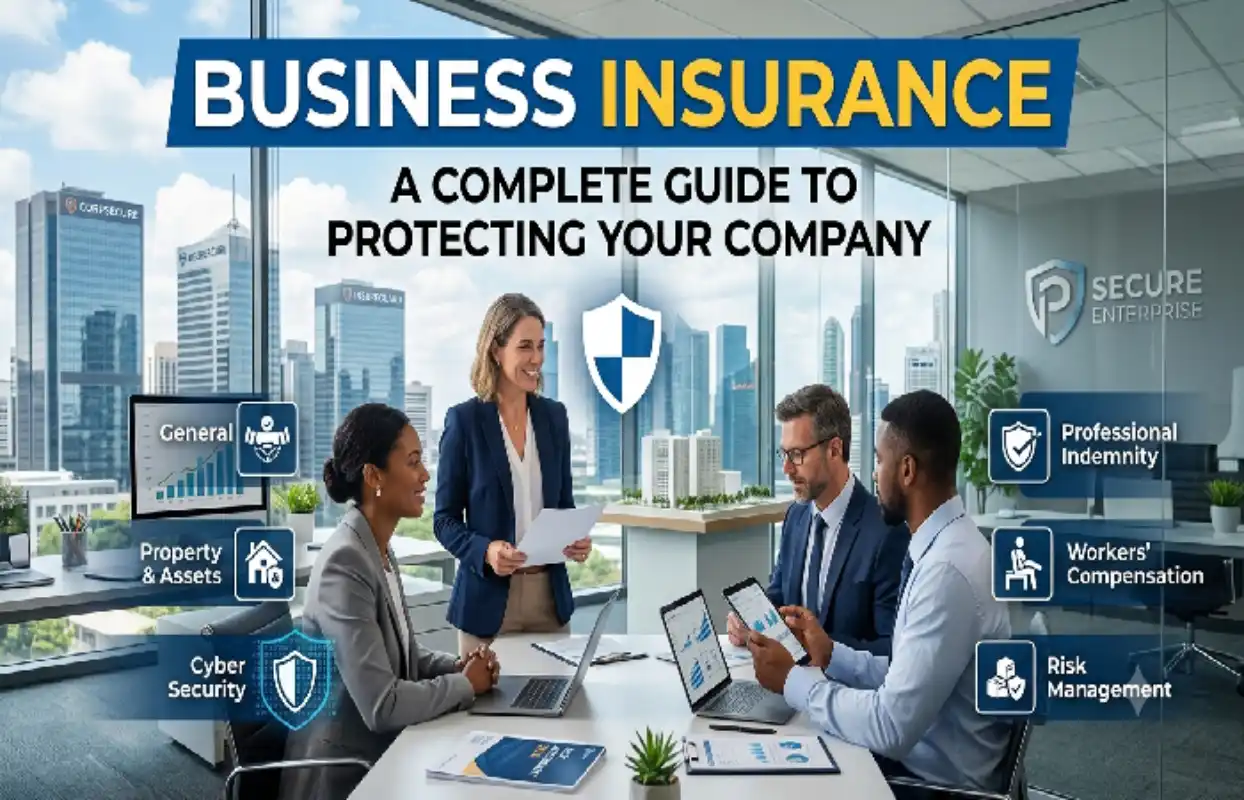
Business Insurance: A Complete Guide to Protecting Your Company
Last Updated: September 21, 2026
Running a business is about more than just handling sales, staff members, and customers. Each enterprise is exposed to unforeseen expenses or liabilities for example from lawsuits, damage of property, theft or data loss, operation breakdowns, and so on. Business insurance enables businesses to take control in the face of such risks.
The proper coverage also varies according to your field, how many employees you have, your geographic market, how much property you have, your customers, and the types of other risks you face. Your small consulting company may have entirely different needs than a construction company, a restaurant, or an online distributor.
Knowing the main types of business insurance can help you see where you might be missing out and make better choices.
Definitions of Business Insurance
Business insurance is a set of policies that collectively shield a company from certain potential financial losses. Rather than having one policy and hoping it covers everything, businesses tend to have a number of different coverages:
Business insurance may help cover:
- Third-party injuries or property damage
- Professional mistakes and negligence claims
- Employee workplace injuries
- Damage to business property
- Theft and vandalism
- Cyberattacks and data breaches
- Business interruption losses
- Legal defense expenses
- Certain settlements or judgments
Insurance doesn’t eliminate business risks, but it can reduce the financial impact of covered events.
1. General Liability Insurance
Of the various types of business coverage, General liability insurance is one of the most common. It typically covers a business for specific third party legal liabilities resulting from bodily injuries, property damages, and personal or advertising injuries.
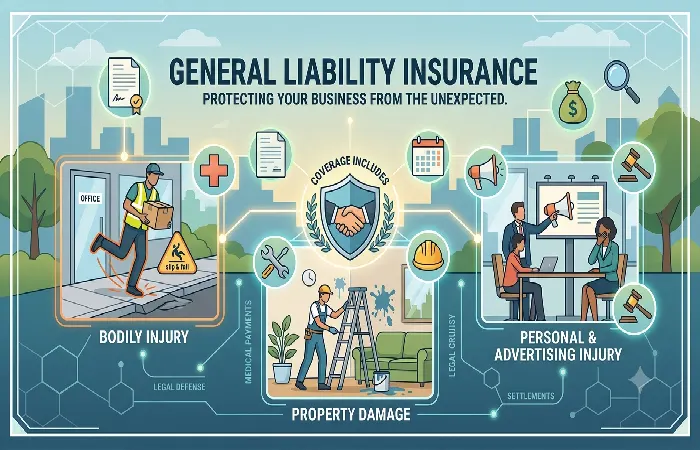
For instance, a patron comes onto your property, falls on a slick floor, and gets hurt. If you are liable, the general liability part of your policy can help pay for permitted medical expenses, legal defense costs, settlements, or judgments.
The kind of general liability insurance is also sometimes needed if a business services a customer‘s property, damaging it in the process.
Common areas of protection may include:
- Customer injuries
- Third-party property damage
- Certain advertising injury claims
- Legal defense costs
- Certain completed-operations claims
General liability coverage tends to be more crucial for the sorts of business which are very customer facing, have a fixed premises base or send staff out to attend site.
However, not all business risks are covered by the basic public liability insurance. It might not deal with employee accidents, professional errors, business vehicles and cyber attacks all need to buy an extensional insurance.
2. Professional Liability (E&O) Insurance
If you run a business offering professional advice, services or expertise, then professional liability cover (sometimes called errors and omissions (E&O) insurance) may be appropriate.
A client could also allege that your company was negligent in its provision of professional work supplied incorrect information or advice.. failed to provide expected services.. has been negligent..or made an error.
For instance, consultants could face a claim that bad advice resulted in a financial loss to a client. Accountants, designers, computer programmers, architects and marketing professionals may also face similar charges depending on the services offered.
Professional liability insurance may help cover eligible:
- Legal defense costs
- Professional negligence claims
- Errors or omissions
- Claims arising from professional services
- Certain settlements or judgments
The exact coverage varies considerably by profession and policy.
Businesses should pay close attention to exclusions and policy definitions because professional liability insurance is highly specialized. A policy suitable for an accountant may not provide the coverage required by an architect, technology consultant, or healthcare professional.
3. Workers’ Compensation Insurance
Workers’ compensation insurance provides benefits for employees who suffer qualifying work-related injuries or illnesses.
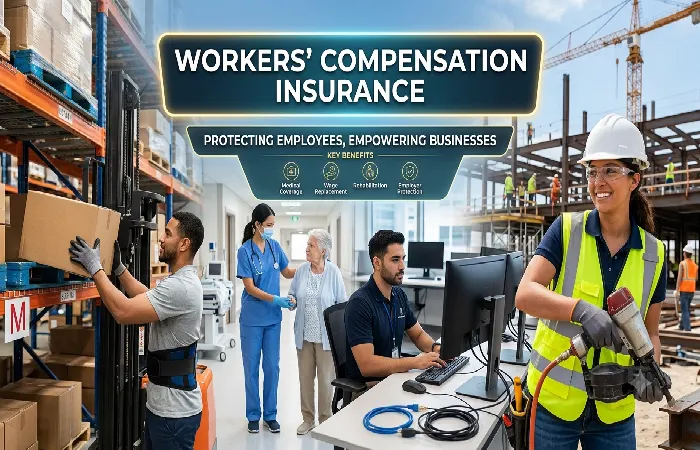
Depending on applicable laws and the policy, workers’ compensation may provide benefits associated with:
- Medical treatment
- Lost wages
- Rehabilitation
- Disability benefits
- Death benefits for eligible dependents
Work Compensation laws and requirements are contingent on Location, Business Format, Number of employees, industry, etc. In several regions if place of business that getting workers compensation is mandatory as soon as full-time employment, or the payroll exceeds a specified amount.
E.g. a construction company is likely to have significantly different hazards in their workplace compared to a software company based in offices
Employers should therefore ensure they are familiar with the rules in their state or country rather than simply assuming the rules are the same throughout the world.
In addition to being an insurance plan that benefits injured workers, workers’ compensation has a significant business-management value. It can implement a workplace injury management system while ensuring that an employer adheres to the guidelines rules and regulations.
4. Commercial Property Insurance
Commercial property insurance- This covers the physical assets owned by the business against the covered risks.
Depending on the policy, covered property can include:
- Buildings
- Office furniture
- Computers
- Machinery
- Inventory
- Equipment
- Fixtures
- Business supplies
Imagine a fire damages a company’s office and destroys computers, furniture, and inventory. Commercial property insurance may help pay for repairing or replacing covered property, subject to the policy’s limits, deductible, exclusions, and valuation method.
Businesses should carefully calculate the value of their physical assets when selecting coverage. Underinsuring property could leave the company responsible for a significant portion of replacement costs.
Some businesses may also need specialized coverage for risks such as equipment breakdown, business interruption, or valuable inventory.
Business Interruption Coverage
A major property loss can cause more than physical damage. It may prevent the company from operating normally.
Business interruption coverage, when included or purchased separately, can potentially help cover certain lost income and continuing expenses following a covered event.
For example, if a restaurant must temporarily close after a covered fire, eligible business-interruption coverage could help address certain financial losses during the restoration period.
5. Cyber Liability Insurance for Businesses
As businesses increasingly rely on cloud platforms, online payments, customer databases, and connected systems, cyber liability insurance has become an important consideration.
A cyber incident can create expenses related to investigation, notification, recovery, legal services, regulatory matters, and business interruption.
Depending on the policy, cyber coverage may address certain costs associated with:
- Data breaches
- Ransomware incidents
- Cyberattacks
- Data restoration
- Incident response
- Customer notification
- Legal expenses
- Certain business interruption losses
- Cyber extortion events
Cyber insurance shouldn’t replace strong cybersecurity practices. Businesses should still use measures such as multi-factor authentication, employee security training, regular backups, access controls, endpoint protection, and incident-response planning.
Insurers may also assess a company’s cybersecurity controls before providing coverage or determining premiums.
Other Business Insurance to Consider
The five policies above are important, but some businesses need additional protection.
Depending on the company, useful coverage may include:
| Insurance Type | Potential Purpose |
| Commercial auto | Vehicles used for business purposes |
| Product liability | Certain claims involving products sold or manufactured |
| Business owner’s policy (BOP) | Combines certain common coverages for eligible small businesses |
| Directors and officers (D&O) | Certain claims involving company directors and officers |
| Employment practices liability (EPLI) | Certain employment-related claims |
| Inland marine | Certain business property transported or stored away from its normal location |
| Equipment breakdown | Repair or replacement of covered equipment after qualifying breakdowns |
Not every business needs every type of insurance. The objective is to match coverage to actual exposures.
How Much Business Insurance Do You Need?
There is no universal coverage amount for every company.
Consider:
- Industry risks — Construction and manufacturing can have different exposures from consulting.
- Business size — Larger companies may have greater assets, revenue, and liability exposure.
- Number of employees — Employee-related requirements and risks can affect coverage needs.
- Physical assets — Calculate the replacement value of buildings, equipment, and inventory.
- Customer contracts — Some clients or landlords may require specific insurance limits.
- Cyber exposure — Businesses handling sensitive customer information may need specialized protection.
- Legal requirements — Check local insurance requirements for your industry and location.
It’s also important to review coverage whenever the business expands, hires employees, moves locations, purchases expensive equipment, launches new products, or begins serving new markets.
How to Choose the Right Business Insurance
Start by conducting a basic business risk assessment. Identify what could cause a significant financial loss and determine which risks can be transferred through insurance.
When comparing policies, look beyond the premium. Examine:
- Coverage limits
- Deductibles
- Exclusions
- Policy conditions
- Claims process
- Additional endorsements
- Insurer financial strength
- Industry experience
Working with a qualified insurance professional can be useful when your company has specialized risks or complex coverage requirements.
Final Thoughts
Business insurance is an important part of risk management. General liability insurance can address certain third-party claims, while professional liability insurance can protect eligible service-based businesses from specific professional negligence allegations.
Workers’ compensation covers any employee who sustains a covered injury, commercial property insurance covers the physical property which is covered and cyber liability covers may help some companies offset some costs of a cyber event.
The right mix will vary according to your company‘s individual situation.
Rather than opting for the least expensive policy there is, concentrate on understanding your key exposures, exclusions, limits, and reviewing cover as your business evolves. Implementing a quality insurance plan will enable your business to recover more quickly when a crisis arises and will make the business owner feel more secure as they scale up.