
Digital Marketing Basics: A Complete Beginner’s Guide (2026)
Last Updated: September 21, 2026
Digital Marketing: It is the marketing of products, services, or brands over digital channels to engage with potential customers and convert them into buyers. Present in 2026, it is essential to every kind of business, right from a single shop to a multi-million-dollar business.
What is Digital Marketing?
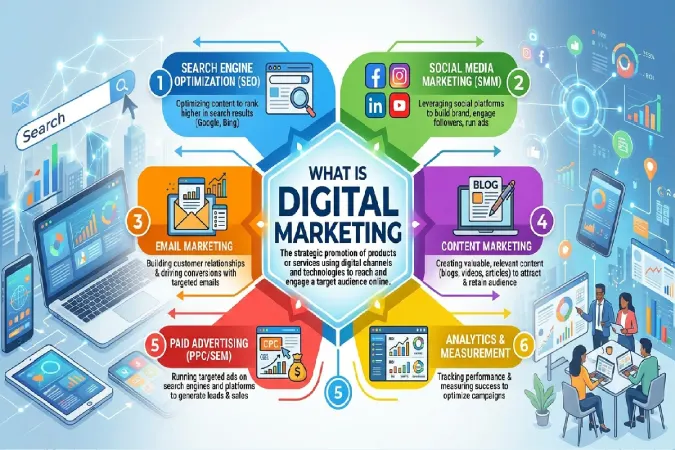
Digital marketing is the marketing of products or services through digital technologies, such as the internet or any other electronic device. It can also be defined as a means by which a business can get to its current and potential customers. It can also be tackled as an umbrella term that includes e-marketing, marketing through mobile phones, etc. The different forms of digital marketing include search engines, social media, email, websites, and applications.
Why Digital Marketing Matters in 2026
- Customers are digital-first. Most people do search online before purchases; these same individuals take note of customer testimonials, they follow brands on Facebook and Twitter, and they love a tailored experience.
- Cost-effective. You can start small with no investment, experiment, and expand only what proves to be effective. Excellent for a small start-up business, for a sole trader.
- Anything can be measured. You will have the ability to monitor clicks, leads, sales, and ROI, and determine accurately what works and what doesn’t.
- AI and automation: Beginning to do the heavy lifting. By 2026, incremental AI tools will do everything from writing content to optimizing ads, to cathering into customer segments, to answering basic customer questions with lean teams operating like big teams.
Core Components of Digital Marketing
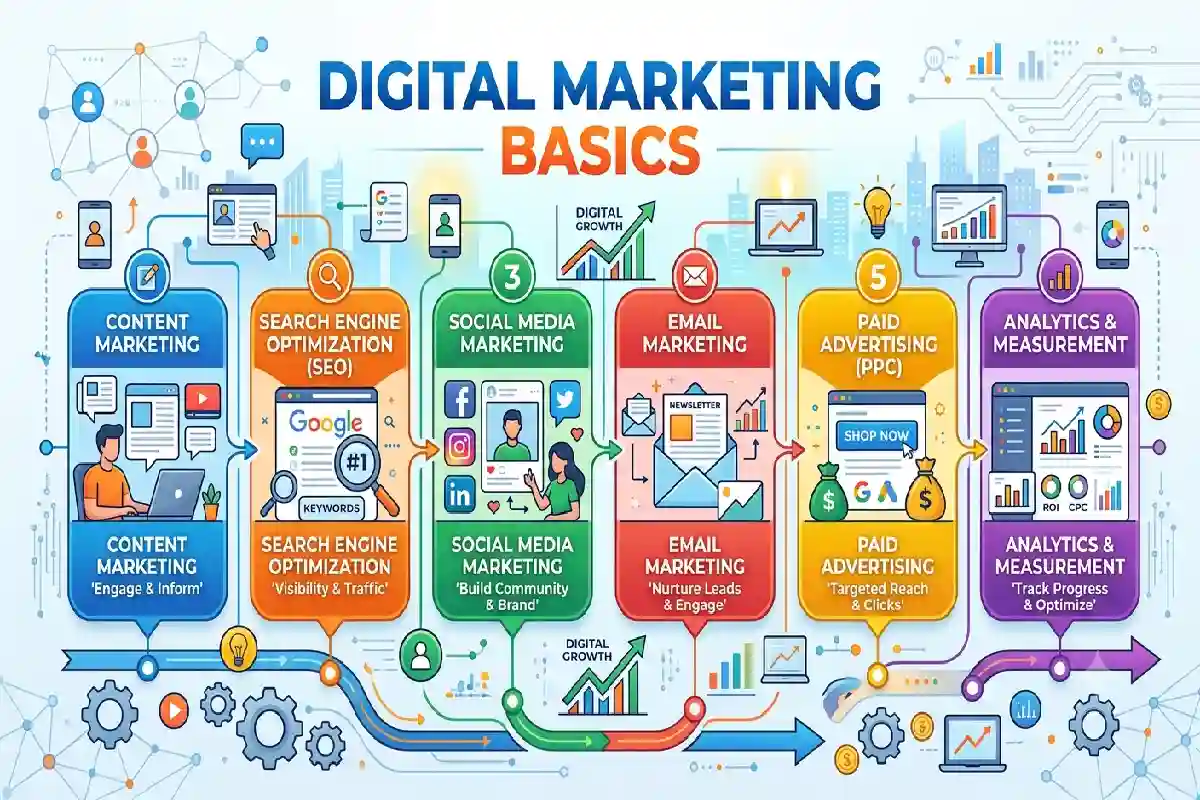
1. Search Engine Optimization (SEO)
Search Engine Optimization (SEO): assisting the Search Engine in getting your site listed higher up in its free or natural search results.
Key elements:
- Finding the exact search words your target market is using to find your product (e.g., best skincare routine for busy professionals).
- On-page seo: Completely optimized titles, Hs, sitemap, image, and Internal linking of your website.
In 2026, SEO will be with AI-assisted search experience optimization and voice search. The Ads should be intent-driven and premium value-oriented.
2. Search Engine Marketing (SEM) / Paid Search
SEM – Paid Search advertising on search engines, mostly through Google Ads.
How it works: When you choose keywords, your ad appears when viewers are searching for those keywords. Payment is made when the page is clicked (PPC) or simply based on the number of people that view your ads (per impression).
Common formats:
- Search ads (text ads on Google results)
- Display ads: banner ads that are run on websites and are non-clickable.
- Shopping ads (product listings that appear on Google.com, include images, prices, and a wealth of other information)
- Video advertising (using pre-roll, still works as some people opt out of auto play!): 3.7 billion impressions (including ads on YouTube and our partner sites).
Paid search is good for visibility immediately (like for fiercely competitive keywords or new products).
3. Social Media Marketing (SMM)
Your SMM will be based on the using of Instagram, Facebook, Twitter, LinkedIn, YouTube and new available channels to develop your brand, com-municate with your target and for sales.
Key activities:
- Developing and planning content (images, reels, stories, carousels)
- Running paid social campaigns (Meta Ads, LinkedIn Ads, YouTube Ads)
- Browsing comments, DMs and the group in the community
- Collaborate with influencers and creators
4. Content Marketing
Content marketing is about developing and distributing interesting, relevant articles (blogs, videos, podcasts, guides, infographics, etc) in order to engage and attract a clearly defined and understood audience.
Why it works: The foundation of good content builds trust, educates customers, and enhances SEO, in turn strengthening every other channel.
Examples:
- “Guide on choosing best skin care products for oily skin” (blog)
- “5 AI tools that save small business owners 10 hours/week” (video)
- Free to be downloaded template, checklist or mini course
In 2026, even as the number of marketers using AI tools to research, do outlines and create first drafts grows, editing and human intelligence remain key to quality and credibility.
5. Email Marketing
Email marketing is one of the most ROI effective digital channels, being used to nurture leads, onboard customers, communicate offers, and encourage loyalty.
Common uses:
- New subscriber Welcome sequence
- Education pages (advice, best practice, articles)
- Promotion activities (discounts, launching new products)
- Automated flows (such as abandoned cart email reminders, re-engagement email prompts, etc.)
For tools on the market, Platforms such as Mailchimp, Brevo, or HubSpot offer easy set-ups for automation, segmentation of audience, and monitoring of performance.
6. Affiliate and Influencer Marketing
Affiliate marketing! You locate people or sites that will advertise your product for a commission on all sales or leads they generate.
Influencer marketing is when you leverage someone with a loyal following to promote your brand, and this could be in the form of sponsored or fan posts, reviews, or co-creation.
Why it’s good in 2026: Micro-influencers (10k–100k followers) in niche categories are likely to have greater credibility and ongoing conversations with them than bigger celebrities, which is perfect for local/niche brands.
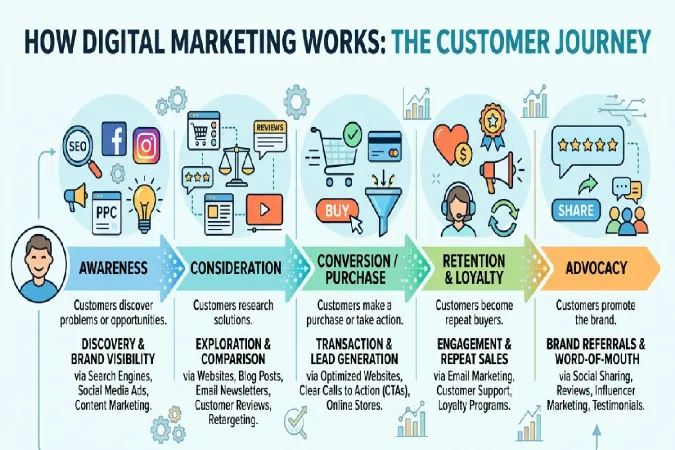
How Digital Marketing Works: The Customer Journey
A simple way to understand digital marketing is through the customer journey or funnel:
- Awareness: Established through search, social, advertising, and content.
- Interest: This is when they are interested in what you publish, they follow you or they visit your website.
- Consideration: They browse through your choices, check reviews, and explore your pitch, contribution or discount.
- Conversion: They purchase, schedule a call, or subscribe.
- Loyalty/Advocacy: They are a customer for life, and they sell you to others.
Essential Digital Marketing Skills for 2026
To succeed as a digital marketer or business owner, focus on:
- Copyright: Knowing how to create professional, effective headlines, ads, emails, etc.43
- Simple design: Basic visuals in Canva or others.
- Data literacy: Understanding of analytics, KPIs, and how to make sense of dashboards.
- AI fluency: knowledge and ability to utilize AI tools for research, content ideas, drafts, automation, etc.
- Strategy: links channels into a comprehensive plan that is aligned with the business objectives.
Common Mistakes Beginners Should Avoid
- Not being able to turn off unused channels and croppings. Try to work with 1–2 channels at first and learn how to use them effectively.
- Going for vanity metrics rather than business metrics.
- Going to ignore tracking & analytics. If you can’t measure it, then you can’t improve it.
- Absorbing everything without trying. Just because something is right for one brand does not necessarily make it right for yours.
- Ignoring mobile and speed. Most traffic is mobile; slow sites will not only turn off visitors but they also will be penalized in search engines.
Career and Business Opportunities in Digital Marketing
Digital marketing offers multiple paths:
- Provide SEO, social media, and ads to small businesses.
- Agency owner. Start a team; provide services to many clients.
- In-house marketer. An employee who works for a company as a marketing specialist or a marketing manager.
- Entrepreneur. Grow your own product business or service business by applying digital marketing.
In 2026, there is also continued demand for individuals who know marketing basics and combine this knowledge with AI tools, data expertise and a results-oriented to deliver ROI.
Conclusion
By 2026, digital marketing isn’t the way that businesses go about doing what they do; if you’re serious about it, you need to know how to find, attract, engage, and keep clients and customers happy. Using a mixture of SEO, content, social media, paid advertising, and emails, along with good analytics, even tiny startups and one-man-band businesses can be competitive.
It’s not that you need to KNOW ALL channels and tools before you start marketing. It’s just that you need to have a clear audience, a clear offer, and probably 1-2 core channels to start. Then constantly experiment and measure meaningful metrics and use AI and automations to scale your work exponentially, and don’t get burnt out. A small daily effort will last forever!
If you’re beginning a side business, building a startup, or carving out a marketing career, the fundamentals are, whether you happen to realize this or not, the same: Solve for real problems, master conveyance, and rely on data. Start small, be relentless, and let those first ten or twenty customers become the foundation for what’s next.