

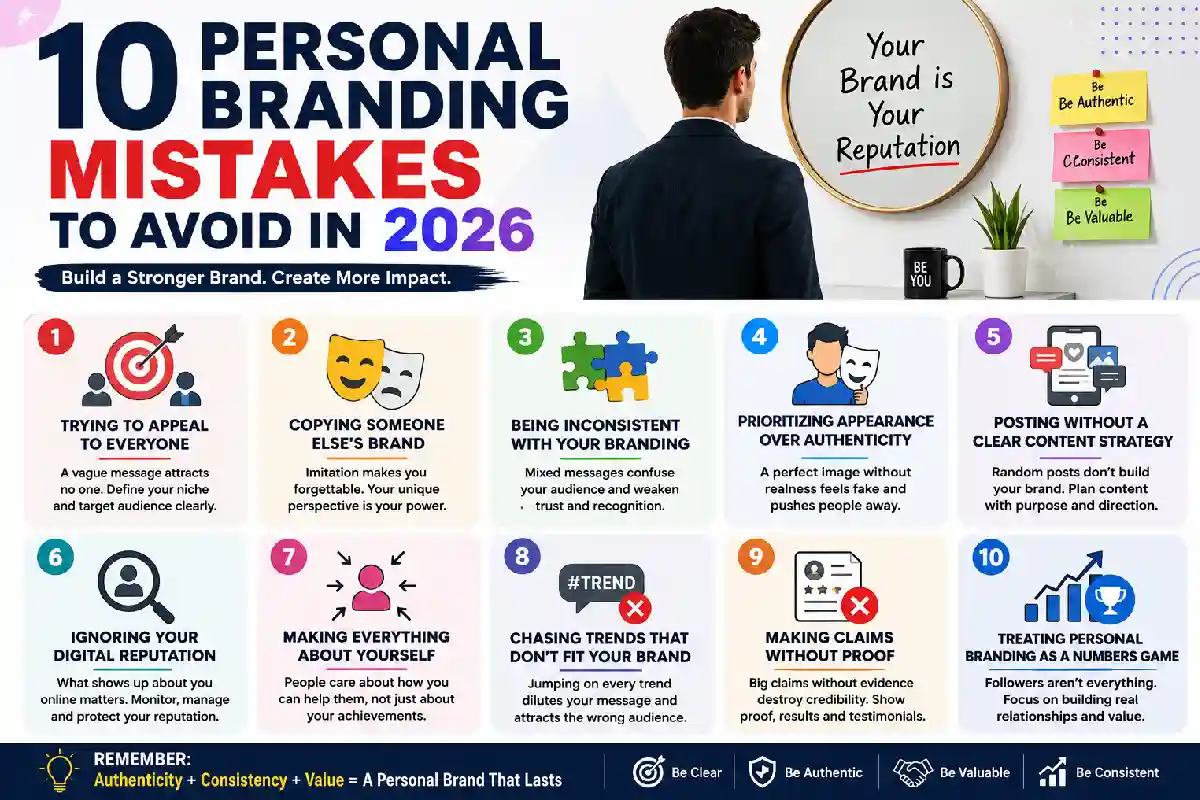
10 Personal Branding Mistakes to Avoid in 2026
Last Updated: September 21, 2026
In 2026, your brand will represent more than any other time in the past. Whether you are a start-up, self-employed, executive, creator, consultant, looking for a job your online identity can determine how others perceive your capabilities, reputation and status.
But creating a strong personal brand is somewhat more than just creating more and more writings or creating good looking social media pages. The key elements of a personal brand which is convincing enough are coming through messages and consistency, real values and creditability and what you know about your audience.
There are many advantages to be gained in the workplace and easily the most important is that your good reputation can be strengthened and not but ruined in a matter of moments due to the many mistakes.
Whether it is inconsistent messaging or copying the competition, here are 10 personal branding mistakes you can make in 2026 and ways to correct them.
What is personal branding in 2026?
A personal brand is your conscious effort to tell others who you are and what you stand for – what you know how to do; who you are as a person; what is important to you; and what separate you from your competitors.
Your personal brand exists across multiple touchpoints, including:
- YouTube
- X
- Personal Website
- Podcasts
- News articles
- Communities of practice.
- Communities of professionalism.
- Speaking engagements.
- Search engine results
- Platforms for reporting portfolios
When using a portfolio platform for reporting purposes, the key question is whether that platform is suitable for your reporting needs
10 Personal Branding Mistakes to Avoid in 2026
1. Trying to Appeal to Everyone
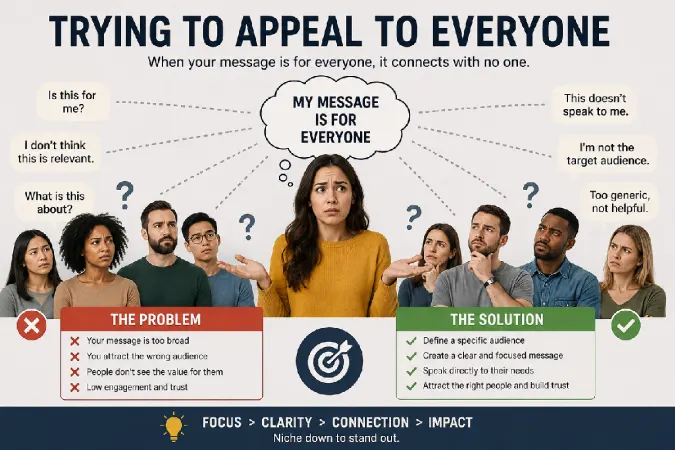
One of the biggest branding mistakes is creating content for everyone.
A broad statement such as:
I‘m a business growth consultant.
doesn’t tell potential customers much.
Grow how?
For whom?
Using what expertise?
Compare it with:
I help B2B SaaS companies develop SEO strategies for attracting the right qualified organic leads.
The 2 nd sentence immediately carves out a niche, target audience, and value equation.
Why This Is a Problem
When your positioning is too broad:
- your content becomes generic
- your audience becomes difficult to define
- your expertise becomes harder to recognize
- your marketing becomes less targeted
- differentiation becomes difficult
How to Fix It
Define your personal brand around the intersection of:
Expertise+ Audience+ Problem+ Perspective.
You don‘t have to stay in a narrow niche forever. However, if you have a defined place to start from it will be much easier for people to want to follow you or hire you.
2. Copying Someone Else‘s Personal Brand
The other most common personal brand fail is copying the personality, content style, visual identity and way of communicating of a different creator.
You might admire a successful entrepreneur’s:
- LinkedIn posts
- speaking style
- photography
- storytelling format
- newsletter
- video style
- color palette
- personal website
Learning from successful people is useful.
Copying them is not.
Why It Doesn’t Work
People can usually recognize when a personal brand feels manufactured.
If your content sounds like everyone else’s content, you become interchangeable.
A strong personal brand should make your audience think:
“This sounds like you.”
rather than:
“I’ve seen this post 50 times already.”
How to Fix It
Study competitors and creators for patterns, not personalities.
Ask:
- What topics do I have unique experience with?
- What opinions have I developed through experience?
- What mistakes have I made?
- What lessons can I explain better?
- What perspective do I bring that others don’t?
Your experience is one of your strongest branding assets.
3. Being Inconsistent With Your Branding
Inconsistent branding is one of the easiest ways to confuse your audience.
Imagine someone discovers your LinkedIn profile and sees you positioned as a technology consultant.
They then visit your website and find you describing yourself as a marketing coach.
Your Instagram focuses on lifestyle content.
Your portfolio emphasizes graphic design.
Common Signs of Inconsistent Branding
- Different professional titles across platforms
- Inconsistent profile photos
- Conflicting descriptions
- Completely different topics on each channel
- Changing visual identity constantly
- Irregular posting
- Unclear positioning
How to Fix It
Create a basic personal brand guide containing:
| Brand Element | What to Define |
| Positioning | What you want to be known for |
| Audience | Who you want to attract |
| Expertise | Your core knowledge areas |
| Voice | How you communicate |
| Visual identity | Colors, fonts, photography style |
| Content pillars | 3–5 recurring subjects |
| Bio | Consistent professional description |
| Proof | Results, experience, credentials |
Your platforms don’t need to look identical.
They should simply communicate the same professional identity.
4. Prioritizing Appearance Over Authenticity
Professional photography and polished graphics can improve your presentation.
But aesthetics cannot replace authenticity.
One of the biggest personal branding mistakes in 2026 is creating a brand that looks perfect but feels artificial.
People increasingly want to understand the person behind the expertise.
That means sharing:
- lessons learned
- genuine experiences
- thoughtful opinions
- challenges
- professional mistakes
- behind-the-scenes insights
- personal perspectives relevant to your expertise
Authenticity Does Not Mean Sharing Everything
Being authentic does not require revealing your private life.
You can maintain boundaries while still communicating honestly.
For example, instead of posting:
“Everything is amazing! Another incredible day!”
you could share:
“Our launch didn’t perform as expected. Here’s what we changed after analyzing the results.”
The second approach creates credibility because it demonstrates reflection and experience.
5. Posting Without a Clear Content Strategy
Posting every day does not automatically build a personal brand.
You can publish hundreds of posts and still remain forgettable.
Why?
Because volume without direction creates noise.
Build Around Content Pillars
Choose approximately three to five core topics.
For example, a business consultant might use:
- Leadership
- Entrepreneurship
- Business strategy
- Productivity
- Founder lessons
Each content pillar should reinforce the broader positioning.
Use Different Content Purposes
Your content can serve different goals:
| Content Type | Purpose |
| Educational | Demonstrate expertise |
| Opinion | Establish perspective |
| Storytelling | Build connection |
| Case study | Demonstrate results |
| Behind the scenes | Increase authenticity |
| Industry analysis | Build authority |
| Personal lessons | Show experience |
The goal is not simply to publish.
The goal is to make each piece contribute to your reputation.
6. Ignoring Your Digital Reputation
Your personal brand is not limited to the content you intentionally publish.
Search results, old profiles, comments, interviews, portfolio pages, and third-party mentions can also shape how people perceive you.
One of the biggest personal brand red flags is having a highly polished social profile while your broader online presence tells a completely different story.
Conduct a Personal Brand Audit
Search your name and review:
- Google results
- social media profiles
- old websites
- public portfolios
- interviews
- articles
- professional directories
- outdated bios
Ask:
“If a potential client searched my name today, what would they believe I do?”
If the answer isn’t clear, your digital presence needs work.
7. Making Everything About Yourself
Personal branding may seem self-centered; however, a good personal branding is focused on your audience.
The people following you to may not be interested in every aspect of your career.
Here‘s what they only want to know: how this will help them.
Weak Approach
“I have 15 years of experience in marketing.”
Stronger Approach
“After 15 years in marketing, I’ve learned three ways businesses waste their content budgets—and how to avoid them.”
The second statement converts experience into value.
Use the Experience-to-Value Formula
My experience → My lesson → Your benefit
For example:
My experience:
I managed multiple product launches.
My lesson:
Most launches fail because teams focus on promotion before validating demand.
Your benefit:
Validate your audience before investing heavily in launch campaigns.
That’s how personal expertise becomes useful content.
8. Chasing Trends That Don’t Fit Your Brand
Trends can generate attention.
But attention is not always authority.
One of the most often made mistake with branding in 2026 is jumping on any story going around that has gone viral even though it may have absolutely nothing to do with your business.
A persona with such keywords, such as a computer security consultant suddenly talking about irrelevant celebrity news, might receive views but not the right audience.
Ask Three Questions Before Following a Trend
- Does this relate to my expertise?
- Will my target audience care?
- Does participating strengthen my positioning?
If the answer is no to all three, skipping the trend may be the smarter branding decision.
Use Trends Strategically
Instead of copying a trend, connect it to your expertise.
For example:
Trend: AI adoption
Generic post:
“AI is changing everything!”
Expert post:
“Five ways small businesses can use AI without increasing operational complexity.”
The second approach builds authority.
9. Making Claims Without Proof
Credibility is one of the most valuable assets in personal branding.
Unfortunately, many professionals make impressive claims without providing evidence.
Examples include:
- “I’m a world-class strategist.”
- “I help companies achieve massive growth.”
- “I’m one of the top experts in my industry.”
- “I’ve helped thousands of businesses.”
These statements may be true, but unsupported claims are weaker than demonstrated results.
Replace Claims With Evidence
Instead of saying:
“I’m an expert in SEO.”
Show:
- case studies
- original research
- client results
- published work
- certifications
- speaking experience
- frameworks
- industry analysis
- useful educational content
Remember
Authority is demonstrated, not declared.
Your audience should gradually reach the conclusion that you are credible because your work consistently proves it.
10. Treating Personal Branding as a Follower-Count Competition
Follower count is one of the most visible personal branding metrics.
It is also one of the easiest metrics to misunderstand.
A professional with 5,000 highly relevant followers may generate significantly more business than someone with 100,000 followers who have little interest in their services.
Better Personal Branding Metrics
Instead of focusing exclusively on followers, track:
| Metric | What It Indicates |
| Profile views | Discoverability |
| Relevant followers | Audience quality |
| Engagement quality | Content relevance |
| Saves | Practical value |
| Shares | Content usefulness |
| Website visits | Intent |
| Email subscribers | Owned audience |
| Qualified inquiries | Business impact |
| Speaking invitations | Authority |
| Collaboration requests | Professional influence |
| Client conversions | Revenue impact |
The goal is not to become famous.
The goal is to become valuable and recognizable to the right people.
Authenticity and Personal Brand: Finding the Right Balance
Authenticity is essential, but it is frequently misunderstood.
There is a difference between:
authenticity and oversharing.
You can be authentic while maintaining professional boundaries.
A useful framework is:
Share Your
- experiences
- lessons
- professional opinions
- mistakes
- insights
- values
- expertise
Protect Your
- private relationships
- confidential client information
- sensitive business information
- personal security
- information that could harm others
Your personal brand should reveal enough of your personality to create connection without requiring you to sacrifice privacy.
Final Thoughts
In 2026, it is not about trying to be a superstar through the Internet.
It‘s shaping a recognizable, credible and trustworthy professional brand that others can remember and associate with similar types of value.
Steering clear of what is arguably the most damaging of personal branding mistakes can improve your reputation for the long run…