

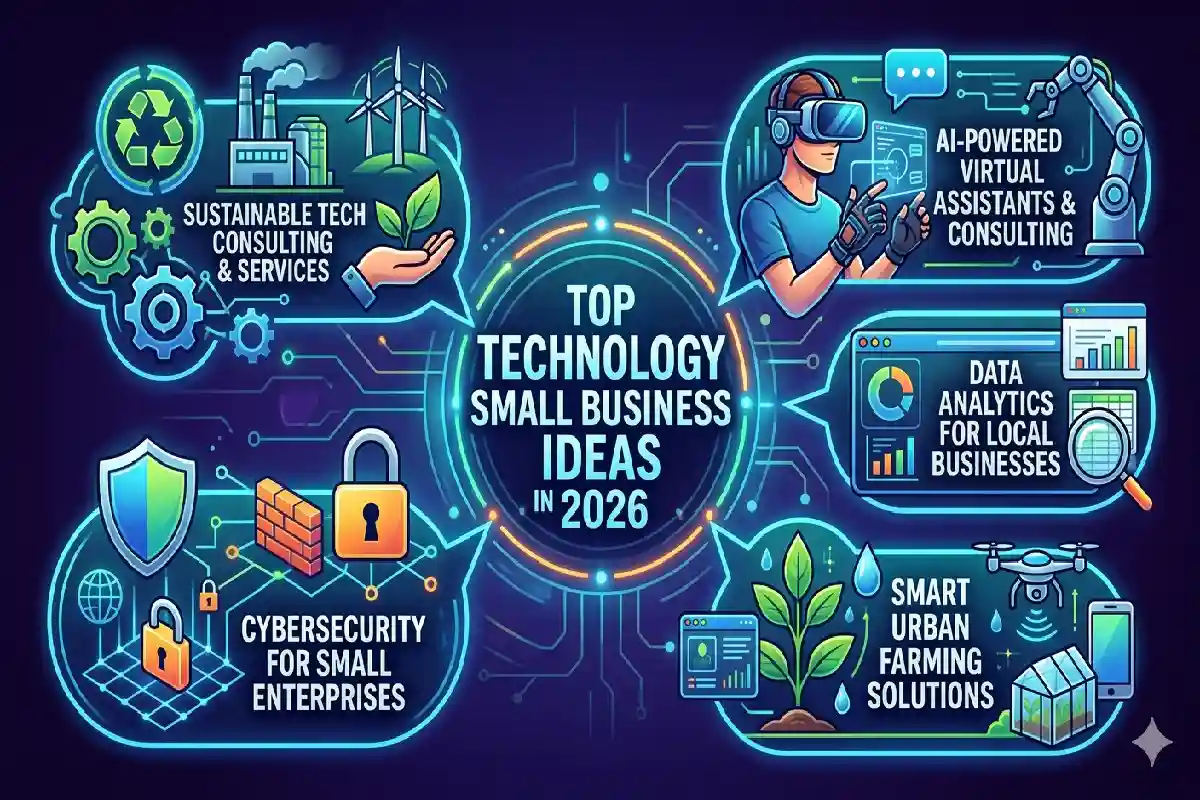
Top Technology Small Business Ideas in 2026
Last Updated: June 23, 2026
What tech business ideas are some of the best small business opportunities 2026 offers? These ideas can get lean, focus on solving concrete business problems and scale quickly with the right offer. Here you will find a little intro to the best tech startup ideas, a comparison table, setup directions, troubleshooting tips and an SEO optimized structure ready to publish.
Why Technology Business Ideas are relevant in 2026
Technology has left the large companies behind. Now small businesses are working with AI, automation, software tools, cloud applications and digital systems daily, allowing an entrepreneur to develop a service for those existing needs. The top ideas in 2026 are not technology-centric “techy” ideas; they are straightforward for customers to understand.
Search interest is also strongly commercial. The guy searching for tech business ideas generally wants a list of possible businesses to start, check out, and verify before he commits his resources time and money. So your article should enable him to determine which possible business works best for his pocketbook, skills, and desires.
Best Technology Small Business Ideas for 2026
1. AI Consulting for Small Businesses

AI consulting sits clearly at the top of the list of most straightforward high-value tech services to launch in 2026. Small firms are seeking guidance in automation, content processes, customer service, prospecting, and employee productivity. You can launch with basic packages such as AI audits, implementation, workflow design, and training.
2. Micro-SaaS product
The micro-SaaS is a single product solution, very narrow in scope. This is a very appealing concept because it can start with minimal overhead and scale via subscription revenue. Typical use-cases are things like appointment reminders, automated invoicing, reputation management, niche reporting, etc.
3. Web and Software Development Services
How much of this does your business still need? Websites, custom tools, dashboards, landing pages, internal software. If you or your team have the ability to deliver solutions to clients quickly, this business will thrive. And it opens the door for you to then transition into productized services down the line.
4. Cybersecurity support for Small Firms
Cybersecurity now needs to be pervasive at the small business level. The service offering can range from establishing passwords, preparing training on phishing email awareness, installing security on laptops and PCs, designing backup strategies and simple compliance support. The offering works because there are many small companies that recognize they need protection but are unsure how.
5. IT support and Managed Tech Services
Small companies usually like to have somebody to work with them any time they need ongoing support with devices, email system, cloud subscriptions, troubleshooting and software onboarding. A managed support framework makes it easy to establish a regular monthly income stream. This is particularly handy for local businesses needing cheap and dependable tech support.
6. Digital Marketing Automation Services
This business is about automation, lead nurturing, email follow-up, customer segmentation, and reporting. It is right at the intersection of technology+growth. If you know how the workflows work, you should be able to build this as a service and get signed-up repeat customers.
7. Cloud setup and Migration Support
Moving from manual systems to cloud-based tools. Many small firms want to start using tools like Dropbox to replace manual systems. You can help with choosing the right software, migrating existing files, sharing access and setting up collaboration systems to run the business more effectively. This would be ideal for a growing business.
8. AI content operations service
This concept is centred around building content workflows around AI applications. Use cases can be blog ideation, repurposing, social content creation, and editorial automation. It is designed to work for companies, creators, agencies, and consultants that want to consistently produce content.
9. No-Code App Development
There’s no coding required to develop functional apps using no-code tools. Building client portals, booking calendars, lead tracking, internal dashboards, and automating business processes are all feasible. This is a pragmatic starting point for founders eager to provide digital services quickly.
10. Niche Tech Training and Workshops
If you’re familiar with a tool or process, you can also train businesses or teams on how to use it. Examples of this are an AI product for increased productivity, automation for sales teams, software training services for small business owners. This is a good strong model for initial engagements as it is an authority builder and then can lead to consulting or product sales.
Compare: Top Ideas
| Idea | Startup cost | Skill level | Time to first revenue | Scalability | Best for |
| AI consulting | Low | Medium | Fast | High | Beginners with business sense |
| Micro-SaaS | Medium | High | Slow to medium | Very high | Builders and product thinkers |
| Web/software development | Low to medium | High | Fast | High | Technical founders |
| Cybersecurity services | Low | Medium to high | Medium | High | Detail-oriented professionals |
| IT support services | Low | Medium | Fast | Medium | Local service providers |
| Marketing automation | Low | Medium | Fast | High | Marketers and consultants |
| Cloud migration support | Low to medium | Medium | Medium | Medium | Ops and systems people |
| AI content operations | Low | Low to medium | Fast | Medium | Content creators |
| No-code app development | Low to medium | Medium | Fast | High | Problem solvers |
| Tech training workshops | Very low | Low to medium | Fast | Medium | Educators and trainers |
What is the most suitable Business Idea for beginners
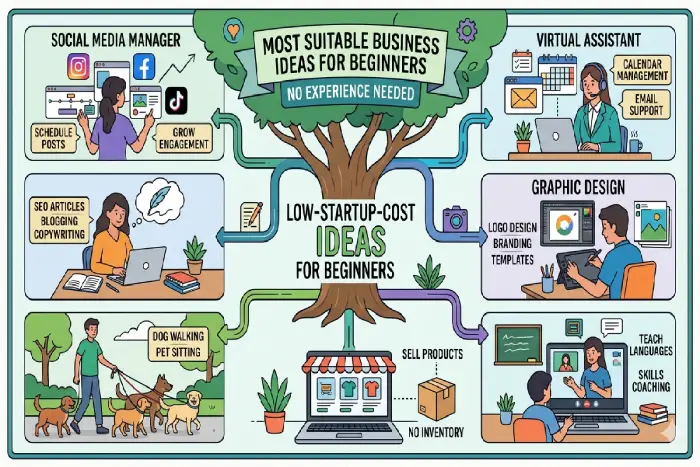
If your target reader is a beginner, I would recommend a service-based business. They are often easier to get going with because they generate revenue without requiring an entire product being built first. AI consulting, marketing automation, IT support, and technical education are particularly good as they can be marketed as obvious, no-brainer packages.
Micro-SaaS and no-code products are also appealing, but require more patience and testing. They tend to be most successful when the founder can pinpoint one particular pain point and test demand before building out a large feature set.
How to validate your idea
No tech business should be created without first asking the entrepreneur three questions: who will use it, what problem will it solve, and why would users pay today? This particular query circuit is where most ideas get established or discarded.
A simple validation process looks like this:
- Pick one niche.
- Identify one urgent problem.
- Create one clear offer.
- Reach out to 20 to 50 potential buyers.
- Test demand before investing heavily.
For instance, instead of writing “I do tech services,” try to formulate the offer as: “I help local service businesses to automate the lead follow up using AI and no-code tools.” It sells and is easier to understand.
Fixing common errors
Most people tend to think too big in tech business ideas. This makes the value proposition less easy to communicate and to sell. A focused niche tends to do better than a general “technology services” business.
Another one is the build before selling mistake. Founders are very often not validating the demand early enough by getting too focused on branding, websites or new software features. Use a service, a pre-sale, or a very simple landing page whenever you can.
Pricing is another area of weakness. When the offer is not clearly defined, the pricing isn‘t clear either. Clear deliverables, timelines, and results help customers buy.
FAQ
What is the top technology business idea in the year 2026?
One of the best options for AI consulting is this because of high demand, low startup cost, and companies eager to know how to apply AI in real life.
Is it possible for a beginner to start a tech business without coding?
Yes. Plenty of ideas like AI consulting, tech training, automation, and IT support are no-coder intensive.
What technology company is simplest to begin?
Tech training, AI workflow setup, and IT support are among the easiest in that they can start as a service business with little or no set-up.
What about Is Micro-SaaS worth starting in the year 2026?
Yes, but only if this idea addresses a confined problem with known demand. This is for founders who are ready to test things out, do a few iterations and wait for recurring revenue.
How to fund a technology business?
It depends on the model. Service companies may begin with little investment, while it generally takes more development time and money for software products.
Conclusion
Technology business ideas for 2026 best meet their market when they address a specific business pain, can be started with minimal expense and scale to recurring revenue. The most successful opportunities were AI consulting, micro-SaaS, automation services, IT assistance, and specialised tech education since they are ready for market, feasible and scalable.