

Startup Hiring Plan: Decide Who to Hire and When
Last Updated: September 25, 2026
Hiring at the right time allows a startup to grow its capacity efficiently. The key question is who do we first hire, when do we hire, and what should we expect the hire to accomplish?
Cash limited, under resourced, changing priorities. startups with Cash strapped, small team and changing priorities hasty hires could be an early trap, too long a delay could set the founding team into despair. and the momentum of growth could be lost.
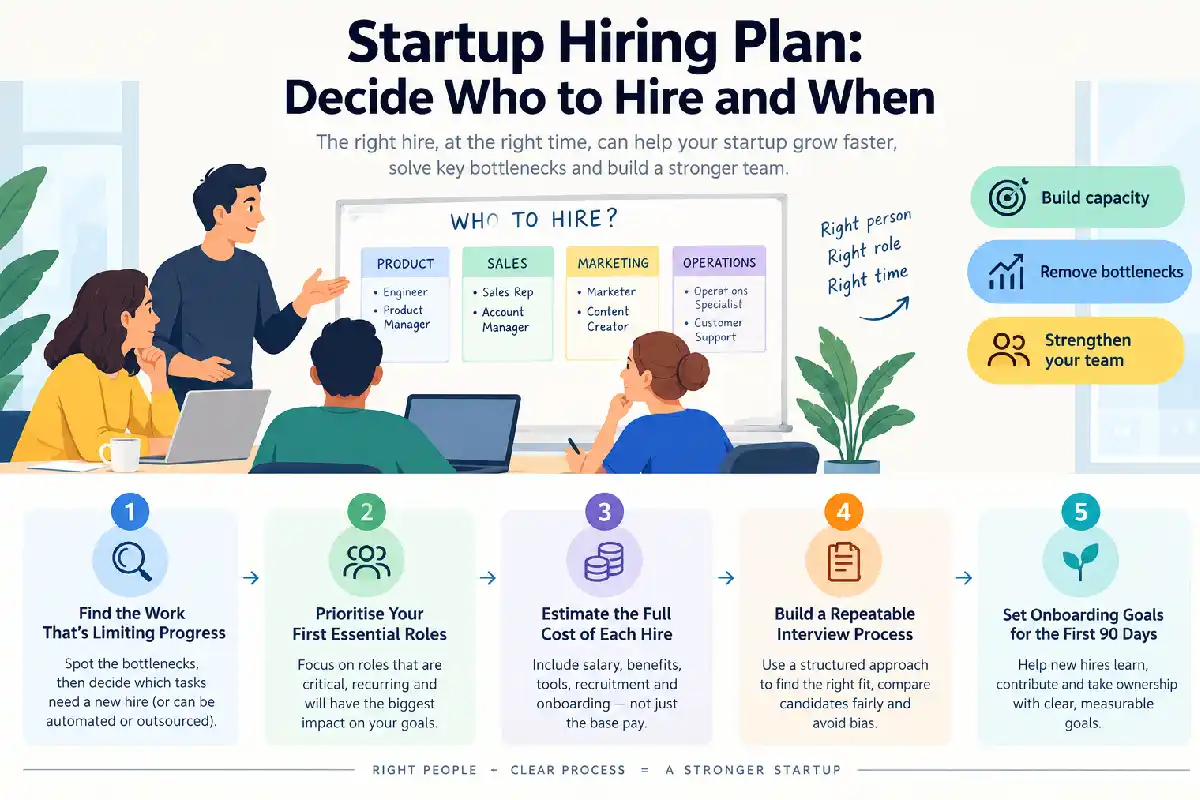
A realistic startup hiring plan ties every fresh position to a relevant business requirement. Rather than hiring as the company expands, founders need to first find out what activity is responsible for the slowdown, recognize the corresponding skill set that is absent, put a price to the whole hiring procedure, and create a regular hiring and introduction process.
Find the Work That Is Limiting Progress
The initial question is not “Who should we hire?” but rather “What work is holding the company back?”.
A lot of founders play multiple roles. They can be involved in sales, customer support, product development, administration, marketing, recruiting, right from beginning.
In the further stages of a company that became more time consuming.
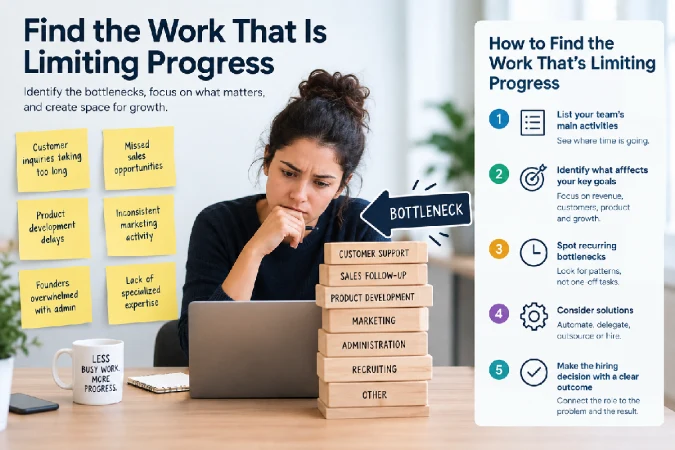
Look for recurring bottlenecks such as:
- Customer inquiries are taking too long to answer.
- Sales opportunities are being missed because nobody owns follow-up.
- Product development is delayed by limited technical capacity.
- Marketing activities are inconsistent.
- Administrative work is taking founders away from strategic priorities.
- Existing employees regularly work beyond their sustainable capacity.
- Specialized tasks require expertise the team does not currently have.
One approach to getting a grip on the situation can be listing the projects your team is involved in, and the relative amount of time being spent on each. Then figure out the projects that may impact the companies revenue, customers, products or other critical success factors.
Not all overburdened tasks need a more efficient full time employee. Some projects can be eliminated, automated, delegated to internal department or can be outsourced.
The role and the expected result in the business strengthen the hiring decisionif the problem is connected to them clearly.
Prioritise Your First Essential Roles
Once the main bottlenecks are identified, rank potential hires according to business necessity.
A first hire might be an engineer, salesperson, customer-support specialist, marketer, operations employee or another role depending on the startup’s business model.
Consider four questions for every potential position:
- Is the work essential?
If the work directly affects the startup’s ability to deliver its product or serve customers, it may deserve higher priority.
- Is the work recurring?
A permanent role makes more sense when the company has a continuing need rather than a short-term project.
- Can someone on the existing team realistically handle it?
If the work can be absorbed without affecting critical priorities, hiring may not be urgent.
- What happens if we do not hire?
Provides a means of differentiating between a real need to hire and something we would like to have.
If, for example, a founder was devoting 20 hours a week to customer support, that time might be better spent on sales, partnerships or product strategy. If that is the case, then hiring a customer-support representative might be profitable, even if support is not generating revenue on its own.
A simple priority system can help:
| Priority | Hiring situation |
| Immediate | Work is blocking revenue, customers or critical product development |
| Soon | Existing team is consistently overloaded |
| Later | Role would improve efficiency but is not currently essential |
| Optional | Work can be outsourced, automated or handled internally |
The goal is not to build a large team quickly. It is to add capacity when the business has a clear reason for it.
Estimate the Full Cost of Each Hire
Salary is only one part of the cost of hiring.
Before approving a position, calculate the expected total employment cost. Depending on location and employment arrangement, this may include:
- Base salary
- Employer taxes and statutory contributions
- Bonuses or commissions
- Health or other benefits
- Equipment
- Software subscriptions
- Recruitment costs
- Training
- Office or workspace costs
- Payroll and administrative expenses
- Time spent by existing employees during recruitment and onboarding
For example, a startup considering a full-time sales employee should not evaluate the position only by comparing salary with expected sales. It should also consider commissions, tools, travel, training and the time required before the employee becomes productive.
Founders should also consider cash runway. A recurring employee expense can affect the company’s financial flexibility for months or years.
Before hiring, document:
Expected annual employment cost + recruitment cost + onboarding cost = estimated first-year hiring cost
Then compare that cost with the business problem the role is expected to solve.
The calculation does not need to predict an exact financial return. Its purpose is to make the financial commitment visible before the company makes it.
Build a Repeatable Interview and Selection Process
As a startup begins hiring repeatedly, an informal hiring process can create inconsistency.
A simple repeatable process might include:
Step 1: Define the role
Write down the responsibilities, required skills, preferred experience and expected outcomes.
Step 2: Define success
Describe what successful performance should look like after the first few months.
Step 3: Screen applications
Evaluate candidates against the requirements rather than relying only on resumes or educational background.
Step 4: Conduct structured interviews
Ask candidates similar core questions so their responses can be compared consistently.
Step 5: Use practical assessments when appropriate
For relevant roles, a work sample can demonstrate how a candidate approaches an actual problem.
Step 6: Check references where appropriate
Reference checks can provide additional information about previous work performance and responsibilities.
Step 7: Make the decision against predefined criteria
Avoid changing the requirements simply because one candidate has an impressive but unrelated characteristic.
For each candidate, create a simple evaluation framework:
| Criteria | What to evaluate |
| Technical or functional skills | Can they perform the core work? |
| Relevant experience | Have they handled similar responsibilities? |
| Problem solving | How do they approach unfamiliar situations? |
| Communication | Can they communicate clearly with the team and customers? |
| Role expectations | Do their expectations match the position? |
| Evidence of performance | Can they demonstrate relevant results or work? |
A defined process will help to standardize the hiring and will reduce the tendency to use subjective information to make hiring decisions.
Be cautious also with regards to creating an overly long process when hiring candidates. Even solid candidates are discouraged by the delays and the numerous interview iterations.
Set Onboarding Goals for the First 90 Days
The hiring process doesn‘t stop once an offer is accepted.
The first 90 days should give the new employee a clear path from learning to independent contribution.
Days 1–30: Learn
The employee should understand:
- The company’s product or service
- Customers and target market
- Team structure
- Key processes
- Tools and systems
- Role expectations
- Current priorities
The goal is not to expect maximum productivity immediately. It is to give the employee enough context to understand how their work fits into the company.
Days 31–60: Contribute
During the second month, the employee should begin owning defined responsibilities.
Examples include:
- Managing a group of customer accounts
- Completing product tasks independently
- Running a marketing activity
- Building a sales pipeline
- Improving an operational process
Managers should provide regular feedback and remove obstacles.
Days 61–90: Own
By the third month, the employee should have clear ownership of meaningful outcomes.
Set two or three measurable goals rather than creating a long list of tasks.
For example:
Sales hire: Build a qualified pipeline and establish a repeatable outreach process.
Marketing hire: Develop and execute a content or acquisition plan tied to measurable business objectives.
Engineer: Deliver agreed product improvements while following the team’s development and review processes.
Operations hire: Take ownership of defined recurring processes and identify opportunities to improve them.
The exact goals should depend on the role and the startup’s stage.
Create a Hiring Roadmap
A hiring plan works best when it is connected to company milestones rather than a fixed desire to increase headcount.
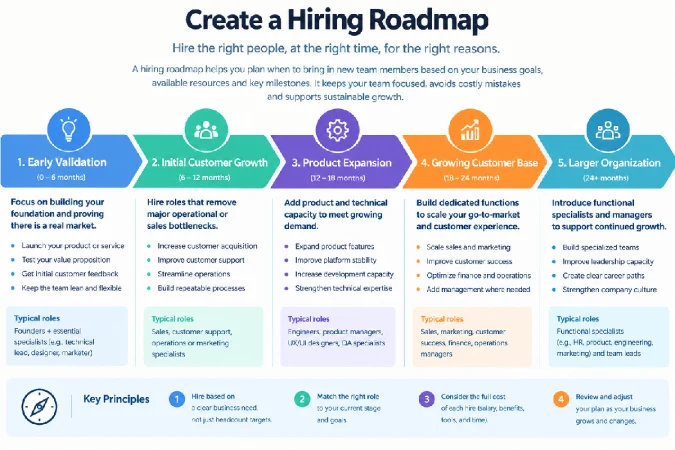
For example:
| Stage | Hiring focus |
| Early validation | Founders + essential specialists |
| Initial customer growth | Roles that remove major operational or sales bottlenecks |
| Product expansion | Additional product and technical capacity |
| Growing customer base | Customer success, sales and operations |
| Larger organization | Functional specialists and managers |
This does not mean every startup should follow the same sequence. A software company may need engineers early, while a service business may initially require sales or delivery specialists.
The important principle is to hire in response to a demonstrated business need.
Review the Hiring Plan Regularly
A startup’s priorities can change quickly. Review the hiring plan whenever there is a major change in revenue, customer demand, product strategy, funding or workload.
Ask:
- What work is currently slowing the team down?
- Which responsibilities are becoming too large for one person?
- Which skills are missing?
- Can the problem be solved without a permanent hire?
- Can the company afford the full cost?
- What measurable result should the hire achieve?
- Does the current team have enough capacity to onboard someone?
If the answers change, the hiring plan should change too.
Conclusion
A plan of hiring for start-up should be a function of workload, business targets and quantifiable needs rather than headcount targets.
Begin by pinpointing the blocker you‘re avoiding. Give high priority to roles that work on critical bottlenecks, measure the cost of each new hire, and set up a scaled reliable hiring process. When you pick your candidate, provide concrete objectives for the first 30, 60 and 90 days.
The “right” hiring choice is not just the earliest possible hire. The “right” hire is the hire that can provide the startup with the capacity it needs at the appropriate time.
Founders hire as a crisis response a necessity to cope with a heavy workload. Instead they should manage a hiring process as a strategic activity so that they create a lean, simple and more sustainable team.