

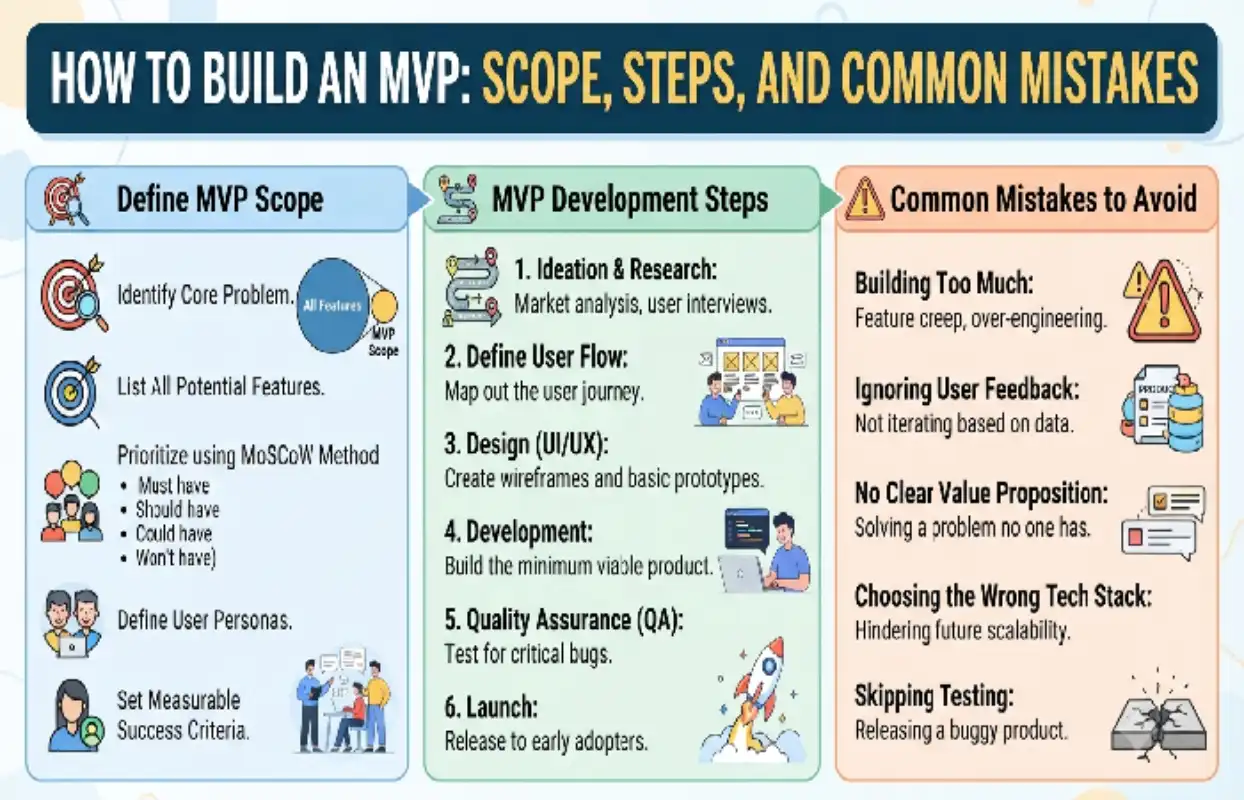
How to Build an MVP: Scope, Steps and Common Mistakes
Last Updated: September 30, 2026
A minimum viable product (MVP) is the essence of the product, stripped down and concentrated, in order to evaluate critical business and customer assumptions with actual data. It is not just a bite-sized prototype of the entire product. An MVP is a strategic plan, containing the minimum set of features necessary to address a customer’s problem and produce validated learning for subsequent product development.
An MVP is a good way for startups to cut out costlier features and get to customer feedback faster. But the MVP can fail trying to cover every feature, building before talking to potential customers and measuring the wrong metrics can trip up even experienced founders.
How to Create an MVP: The Complete Guide Explains how to scope an MVP and then what to do after you make the first release.
Choose One Customer Problem for the MVP
The first step is to identify one specific customer problem that the MVP will address. Avoid starting with a list of features or a broad product vision.
A useful problem statement should explain:
- Who experiences the problem?
- What are they trying to accomplish?
- What makes the current process difficult?
- How frequently does the problem occur?
- What alternatives do customers currently use?
Set narrower goals. For instance, instead of “We want to create a better project management tool,” set a more focused problem like “Marketing teams of 1-3 people have a hard time keeping on top of deadlines for clients and approvals received via email and spreadsheets.”

A narrow problem simplifies managing your MVP scope. It helps you identify who you’ll be testing with early on.
Customer interviews, surveys, competitor research, support calls and observations all help to validate the problem. Seek proof that customers are already taking time, money or effort attempting to address it.
So the MVP should then try to give a first real improvement to that specific use case rather than trying to address all possible users.
Define Essential Features and Success Criteria
Once you’ve identified the issue, delineate core functionality from optional features.
A simple feature-prioritisation approach is to divide potential features into three groups:
Must: We cannot solve the heart of the problem without this.
Usefulness: The feature adds value but is not essential to the test.
Later: Perhaps in due course this is a good feature, but it adds no obligation to prove the assumption that has been examined.
E.g., A booking service’s minimum viable product might include customer registration, choosing availability, confirming bookings, and simple notifications. Sophisticated reporting, loyalty rewards, intricate integrations, and in-depth customisation would be handled at a later stage.
Create a simple user journey before finalising the feature list:
Problem → Entry point → Core action → Result → Follow-up
Every feature should support this journey. If a feature does not contribute directly to the main customer outcome or the learning objective, consider removing it from the first version.
You should also define success criteria before development begins. These should be measurable rather than vague.
Possible MVP metrics include:
- Number of users completing the core action
- Activation rate
- Repeat usage
- Conversion rate
- Time required to complete a task
- Customer retention
- Number of qualified enquiries
- Willingness to pay
- Customer-reported satisfaction
The appropriate metric depends on what you are trying to validate. An MVP designed to test demand may focus on sign-ups or paid conversions, while one testing usability may focus on successful task completion.
Compare Manual, No-Code and Custom Build Options
Not every MVP needs traditional software development.
Founders can generally consider three approaches: manual delivery, no-code or low-code tools, and custom development.
A manual MVP uses people and existing tools to provide the service behind the scenes. For example, a startup could collect customer requests through a form and manually process each request instead of immediately building an automated platform.
This approach can be useful when you need to test whether customers actually value the outcome before investing in technology.
A no-code or low-code MVP uses existing platforms to create workflows, databases, forms, websites, dashboards, or simple applications. This can reduce development time and allow founders to modify the product quickly.
It makes more sense to build a custom-MVP in the case of: core value is based on functionality that is not possible with existing tools, or technical performance, security, integration and scalability are key to the initial validation.
The wrong question isn‘t, “What is the most elegant way to construct this?” Instead, it is, “What is the quickest reliable way to validate the most critical assumption?”
Don‘t over-invest in architecture for use cases that haven‘t been validated. Likewise, don‘t make suboptimal technology choices for the sake of saving cost. Think about data security, stability, integrations, user experience, maintainability, and the probability that the MVP will be later adapted.
Build and Test the Core User Journey
Once the approach is settled, construct only what is needed to facilitate the fundamental journey.
Begin by tracing the user‘s actions from the time he/she enters the product to the time the desired result is achieved. Eliminate screens, fields, settings and choices that are not needed.

For example:
- User discovers the product.
- User creates an account or submits basic information.
- User completes the primary action.
- Product provides the intended result.
- User receives confirmation or next-step guidance.
Test this journey internally before inviting external users. Check for broken links, confusing instructions, missing information, incorrect calculations, failed notifications, and other problems that could prevent users from reaching the intended outcome.
Then conduct usability testing with a small number of representative users. Ask them to complete realistic tasks rather than simply asking whether they “like” the product.
Observe where they hesitate, make mistakes, ask questions, or abandon the process.
Do not immediately add features whenever someone requests one. First determine whether the feedback reveals a genuine problem with the core experience or simply a personal preference.
Release to Early Users and Decide What Comes Next
An MVP becomes useful when real customers interact with it and provide evidence.
Start with a manageable group of early users who closely match your target customer. Explain what the product does, provide clear instructions, and make it easy for users to report problems or feedback.
Track both quantitative and qualitative evidence.
Quantitative data can show what users actually do. For example, you may discover that many people sign up but very few complete the core action.
Qualitative feedback can explain why. Users might find the workflow confusing, lack necessary information, distrust the result, or simply not consider the problem important enough to solve.
After the initial release, review the evidence against your original success criteria.
You may decide to:
Continue: Evidence supports the problem, solution, and early product experience.
Improve: The problem appears valuable, but usability, positioning, or functionality needs work.
Change direction: Customer evidence suggests a different segment, problem, or solution deserves attention.
Stop: The evidence does not justify further investment under the current assumptions.
Common MVP Mistakes to Avoid
Several mistakes repeatedly make MVP development slower and more expensive than necessary.
Building too many features: A long feature list increases cost and makes it harder to identify what actually creates value.
Confusing an MVP with a poor-quality product: An MVP can have limited functionality while still being reliable, understandable, and usable.
Building before validating the problem: Development cannot compensate for weak customer demand.
Ignoring the target customer: A product designed for “everyone” often fails to solve a specific problem well.
Measuring vanity metrics: Downloads, page views, or sign-ups may look impressive without demonstrating meaningful product value.
Ignoring feedback: Early users provide evidence about the assumptions behind the product. Their feedback should influence subsequent decisions.
Overengineering too early: In most cases the architecture and automation are more complex than needed before validating business model and product demand.
Conclusion
Creating a MVP, is just in essence a learning process, instead of just a software launching process. Identify a user problem, determine the minimum functionality needed to solve that problem, then pick your all-in approach to validate the primary journey with real users.
The mission is to turn assumption into facts A good MVP does not have to be full of features it does need to be able to mine valuable information about whether customers have the problem, whether your solution solves it and the immediate next step.