

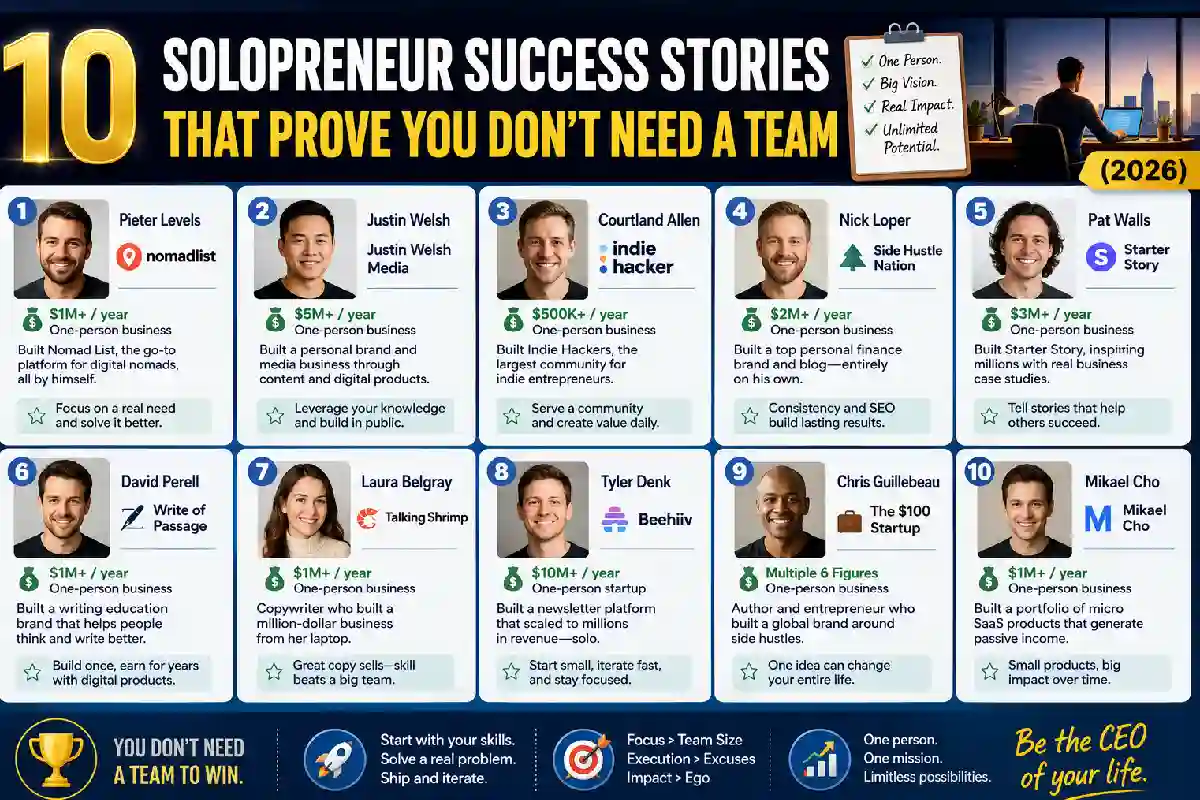
10 Solopreneur Success Stories That Prove You Don’t Need a Team (2026)
Last Updated: September 15, 2026
A solopreneur business is a single-person enterprise that leverages current infrastructure, automation, advanced technology, and scalable lean systems to earn extreme revenues and profits without having a conventional human resources department. Solo founders scale enormous profits through the substitution of the payroll, HR department, R&D department, and more by using intelligent software and artificial intelligence.
This has been the traditional startup recipe for years: get a co-founder, bring on developers, grab some funding, put a team together, and grow fast.
1. Pieter Levels Build Small Products Instead of One Giant Startup

Pieter Levels is surely one of the best modern examples of the one-man internet business.
He assembled products such as Nomad List and Remote OK, in addition to an extensive list of experiments and side projects. His personal project archive, last revised as of June 2026, contains dozens of launches some unsuccessful, others quite profitable, and a handful of which have become long-term ventures.
His approach is almost the opposite of traditional startup culture:
- Build out, then build in.
- Don‘t wait too long to go live.
- Address them as if you are talking to a user.
- Abandon projects that fail to deliver sometimes the simplest solution is best.
- Doubling down on products that work.
- Treat your costs of infrastructure and operations as other effective inputs to the process.
The real benefit of Levels is not “that he writes code.” It is that he takes action without seeking organizational endorsement.
2. AJ Carrd Turned Simplicity Into a Business
AJ, the person who developed Carrd began by giving it a test run: could he create a simple website builder alone?
Yes.
Carrd was initially a side project, launching on Twitter and Product Hunt before expanding to millions of websites and over 1 million USD ARR, as reported by AJ himself in 2021.
It was a radical focus on the product.
Those all interested in cars at that time. carrd didn‘t try to Do everything that WordPress, Webflow, Squarespace and Wix Do at the same time. It nailed a single powerful use case as
Allows you to efficiently make a good looking one page website.
As of today Carrd can still be listed as a one page fully responsive website making tool in its original documentation.
3. Marc Lou Turn a Portfolio of Small Products Into One Business

Marc Lou exemplifies a second increasingly significant case of solopreneur: multiple related products, rather than one single company with one hundred employees.
As for past performance, as of Jan 2026, Lou had completed his 2025 financial recap showing revenue of $1.032 mm across his books.
His businesses were ShipFast, CodeFast, and DataFast, with Data Fast generating a monthly recurring revenue (MRR) of $15.8K.
And instead of focusing on a single product he established several different streams of income along with each other.
- A product can have an audience.
- The audience can see the second product.
- This product can lead the consumers for another product.
- The combination of should make it less like a normal startup, and more like one person or company doing one thing, which is a product ecosystem.
4. Justin Welsh Build an Audience Before Building a Large Organization
Justin Welsh exhibits a different example.
Constructed his personal-media and digital-product enterprise about his strength instead of launching a software enterprise;
Welsh states he now runs a single-person business that teaches creators to develop marketable online skills. His newsletter has gained a subscriber base of over 150,000 and his websiteis advertising a free guide that explains how he built a $15 million solo enterprise.
His model combines:
- Content
- Newsletter
- Digital items
- Courses
- Sponsorships
- Consulting/advising
- Community
Previously, he had announced in the press that he achieved $3 Million in sales in his one-man business with a 94% margin and no advertising.
5. Daniel Vassallo One Person, Multiple Revenue Streams
Daniel Vassallo quit a purported $500,000-a-year job at Amazon and intentionally avoided the mainstream startup circuit.
Instead, he developed a portfolio of relatively small businesses and information products.
His revenue streams included:
- An AWS book
- A Twitter course
- Small Bets community
- Consulting/product work
- Freelancing
- Affiliate income
- Other small projects
In 2022, Vassallo announced that he had earned $1 million in cumulative profits achieving this as an independent long in about three years.
6. Jon Yongfook Patience Can Beat Startup Hype
Jon Yongfook‘s Bannerbear story provides an interesting corrective to easy to tell stories of overnight success.
Prior to Bannerbear, he tried 12 startups (including a “12 startups in 12 months” challenge most didn‘t make any money).
He targeted a concrete problem in the first place and he created Bannerbear, an API designed for systematically creating images or videos.
He publicly shared the story of how he scaled from $0 MRR to $10,000 MRR, including the paths and pivots he took along the way.
That‘s important, because too many solopreneurs give up too soon.
A business doesn‘t have to just blow-up right now.
Sometimes the advantage lies in sticking with the right problem long enough for the power of compounding to take effect.
7. Eric Barone Stardew Valley Shows What Extreme Focus Can Produce
It is important to note that Eric Barone otherwise famous as the ConcernedApe developed the game almost entirely independently.
He spent years working on programs, graphics, sound, writing, and design. Official bios note close to five years spent developing everything alone by eye before the 2016 release.
As of reporting found, by the beginning of February 2026, sales for Stardew Valley exceeded 50 million.
Here is the important caveat: Barone did bring in collaborators to help develop and update it later on. So this isn‘t proof that a massively long-term game franchise can always be run by a solo developer.
But it is extraordinary evidence of something else:
One person can also produce the valuable intellectual property.
8. Arvid Kahl A Tiny SaaS Can Become a Serious Asset
FeedbackPanda was developed by Arvid Kahl and Danielle Simpson without external investment or an employees.
The education SaaS earned $55k MRR, supported ~5k paying teachers, and was sold after about 2 years.
There is an important distinction, here: FeedbackPanda was a two-founder company, not really a lone one.
Which actually makes the story all the more useful!
In my opinion, it exemplifies the general principle driving today‘s solopreneurship: a venture doesn‘t need to turn into a 20-, 50- or 200-member company to attain any worth.
A small team or in other situations even a lone founder can develop an asset capable of bringing in enormous amount of recurring income.
9. Tony Dinh Small Tools Can Compound Into Serious Income
Another illustration of an indie-hacker whose name is Tony Dinh.
Rather than launching a huge startup, he launched a “series of very narrowly focused things” i.e., “products before ventures” as he called it. He launched many tools like DevUtils, BlackMagic, TypingMind etc.
These experiences have been publicly documented and a few newsletters disclose that his account history [shows a] peak of even in a month while working a herdsman.
His approach makes a lot of sense, especially in 2026 when AI has radically decreased the amount of time I have to produce software.
The real, deeper lesson isn‘t that “AI allows you to write code more quickly.”
It‘s:
A fledgling software product can be a business in itself.
A founder doesn‘t have to put together one enormous platform with dozens of labs and teams.
They can also create a set of tightly targeted offerings which attract certain types of customers.
10. The Thousands of Smaller Solopreneurs Who Never Go Viral
Maybe the biggest story of all.
The Internet showing us the spectaculars: $1M ARR, $5 million businesses, $10 million exits.
But the more interesting development in 2026 is the relative proliferation of very small businesses.
- Single user SaaS products.
- Paid newsletters.
- Specialized consulting practices.
- The digital products.
- Agencies.
- E-learning.
- E-commerce types include.
- Services enhanced by AI.
There are some founders who shared publicly that they hit $1K, $5K, $10K, or $20K+ months in revenue without creating an organized organization. One single founder with a product in 2026 shared that he grew a SaaS to $1,000 in monthly recurring revenue over 1.5 years that‘s a lot less sexy than a seven-figure exit, but it might be a lot more common of how sustainable solo companies are built.
What These Solopreneur Success Stories Have in Common
While these founders are from very different industries, the stories uncover common themes.
1. They Solve Narrow Problems
Sole businesses simply can‘t compete against mass operations with diversification.
They win when they are specific.
Instead of:
We are handling this irritating situation on behalf of this particular class of individuals.
There is simplicity in the everything.
- It‘s more easily constructed.
- Market a little more friendly.
- Another advantage is that the programlets are easier to explain.
- And more LaTeX-friendly to support.
2. They Build Assets, Not Just Jobs
There is a huge distinction between self-employment and a scalable one person business.
If you quit working and earnings stop, you may have founded a firm.
But if your business has:
- Software
- Content
- Email database
- Search traffic.
- Digital items
- Providing subscriptions
- Machine sales
- Intellectual property
Those resources can still deliver value even when you‘re not necessarily working.
3. They Use Technology as Leverage
Today a solopreneur can off load mundane tasks to software.
- Payments can be automated.
- Automate emails.
- Customer onboarding is automatable.
- Software can also be automatically deployed.
- Timetabling can be automated.
- Analytics is automatable.
AI helps with research, coding, writing, analysis, designing, customer support.
The aim is not to eradicate human labor.
It‘s about saving your precious time for those things that truly require judgment.
4. They Keep Costs Under Control
Revenue is not the same as profit.
Imagine:
$15,000/month revenue
with:
$3,000/month expenses
The less macro advantages that smaller organizations find, the more easy it might be to associate it (reap. Microsft.com).
This is one of the main attraction of digital businesses for solo entrepreneurs.
Conclusion
All these stories Pieter Levels, AJ, Marc Lou, Justin Welsh, Daniel Vassallo, Jon Yongfolk, Tony Dinh and Eric Barone is one variation of the same theme.
You aren‘t required to build a giant enterprise to make a valuable one.
A compelling one-person enterprise might be a software product.
- It may be a collection of small products.
- It can be a newsletter.
- It can be a consulting business.
- They‘re also a digital training company.
- Can become a creative endeavour becoming intellectual properties
- And yes, it can grow into a million dollar solopreneur business.
- But the key number isn‘t always 1 million.
- It can be 10,000 a month at times.
- Sometimes it is 5,000 dollars.
Going to work only to earn a salary that you will have to do something with…being able to choose his time ownership is sometimes good enough.
That‘s what the excitement around solopreneurship is all about.
You don‘t need to start a company just because you should.
You make something small, profitable, automated and your own.
And in 2026 that may be one of the most powerful ways of producing entrepreneurship.