

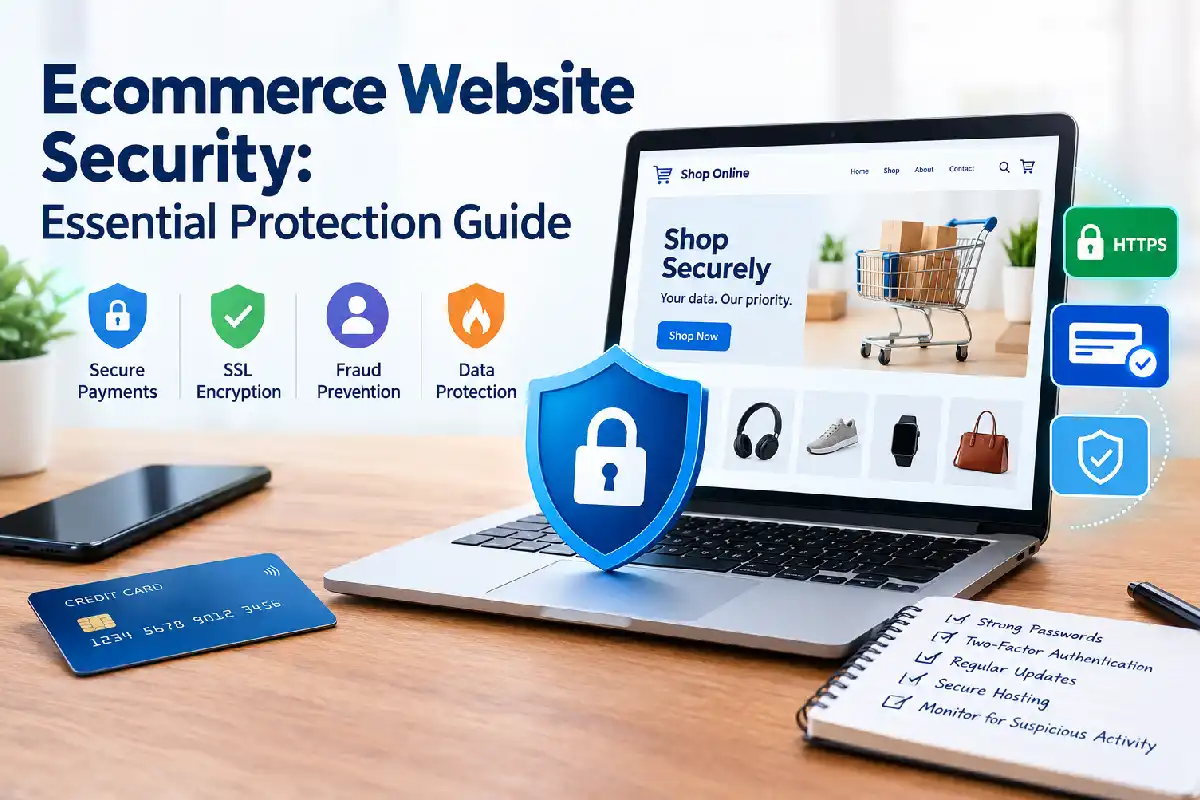
Ecommerce Website Security: Essential Protection Guide
Last Updated: September 10, 2026
Website Security. Online shop sites integrate delicate data every single working day. All kinds of customer data can be stored on online purchase sites such as customer‘s name, addresses, phone numbers, password, payment details and orders. Online shopping stores are always open targets for any hackers. Security breach can be fatal for an online shopping store. It may destroy customer‘s trust, business working and his credibility.
Ecommerce website security is thus very important in relation to any size of business. Security shouldn‘t be approached as a one off install however. It should be monitored, regularly maintained with updates, control of access, secure reimbursement practices and employee knowledge all part of the package.
Why Ecommerce Website Security Is Important
Consumers rely on the site to keep their personal and financial details secure. If there is any doubt about web security shoppers are likely to leave the session or even go elsewhere.
A security incident can result in a number of different issues. For example, the intruders may have taken information about customers, corrupted administrator accounts, injected malicious code, restarted the site, diverted visitors or halted orders and payments. An organization may also suffer financial losses, suffer disruption, bear the cost of recovery, or incur legal or regulatory liability.
Security is a critical topic for ecommerce sites because they potentially incorporate several high-value systems, such as customer databases, payment gateways, inventory management systems, content management systems, marketing applications, and third-party integrations.
The following paragraph details the protection of these systems in a layered approach. Our operating systems have a multisecurity feature each, but no individual native security control can block all forms of attack.
SSL, HTTPS and Secure Ecommerce Payments
SSL certificates and HTTPS are actually the key to e-commerce website security. HTTPS encrypts the data passed between a customer web browser and a web server in order to prevent outsiders from intercepting it.
Once HTTPS is correctly installed, customers should see a padlock or something similar in their browser. However, the most crucial benefit of using encryption is that it safeguards sensitive information (including login credentials and personal details) while being transmitted between the browser and the server.
All pages on ecommerce sites should be switched to HTTPS rather than only checkout pages or login pages. Redirects should be put in place so traffic which visits an HTTP will be automatically redirected to the HTTPS version and certificates should be maintained and renewed.
Secure Payment Processing
Online stores should try not to store sensitive payment data unnecessarily. Using established third-party payment processers and hosted or tokenised payments can limit the data stored or processed by the ecommerce business.
Payment systems need to be implemented with proper controls, fraud detection, authentication and encryption. When accepting card payments businesses should also ensure compliance with the applicable payment-security standards, for example PCI DSS.
You should never ever store sensitive payment information just to make future transactions easier. Gather and keep only the information that is truly needed.
How to Protect Ecommerce Customer Data
Customer information must be secured at every stage of its lifecycle: once gathered, once stored, and once erased.
Collect Only Necessary Information
Don‘t order information that you don‘t actually need, otherwise you‘ll have more data at risk in the event of a security breach.
Use Strong Access Controls
Not all employees require access to information on the customer or administrative tasks. Use a role-based access approach, grant access to only those areas an employee needs to perform his or her duties.
The administrator accounts would be the most sensitive as they allow the most control of the ecommerce site.
Use Strong Passwords and Multi-Factor Authentication
Need difficult to guess, different passwords for customer and staff accounts. Using MFA provides an added level of security for admin accounts than accounts with compromised passwords.
In some cases, MFA will also be enforced for a second factor of verification such as an authenticator app or security key.
Encrypt Sensitive Information
All sensitive information should be secured appropriately in transit, (if required), and if stored. Encryption can make obtained information harder to utilize.
Companies must not only have a secure backup, but also have the backup protected against unauthorized access. The backup should then be regularly tested to see if the data can be recovered.
How to Prevent Ecommerce Fraud and Account Attacks
Cybercriminals employ a variety of methods to attack ecommerce businesses and consumers. This includes phishing, credential stuffing, brute force, fak accounts, payments fraud, automated bots.
Protect Customer Accounts
Login systems should employ rate limiting, account monitoring, and implement suitable authentication controls to prevent automated attacks. Do not disclose if an email address or username exists in the system in the case of failed logins and password reset.
Use one-time secure passwords or mechanisms for resetting passwords – Do NOT use what is easy or good for humans to remember, like a link, a URL or a string of characters.
Make it easier for your customers to be strong here. They should be encouraged to use different passwords across accounts so that if one has been compromised (say on a forum, or another site), it can not be tried on your ecommerce site.
Monitor Suspicious Transactions
Fraud detection systems may sometimes recognize suspicious shopping. For instance, a user placing massive orders from unlikely locations, attempting to pay repeatedly without success, or making fast buys via newly launched accounts may be signs of fraud, among others.
It may be suitable to conduct further verification if a payment is hit by a business and payment provider as being especially high risk.
Protect Against Phishing
Both employees and customers can be targeted via phishing attacks. Possible exploits include creating dummy pages of login portals or sending message impersonating the ecommerce company‘s identity.
Urge customers to practice secure email procedures, train employees to identify suspicious emails, and make sure your corporate customer-service channels are well known. No one should ever ask for all passwords, or complete credit card details, in a standard email message.
Ecommerce Website Security Checklist
Use the following checklist as a practical starting point for securing an ecommerce website:
- Use HTTPS across the entire website.
- Keep SSL/TLS certificates valid and correctly configured.
- Use a reputable payment gateway.
- Follow applicable payment-security requirements.
- Enable multi-factor authentication for administrator accounts.
- Use strong, unique passwords.
- Apply the principle of least privilege.
- Keep ecommerce platforms, plugins, themes, and server software updated.
- Remove unused plugins, extensions, and accounts.
- Use a web application firewall where appropriate.
- Install malware and security monitoring tools.
- Protect administrative login pages.
- Use rate limiting against automated login attacks.
- Maintain regular, secure backups.
- Test backup restoration procedures.
- Encrypt sensitive data where appropriate.
- Collect only necessary customer information.
- Monitor unusual account and transaction activity.
- Establish a process for responding to security incidents.
- Train employees about phishing and security threats.
- Review third-party integrations and their permissions regularly.
- Conduct periodic vulnerability assessments and security testing.
Conclusion
Protecting your ecommerce website against security problems is very important for your customers, business and brand. A well-secured web-shop should implement HTTPS, trustworthy online payment tools, strong authentication, restriction policy, software update procedure, backup plan, and be continuously tracked.
In addition, it is essential for enterprises to understand that security is not only about the website; the access avenues that are provided to they by third-party applications, employee accounts, payment providers, hosting environment and customer database can be used as a venue by hackers.
The most effective -merging- strategy is to integrate security within each element of the ecommerce process. Continually audit your infrastructures, do as little as possible to store customer information, limit admin privileges, monitor for abnormal activity and have a response prepared in case an incident occurs.
If ecommerce businesses embed security as an all-time process instead of a one-time task, they will be able to lessen risks and safeguard customer sensitive details, thus providing a safer shopping environment to their customers.