

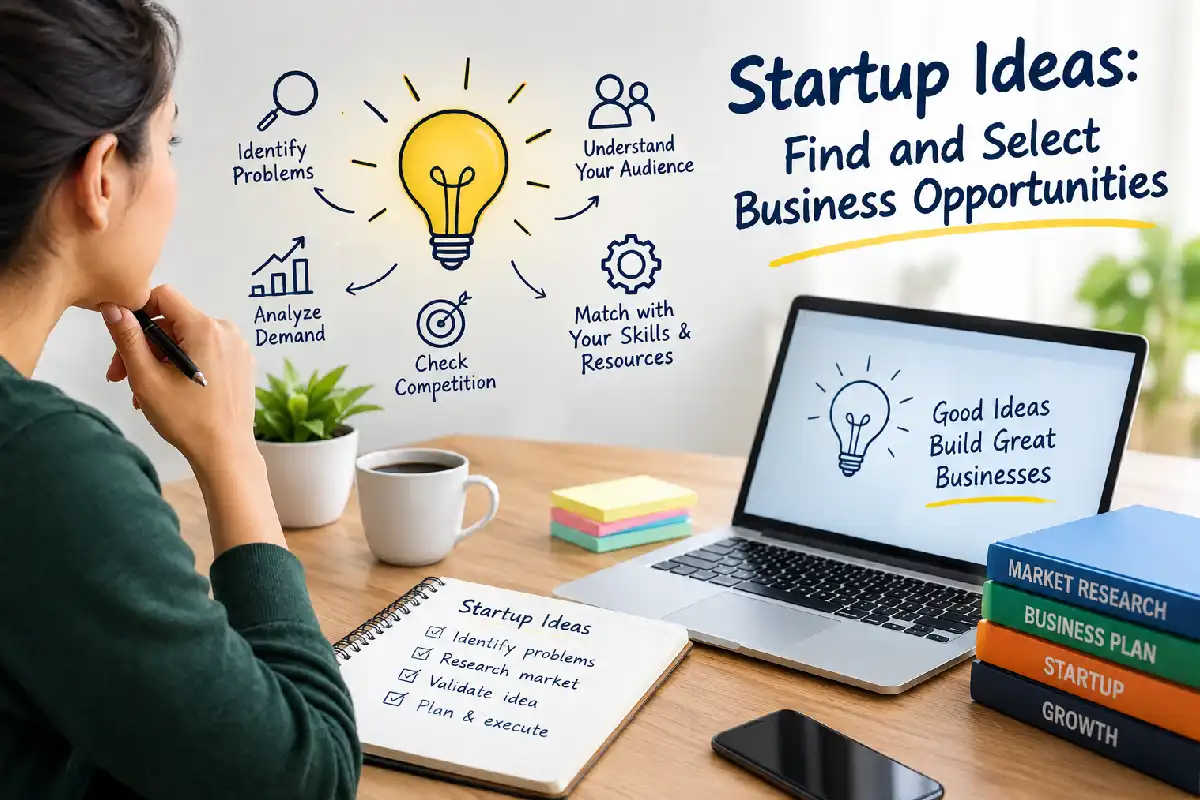
Startup Ideas: Find and Select Business Opportunities
Last Updated: September 24, 2026
The search for an ideal startup idea is sometimes more straightforward than inventing the next cool product; it involves comprehending an existing problem, identifying those who have it and solving it with a feasible solution. Tens of thousands of companies get started every year and the best startup ideas start with an actual customer need (as opposed to a product that is built that no one wants).
A successful startup idea should have the right mix of customer demand, competition, skill sets, resources, startup cost and scalability. Even if the idea seems promising, it would be a tough task to start a business around it if customers are not ready to pay for it and/or the market is already captured by competitors.
Whatever you hope to start a tech firm, online business, service business, local business or side hustle it all begins with ascertaining opportunities to look into.
Here‘s how to discover solvable problems; brainstorm and research startup ideas that align with your known budget and skillset; analyze market (demand) and competition; cut down to the most promising opportunities; and validate an idea in a time and cost-efficient manner.
How to identify problems that can be solved:
Most of the best startup ideas are problem based, not product based.
Instead of asking, “What business should I start?” ask:
What issue do people face that I am capable of doing in a more efficient, less costly or more accessible manner?
Issues may also arise from daily inconveniences, poorly managed operations within companies, shifting customer habits, innovations in technology or niche customer segments.
Pay Attention to Everyday Frustrations
Begin by identifying common problems that people frequently face.
For example, customers might complain about:
- Complicated booking processes
- Expensive professional services
- Poor customer support
- Long waiting times
- Difficult-to-use software
- Limited local options
- Unreliable delivery
- Lack of specialized products
- Confusing information
- Manual business processes
The more people are already investing money, time or effort into something to try and solve that problem, the more interesting it becomes as a startup opportunity.
For instance, a person who highlights reports for hours might be willing to buy something that marks them automatically.
Look for Problems You Understand
Your Personal Experience and Knowledge: 1. Experiences People Might Draw on to Derive Startup Concepts.
You might have experience working in one industry, studying one subject or using one kind of problem-solving approach regularly. Consequently, you might have a better knowledge of customers’ frustrations than a newcomer to the market.
Industry knowledge can help you identify:
- Inefficient processes
- Missing services
- Common customer complaints
- Expensive solutions
- Outdated technology
- Opportunities for automation
But a person‘s just own experience does not necessarily provide proof of a business opportunity. You still have to confirm that more people encounter the same problem and pay for a solution. Talk to Potential Customers.
Talk to Potential Customers
Customer conversations are one of the simplest ways to investigate startup ideas.
Rather than asking people whether they “like” your idea, ask about their existing behavior.
Useful questions include:
- How do you currently solve this problem?
- What is the most frustrating part?
- How often does this happen?
- How much time does it take?
- How much does the current solution cost?
- What alternatives have you tried?
- What would make you switch to another solution?
Behavior is usually more informative than compliments.
Someone saying, “That sounds like a great idea,” does not necessarily mean they would buy it. Someone who currently spends money to solve the problem provides stronger evidence of potential demand.
Identify Repeated Problems
A problem that occurs once a year may be less attractive than one customers encounter every week.
Recurring problems can create opportunities for:
- Subscription businesses
- SaaS products
- Maintenance services
- Membership businesses
- Repeat-purchase products
- Consulting relationships
- Retainer-based services
The frequency of the problem should therefore be part of your startup idea research.
Look for Inefficiencies in Existing Markets
You do not necessarily need to invent something completely new.

Many successful businesses improve existing products or services by making them:
- Faster
- Easier
- More affordable
- More accessible
- More specialized
- More reliable
- More convenient
For example, instead of creating a completely new fitness category, a startup could focus on a specific audience such as remote workers, beginners, older adults, or people with limited equipment.
The opportunity may come from better positioning, not invention.
Startup Ideas by Budget, Skill and Business Model
Not necessarily all the startups being started need the same level of capital, resources and expertise.
A great way of thinking about a startup idea is to classify them on what you have in hand.
Low-Budget Startup Ideas
If you are lacking significant seed capital, starting with a service-based enterprise may seem more convenient.
Examples include:
- Freelance writing
- Graphic design
- Web development
- SEO services
- Social media management
- Video editing
- Virtual assistance
- Consulting
- Online tutoring
- Bookkeeping
- Translation services
- Content creation
A great way to start up in business is with a computer, an internet connection, the relevant software and the correct skills.
The most significant shortcoming is the scalability. If all the revenues are based exclusively on your own working hours, afterward the challenges may arise asking for employees, products or systems.
Moderate-Budget Startup Ideas
Entrepreneurial firms with greater capital are able to venture into markets that demand inventory, machinery, staff or premises.
Examples include:
- Specialized retail
- Food businesses
- Fitness studios
- Cleaning companies
- Home services
- E-commerce brands
- Photography businesses
- Event services
- Local delivery businesses
- Small manufacturing operations
While these companies might incur higher operating costs, they are also more likely to offer repeat business and higher revenue streams.
Technology Startup Ideas
The technology business can be as simple as a piece of software or as complex as a whole platform.
Potential categories include:
- SaaS applications
- AI-powered tools
- Business automation
- Fintech solutions
- Education technology
- Health technology
- Productivity software
- Marketing technology
- Industry-specific software
While often high-growth potencial, technology startups is just beginning when developing the product. In the long run: customer acquired, customer kept, pricing, security, support, infrastructure, all count.
Product-Based Startup Ideas
Product businesses can involve physical or digital products.
Physical product opportunities include:
- Specialized consumer products
- Home products
- Fitness products
- Personal accessories
- Hobby products
- Sustainable alternatives
- Specialty foods
Digital products include:
- Online courses
- Templates
- E-books
- Design assets
- Software tools
- Paid communities
- Digital guides
Digital products can have lower marginal costs because the same product can often be sold repeatedly without manufacturing another physical unit.
Subscription Business Ideas
Subscription models generate recurring revenue by charging customers regularly.
Examples include:
- Software subscriptions
- Membership communities
- Educational platforms
- Content subscriptions
- Product subscriptions
- Business services
- Maintenance plans
A subscription model works best when customers have an ongoing need and receive continuing value.
Marketplace Startup Ideas
Marketplaces connect buyers with sellers or service providers.
Examples include platforms for:
- Freelancers
- Local services
- Rental products
- Professional experts
- Tutors
- Specialized suppliers
- Business services
Markets are difficult for a number of reasons. For example, markets are often beset by the need to keep both customers and suppliers happy.
How to Compare Demand and Competition
A startup idea should not be evaluated based solely on how interesting it sounds.
Two critical questions are:
Is there enough demand?
and
How difficult will it be to compete?
Measure Customer Demand
Start by determining whether people are actively looking for solutions.
Research can include:
- Search trends
- Keyword research
- Customer interviews
- Industry reports
- Online communities
- Competitor reviews
- Social media discussions
- Product reviews
- Marketplace listings
- Existing sales data
Search volume matters as a sign of interest but doesn‘t directly equate to demand to buy.
Consider the case of thousands of queries for the same subject, where people are willing to get the information but not pay for the result.
Look for stronger commercial signals such as:
- Existing competitors generating sales
- Customers requesting specific solutions
- People paying for alternatives
- Businesses advertising similar services
- Repeat purchases
- Positive demand trends
Analyze Competitors
Competition is not necessarily a reason to abandon an idea.
In many cases, the presence of competitors proves that customers already spend money in the market.
Study competitors to understand:
- What they sell
- Who they target
- How they price products
- Their main strengths
- Their weaknesses
- Customer complaints
- Their marketing channels
- Their customer experience
- Their positioning
Reviews also have their strengths. If customers express concerns about or inconsistencies in another company or competitor‘s slow support, complex onboarding, inferior quality or limited features these concerns can be seen as potential areas of differentiation.
Find Your Competitive Advantage
A startup needs a reason for customers to choose it.
Potential advantages include:
- Lower cost
- Better quality
- Faster delivery
- Specialized expertise
- Better customer service
- Easier user experience
- Geographic focus
- Industry specialization
- Unique technology
- Strong brand positioning
You do not need to outperform every competitor in every category.
Instead, identify a specific customer segment and solve an important problem particularly well.
Consider Market Size
A startup opportunity should have enough potential customers to support your business goals.
Consider three levels:
- Total Addressable Market (TAM): “Anyone who might want to use the product or service.”
- Serviceable available market (SAM): That portion of the market your busines…
- Serviceable Obtainable Market (SOM): The market share you could expect to gain now or in the short-term.
These concepts insures against unrealistic optimism.
We’ve seen it all before: big markets are good to look at but may be more difficult to penetrate than they seem.
How to Shortlist Ideas That Fit Your Resources
Having looked at a selection of startup ideas the second challenge is working out which forms are worth testing on.
Your short list should be representative of what you’ve got, not an idealized märt of what you’d like to have.

Evaluate Your Skills
State the skills you possess.
For example:
- Sales
- Marketing
- Programming
- Writing
- Design
- Finance
- Operations
- Customer service
- Management
- Industry expertise
Then identify which startup ideas allow you to use those strengths.
You should also identify important skills you currently lack.
A skill gap does not automatically eliminate an idea, but it may increase startup costs if you need to hire employees, freelancers, or consultants.
Evaluate Your Available Capital
Calculate how much money you can realistically invest without putting essential personal finances at risk.
Separate costs into:
One-time costs
- Equipment
- Website development
- Branding
- Business registration
- Initial inventory
Recurring costs
- Software
- Advertising
- Rent
- Salaries
- Hosting
- Insurance
- Professional services
Don‘t think you need to spend every penny you‘ve got.
The preferable alternative here is to find out the least investment to test if customers really want the solution.
Consider Your Available Time
A startup that demands solely a full-time focus perhaps is not the right type for a worker who is holding down a different job now..
Some ideas are easier to start part-time, particularly:
- Freelancing
- Consulting
- Digital products
- Online education
- Content businesses
- Small e-commerce operations
Other businesses may require employees, physical locations, inventory, or fixed operating hours from the beginning.
Consider Your Network
Your existing relationships can provide an early advantage.
For example, someone with connections in:
- Healthcare
- Construction
- Education
- Finance
- Retail
- Technology
- Hospitality
may have easier access to potential customers or industry insights within that sector.
A network can also help with partnerships, suppliers, referrals, hiring, and early sales.
Evaluate Personal Interest
Interest matters because building a startup often requires persistence through periods of uncertainty.
However, passion should not replace market research.
A useful combination is:
Something you understand + a problem customers care about + a business model that can work.
Create an Idea Scorecard
You can organize your research in a simple table.
| Factor | Question |
| Problem | Is the problem real and meaningful? |
| Demand | Are people actively seeking solutions? |
| Customers | Can you clearly identify the buyer? |
| Competition | What alternatives already exist? |
| Differentiation | Why would customers choose you? |
| Cost | Can you afford to test the idea? |
| Skills | Do you have the capabilities required? |
| Distribution | Can you reach potential customers? |
| Revenue | Is there a clear way to make money? |
| Scalability | Can the business grow beyond your personal time? |
Instead of automatically selecting the idea with the highest theoretical score, use the table to expose assumptions that require validation.
What to Do Before Committing to an Idea
Choosing a startup idea should not mean immediately investing heavily in it.
The next step is validation.
Build a Simple Version
Create the simplest version of your product or service that can test the core customer problem.
This may be called a Minimum Viable Product (MVP).
An MVP does not need every feature.
For example:
- A software idea could start with a basic prototype.
- A consulting business could begin with one defined service package.
- An e-commerce idea could test a small product range.
- A course could begin with a small workshop.
- A marketplace could initially operate manually.
The objective is to learn before spending heavily.
Test With Real Customers
Try to move beyond opinions.
Ask potential customers to take an action such as:
- Join a waiting list
- Schedule a call
- Request a quote
- Sign up for a trial
- Pre-order a product
- Pay for a service
- Use an early version
Actions provide stronger evidence than hypothetical interest.
Test Your Pricing
A common mistake is validating whether customers like an idea without determining whether they will pay enough for it.
Test different pricing structures where appropriate.
Consider:
- One-time purchases
- Monthly subscriptions
- Annual plans
- Usage-based pricing
- Packages
- Premium services
- Freemium models
The price you set should be based on the consumer value, costs of operation, competitor‘s alternative products and the economics needed to support the business.
Calculate Basic Unit Economics
Know how much it cost to acquire and serve a customer prior to scaling.
Important metrics can include:
Customer Acquisition Cost (CAC):
The average resource investment needed to obtain one paying customer.
Customer Lifetime Value (LTV):
The customer lifetime value is the expected revenue or contribution brought in from a customer during the life of the relationship.
Gross Margin:
Revenue is the income after subtracting costs directly related to the provision of the good or service.
These figures will show whether growth makes a sustainable business possible.
Identify Your First Customer Segment
Do not try to serve everyone immediately.
Choose a specific initial customer group.
For example, instead of targeting “small businesses,” you could target:
- Independent restaurants
- Local fitness studios
- Small accounting firms
- E-commerce businesses
- Real estate agencies
A specific segment makes it easier to understand customer needs and create focused marketing.
Create a Customer Acquisition Plan
A startup needs a practical way to reach customers.
Potential channels include:
- Search engines
- Social media
- Partnerships
- Referrals
- Paid advertising
- Cold outreach
- Events
- Communities
- Marketplaces
- Content marketing
A great product can still struggle if customer acquisition is too expensive or difficult.
Examine Legal and Operational Requirements
Some startup ideas require more preparation than others.
Depending on the business, you may need to investigate:
- Business registration
- Taxes
- Licenses
- Insurance
- Contracts
- Intellectual property
- Data protection
- Industry-specific regulations
- Product safety
- Employment requirements
These considerations should be researched before investing significantly.
Define Your Validation Criteria
Decide what evidence would convince you to continue.
For example:
- 20 qualified customer interviews
- 100 waitlist registrations
- 10 paying customers
- A specific conversion rate
- A certain amount of monthly recurring revenue
- Repeat purchases from early customers
This prevents you from continuing indefinitely based on enthusiasm alone.
Common Startup Idea Mistakes to Avoid
Business opportunity, that‘s all there is. In evaluating business ideas, entrepreneurs can place too much emphasis on the potential content of concepts.
Choosing an Idea Solely Because It Is Trending
Trends may provide opportunities, however, they do not ensure sustainability.
Determine if the customer problem will still exist after the trend reverse.
Building Before Validating
Developing a complex product over many months before talking to customers can introduce needless risk.
Initial discussions and rough prototypes can identify issues prior to large investments.
Ignoring Competition
A totally free market without any competition could be questionable.
Competitive Advantage Competition can show that the customer already spends money for a solution.
Rather than asking whether there are competitors, ask whether there is margin to serve customers in a different way.
Trying to Serve Everyone
Broad targeting can make marketing and product development difficult.
Start with a specific audience and expand after establishing a strong foundation.
Underestimating Customer Acquisition
Making a product is different from making a business.
Think about the way in which consumers will find, consider, buy, and then remain using your product.
Confusing Interest With Demand
Likes, comment votes, survey responses and positive Feedback can be useful signals but they are not sales.
Test whatever your customer does.
A Practical Startup Idea Validation Framework
You can organize the entire process into seven steps:
Step 1: Identify Problems
Jot down 10-20 problems that consumers or businesses are facing.
Step 2: Select Promising Problems
Find frequent, costly, urgent, or frustrating issues.
Step 3: Research Existing Solutions
Create an MVP, prototype, package of services, landing page, or something cheap and easy to test.
Step 4: Define Your Customer
Choose a specific audience that experiences the problem.
Step 5: Develop a Simple Solution
Create an MVP, prototype, service package, landing page, or other low-cost test.
Step 6: Seek Real-World Validation
Talk with your customers and then measure things like signups, purchases, trials, or repeat usage.
Step 7: Decide Whether to Continue
Use the evidence to polish, progress, switch or drop the concept.
This process reduces the risk of committing significant resources before you understand the market.
Conclusion
The good idea doesn‘t often come from starting to brainstorm it. The best opportunities are found by blending a real customer problem with real demand, with the feasibility of resources, implementation, and delivering a viable business model.
Begin with issues, not items. Learn what they are doing or not doing today that they believe could be improved by the new product. Investigate new startup ideas that are consistent with your skills, budget, contacts and available time.
Once you have identified a few potential opportunities make a comparison of demand, competition, target customer segments, differentiation, costs and revenue potential. Then, validate your most promising concepts with potential users before attempting to make large investments.
Keep in mind that your initial hypothesis doesn‘t have to be flawless. The reason for researching in the beginning stages is for the learning process. What you discover from customers might cause you to jump entire segments, change the price, alter your product, switch the marketing channel, or even change your entire concept.
The most valuable startup idea is one that can develop into problem→solution→customer→payment→repeatable business model.
If you follow this process, you‘ll be able to take your lengthy list of startup ideas and narrow it down to the few viable opportunities that should be tested and ultimately will allow you to make an informed decision rather than a guess.