

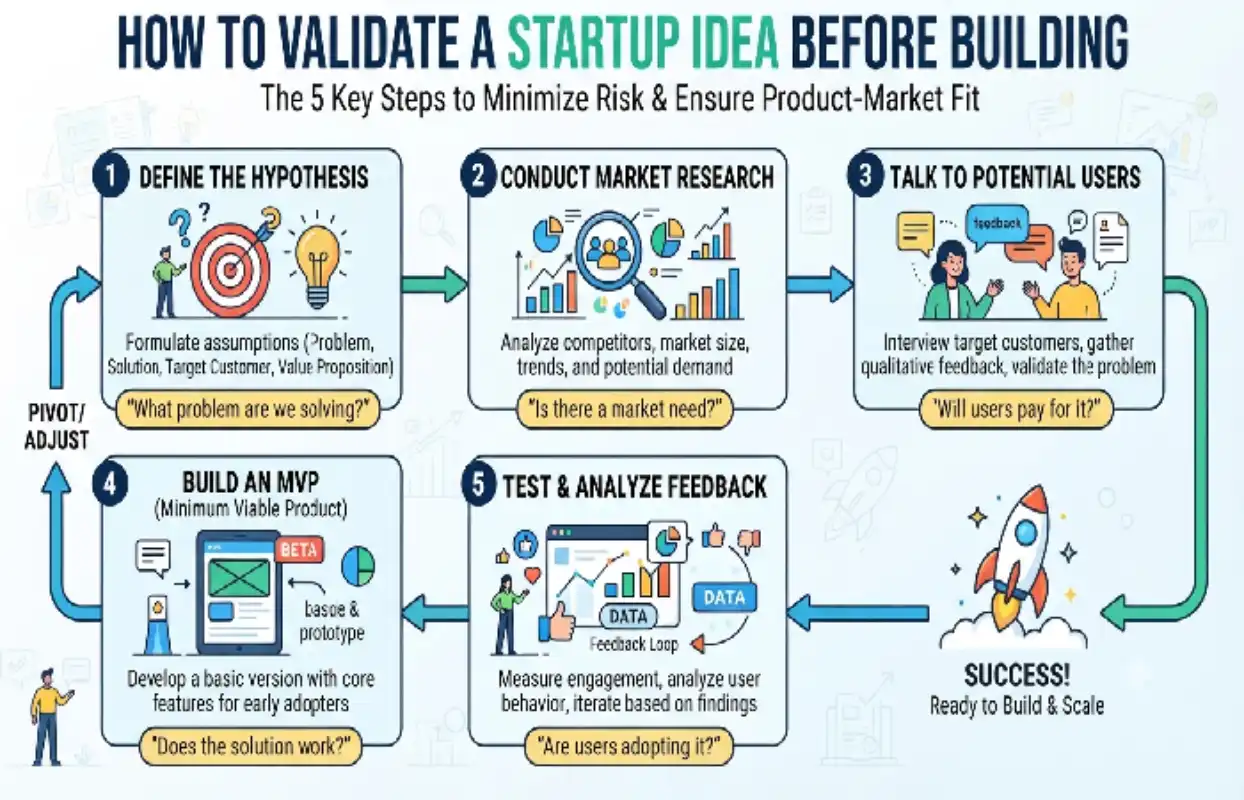
How to Validate a Startup Idea Before Building
Last Updated: September 29, 2026
An idea for a startup can sound good at first glance and could crash and burn in a real customer environment. Prior to designing a product, before hiring a team, before extensive marketing and public relations, entrepreneurs can identify whether there is enough evidence in their assumptions to warrant proceeding now.
Startup idea validation is not about proving that an idea is guaranteed to succeed. It is about reducing uncertainty. A good validation process helps answer practical questions: Does the problem exist? Who experiences it? How are people solving it today? Will they take action to solve it? And are they willing to pay for a solution?
The best way to do it is by finding the riskiest assumption and come up with a cheap way to test it. Set clear metric to evaluate the test and interpret the result objectively.
Identify Your Riskiest Business Assumption
Every startup idea depends on assumptions. These might concern the customer, problem, solution, market, pricing, distribution or business model.
For example, a founder planning a software product might assume that:
- A specific group of businesses has a recurring problem.
- The problem is important enough to solve.
- Existing solutions are inadequate.
- Customers can be reached through a particular channel.
- Customers are willing to pay a certain price.
- The proposed solution can be delivered profitably.
You do not need to test every assumption simultaneously. Start with the one that could most seriously invalidate the idea.

Suppose you want to build an appointment-management platform for small clinics. You may initially assume that clinic owners struggle with appointment administration. However, the bigger risk might be whether they consider the problem important enough to pay for another software tool.
Write the assumption in a testable format:
“We believe that [customer segment] experiences [problem] frequently enough that they will [specific behaviour].”
This makes vague beliefs easier to test.
Also distinguish between problem assumptions and solution assumptions. Customers may genuinely experience a problem without wanting your proposed solution. Validating the problem does not automatically validate the product.
Choose a Low-Cost Demand Test
Once you identify the riskiest assumption, choose the cheapest realistic way to test it.
The test should measure behaviour whenever possible rather than relying only on opinions.
Potential validation methods include:
Customer interviews
Interviews can help establish whether people experience the problem, how frequently it occurs and what they currently do about it.
Ask about recent experiences rather than hypothetical intentions. “Tell me about the last time this happened” is generally more useful than “Would you use a product that solves this?”
Landing page tests
A simple landing page can explain the problem and proposed value proposition. You can measure actions such as sign-ups, demo requests or waitlist registrations.
The page should make the offer specific enough that visitors understand what they are responding to.
Manual or concierge tests
Instead of building software, provide the service manually to a small number of customers.
For example, if the idea is an automated reporting tool, you could initially prepare the reports manually. This lets you test whether customers value the outcome before investing in automation.
Pre-orders or deposits
When appropriate, asking customers to make a financial commitment provides stronger evidence than asking whether they like the idea.
The exact structure depends on the product, market and applicable consumer-protection requirements.
Small marketing experiments
A controlled advertising or outreach experiment can test whether a defined audience responds to a particular problem and offer.
Keep the budget limited and establish the measurement criteria before running the experiment.
The goal is not to create a large campaign. It is to learn whether the underlying assumption survives contact with real customers.
Test Willingness to Pay with a Clear Offer
Interest and willingness to pay are different things.
Someone may agree that a problem is frustrating without considering it worth spending money to solve. Therefore, validation should eventually move from problem interest toward commercial behaviour.
Create a clear offer that explains:
- Who the product or service is for
- What problem it addresses
- What outcome it provides
- What is included
- How much it costs
- What the customer needs to do next
Avoid testing vague concepts such as “Would you pay for better productivity?” Instead, present a concrete proposition.
For example:
“A monthly service that prepares and delivers your business’s weekly sales report for ₹X.”
You can then measure meaningful actions such as requesting a trial, booking a call, starting a paid pilot or making another genuine commitment.
Pricing experiments should also be interpreted carefully. One refused price is not an index of no demand. Any problems could be with the offer: perceived value, offer time, trust/believability, transaction, target group.
You could experiment to different packaging or price points in a more controlled fashion, though you need to not change multiple variables at once if you want to identify the reason for a result.
Set Pass, Revise and Stop Criteria in Advance
A common validation mistake is deciding whether an experiment “worked” only after seeing the results.
Founders can become emotionally attached to an idea and reinterpret weak results as temporary setbacks. Establishing criteria before the experiment reduces this risk.
Create three possible outcomes:
Pass
The test produces enough evidence to justify the next stage.
For example, you might decide in advance that a certain number of qualified prospects must request a paid pilot within a defined period.
Revise
The results show some evidence of demand but reveal a significant problem with the customer segment, offer, pricing or messaging.
You may change one assumption and run another test.
Stop
The experiment produces insufficient evidence after reasonable testing, particularly if the core problem or customer demand appears weak.
Stopping does not necessarily mean the broader business opportunity is worthless. It may mean that the current customer, problem or solution hypothesis does not have enough evidence.
Your criteria should specify:
- Test duration
- Target customer
- Sample or traffic source
- Primary metric
- Minimum acceptable result
- What happens after each outcome
For example:
| Result | Decision |
| Meets predefined threshold | Continue to next validation stage |
| Partial evidence | Revise one major assumption and retest |
| Consistently weak evidence | Stop or reconsider the idea |
The exact thresholds should reflect the economics and context of the business rather than arbitrary numbers.
Interpret Results Without Overstating Small Samples
Early startup experiments often involve small samples. That is useful for learning, but small samples can easily be overinterpreted.
If five people express interest, you cannot conclude that a large market definitely exists. Likewise, if ten people reject an offer, you should investigate whether the sample, positioning or offer was appropriate before making a broad market conclusion.
Look for quality of evidence, not just quantity.
Consider:
- Were participants actually part of the target market?
- Did they have recent experience with the problem?
- Did they take a meaningful action?
- Did they spend money or commit resources?
- Was the test presented clearly?
- Could another explanation account for the result?
- Was the sample biased toward people already familiar with you?
- Would the behaviour likely continue outside the experiment?
Suppose 100 people click an advertisement but only one qualified customer requests a demo. The high click-through activity may indicate curiosity, but it does not necessarily demonstrate strong purchasing demand.
Conversely, three highly relevant businesses agreeing to paid pilots can provide meaningful early evidence even though the sample is small.
Document the result alongside its limitations:
What happened → what it suggests → what it does not prove → what should be tested next.
This prevents founders from turning an encouraging experiment into an unsupported market-size claim.
Build Evidence Before Building the Product
Startup idea validation works best as a sequence of increasingly stronger tests. Start with the riskiest assumption and use the least expensive experiment capable of producing useful evidence.
You might progress from customer interviews to a landing-page test, then a manual service, paid pilot or prototype. Each stage should answer a specific question and determine whether it makes sense to invest more resources.

The objective is not to eliminate all uncertainty before launching. No realistic startup can do that. Rather, validation shows you which remaining uncertainties are most significant and how to collect the evidence to enable the next decision to be made.
Reduce waste through testing demand before building too much. Founders can spend a lot of money making assumptions that have not been tested; however, what customers actually want is often very different. Prior to building a product or service, entrepreneurs may learn what customers desire, and then determine the position, price and business model accordingly.
Conclusion
Validating a startup idea in advance of developing it takes the risk out of spending to much money on something that has not been proven to work. First, find out which assumption could most drastically change the outcome of the business, and second, select a basic experiment that is inexpensive to determine a concrete customer reaction.
Check if customers see the problem, respond to one specific offer and are willing to take action that makes a difference, including paying when necessary. Have pass, revise and stop criteria established prior to running the test so that the outcome can be measured objectively.
Finally, establish early results as signs, not facts. Small samples will help surface important signals, however should not be used to make sweeping assumptions about market demand. Maintain testing the highest uncertainties and apply your learnings to refine, advance or discard the startup before spending substantial money developing product.