

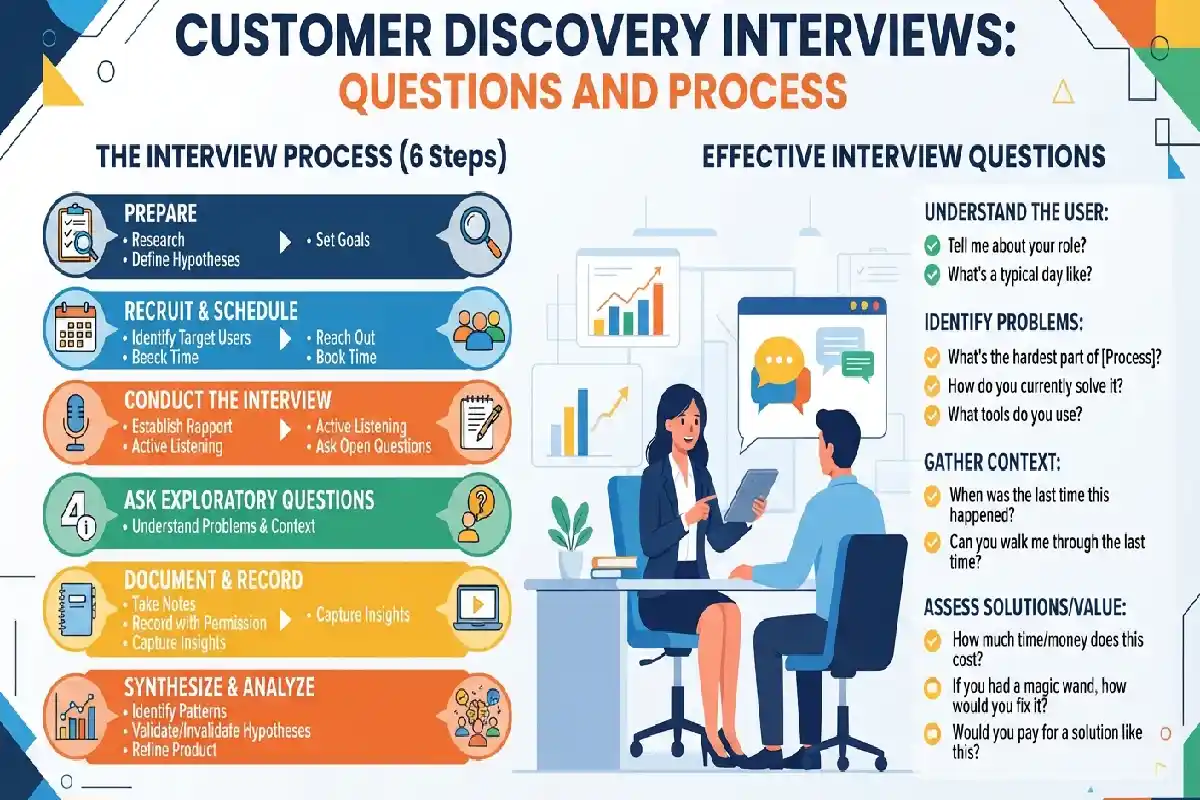
Customer Discovery Interviews: Questions and Process
Last Updated: September 28, 2026
Customer discovery interviews enable entrepreneurs to learn from potential customers about what they encounter, rather than what they say they like, prior to committing to a new product or service. Instead of “do you like this?” questions, questions aim to define real problems, existing behaviors, purchasing decisions, frustrations, alternatives and priorities.
A good interview will also help identify whether the problem is common or critical, what solutions are used today, what causes people to look for a different solution, what blocks them from making a change. The research accuracy is not in asking a lot of questions but rather finding the right customers/users to talk to and understanding them.
Recruit People Who Match Your Target Customer
Customer discovery starts with finding people who resemble the customers you eventually want to serve. Speaking to anyone who is convenient can produce interesting opinions but may not provide useful evidence for your business.
Define your target customer using practical characteristics such as:
- Industry or type of business
- Job role or responsibility
- Company size
- Location
- Customer needs or use case
- Current tools or processes
- Frequency of experiencing the problem
- Recent purchasing behaviour
For a B2B startup, for example, interviewing business owners may not be enough if employees actually experience the problem and managers control the budget. You may need to interview both users and decision-makers.
For a consumer product, consider factors such as buying frequency, lifestyle, spending habits and the situation in which the problem occurs.
Recruit people who have recent experience with the problem, rather than people who simply fit a broad demographic description.
You can find participants through professional communities, existing networks, industry groups, customer referrals, social platforms and direct outreach. If possible, offer a small incentive for their time without making the incentive large enough to influence their answers.
Keep a record of who you interviewed and the characteristics that make each participant relevant. This makes patterns easier to identify later.
Write Questions About Real Past Behaviour
One of the most important customer discovery interview techniques is asking about what people actually did, rather than what they think they might do in the future.
Questions such as “Would you use this product?” often produce unreliable answers. People naturally want to be encouraging, and hypothetical intentions do not always translate into purchases.

Instead, ask about specific experiences.
Useful questions include:
- “Tell me about the last time you experienced this problem.”
- “What were you trying to accomplish?”
- “What did you do first?”
- “Which tools or services did you use?”
- “How often does this happen?”
- “What was the most frustrating part?”
- “Have you tried another solution?”
- “Why did you choose that option?”
- “What did it cost you in time or money?”
- “Who else was involved in the decision?”
- “When was the last time you paid for a solution to this problem?”
Past behaviour gives you something concrete to investigate.
Pay particular attention to actions, frequency and consequences. Someone saying that a problem is frustrating is useful. Someone describing how they spend several hours every week manually dealing with it, have already paid for a workaround and are actively searching for alternatives provides much stronger evidence.
Prepare a discussion guide rather than a rigid script. Your questions should help maintain consistency across interviews while leaving enough room to explore unexpected information.
Run Interviews Without Pitching Your Solution
The purpose of a discovery interview is to learn, not to convince.
If you introduce your product too early, participants may start reacting to your idea instead of describing their existing behaviour. They may also unconsciously tell you what they think you want to hear.
Begin with their situation.
A simple structure is:
- Understand their role or circumstances.
- Explore the relevant workflow or experience.
- Ask about recent problems.
- Investigate current solutions and alternatives.
- Understand purchasing or switching behaviour.
- Explore consequences and priorities.
- Ask follow-up questions based on what they said.
Use open-ended questions and allow pauses. You do not need to fill every silence.
Avoid leading questions such as:
“Wouldn’t it be easier if this process were automated?”
Instead ask:
“How do you currently handle this process?”
The second question does not suggest what the answer should be.
You should also avoid defending your idea when someone describes a weakness. Their criticism can be valuable research. If several people independently identify the same obstacle, you have discovered something worth investigating.
If you eventually show a concept or prototype, separate that stage from the discovery portion of the interview. First understand the existing problem; only then test reactions to a potential solution.
Group Findings by Problem and Buying Behaviour
After several interviews, organise your notes systematically. Looking at each interview individually can make every customer’s story seem unique. Grouping similar observations helps reveal patterns.
Useful categories include:
| Category | What to look for |
| Problem | What customers struggle with |
| Frequency | How often the problem occurs |
| Current solution | How they handle it today |
| Trigger | What causes them to seek a solution |
| Consequence | Time, money, risk or inconvenience |
| Buying behaviour | How they choose and purchase |
| Alternatives | Competitors, workarounds or internal processes |
| Barriers | Reasons they do not switch |
Look for repeated behaviours rather than simply counting positive comments.
Suppose eight people say they would “love” a new tool, but only one has recently searched for a solution and none has paid for an alternative. That may indicate interest without strong buying evidence.
On the other hand, if several participants independently describe the same recurring problem, use similar workarounds and have recently spent money trying to solve it, the pattern deserves closer attention.
You can create an evidence table for each major finding:
Observation → supporting interviews → actual behaviour → frequency → consequence → confidence level
This prevents one memorable interview from dominating your conclusions.
Separate Strong Evidence from Polite Encouragement
Not every positive statement from an interview represents genuine demand.
Customer discovery requires distinguishing between what people say and what their behaviour demonstrates.
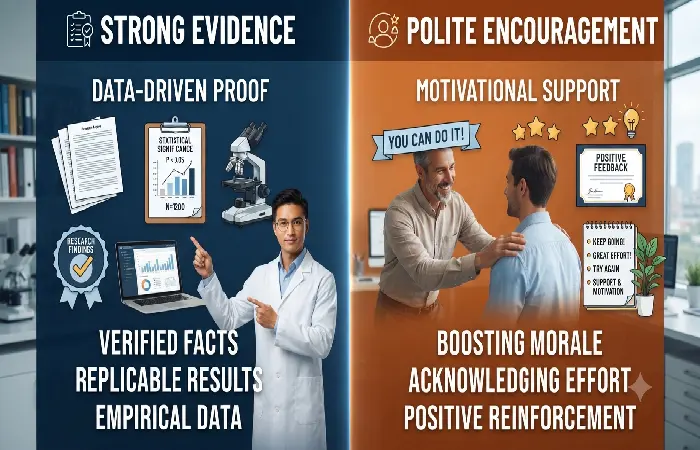
Consider the difference:
Weak evidence:
- “That sounds useful.”
- “I would probably try it.”
- “I know other people who need this.”
- “Keep me updated.”
Stronger evidence:
- “I experienced this problem last week.”
- “We currently pay for another solution.”
- “I spend five hours a week dealing with this.”
- “I have already compared alternative providers.”
- “This problem caused a measurable loss.”
- “I am actively looking for a replacement.”
Strong evidence does not guarantee that a startup will succeed, but it gives you a more concrete basis for further testing.
Be careful with requests for features as well. Customers may suggest solutions based on their current assumptions. Record the underlying problem separately from the feature request.
For example, if someone asks for an automated reporting dashboard, investigate why they want it. The underlying issue might be that preparing reports takes too much time or that managers lack timely information.
Turn Interviews Into Testable Decisions
The final stage of customer discovery is converting conversations into decisions.
Ask:
- Which problems appeared repeatedly?
- Which customer segments experienced them most strongly?
- What solutions are already being used?
- Are customers spending money or significant time on alternatives?
- What triggers them to search for something new?
- What objections or switching barriers appeared?
- Which assumptions remain untested?
Interviews shouldn‘t be considered (or designed) as a one off validation step. Take the results to update your customer segment, define the problem more specifically and iterate on your business assumptions and go back into the market with more research if needed.
What we are not trying to do: remember to always do this; The aim is not to garner compliments; not to reach a certain number of positive responses; Our aim is to construct a clearer picture of who has got this problem; who behaves like that today; how important it is; what evidence shows that they can & will.change.
Customer discovery interviews that address actual needs versus fake/expected needs should be used as the basis for what to test, what to tweak and what not to build.
Conclusion
Customer discovery interviewing provides a “lean” process for entrepreneurs to learn directly from customers before spending large investment of time and money on a new venture. Recruit authentic target customers, ask about real historical behavior, do not pitch the product early on, and learn the problems and buying habits that surveys or jumping to conclusions cannot.
The most valuable contributions are made by repeated actions, other spurts, existing expenditure, current workarounds, and concrete results, rather than best-practice testimonials. Arrange interview findings by problem, who the customer is, and how they buy to make patterns more visible.
Learn from all rounds of interviews. Build on the evidence you gathered and test your assumption again in order to decide what to test next. Good customer discovery will not validate that a startup idea will succeed, but will help founders make stronger decisions such as what problem to solve, who it is for, and what is lacking in the evidence.