

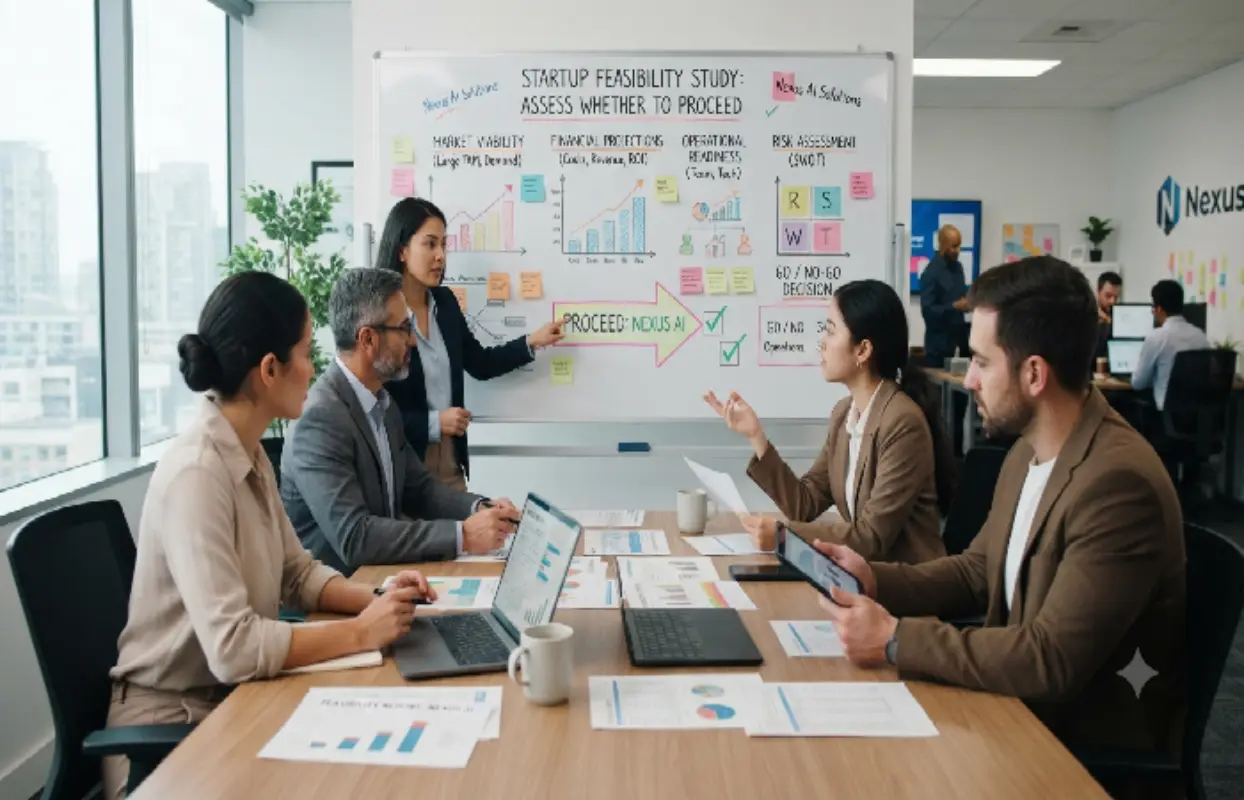
Startup Feasibility Study: Assess Whether to Proceed
Last Updated: September 29, 2026
The purpose of a startup feasibility study is to allow the entrepreneurs to assess the feasibility of their idea prior to the‘heavy lifting‘of investing personal savings, time and other resource. An idea can have a legitimate need solved by it. However, it can be a difficult concept to deliver: costly to operate; be subject to regulations that limit the sale or profit and sale of a concept.
Combining all these considerations in a systematic analysis is a feasibility study. It says that a startup proposal does not have to succeed but helps by indicating the hypothesis, pre-conditions, hazards and proof that will determine the subsequent decision.
This exercise can be especially valuable before creating the entire product, signing key contracts, hiring staff or making the substantial marketing investments.
Define the Idea and Feasibility Criteria
Begin by defining the business you plan to start. Outline what kind of startup it would be, who would benefit and where you hope to derive an income.
A simple starting statement could be:
We will offer a web-based scheduling and customer-management service to small home service businesses, available on a monthly subscription basis.
Followed by defining the questions to be answered by the feasibility study.
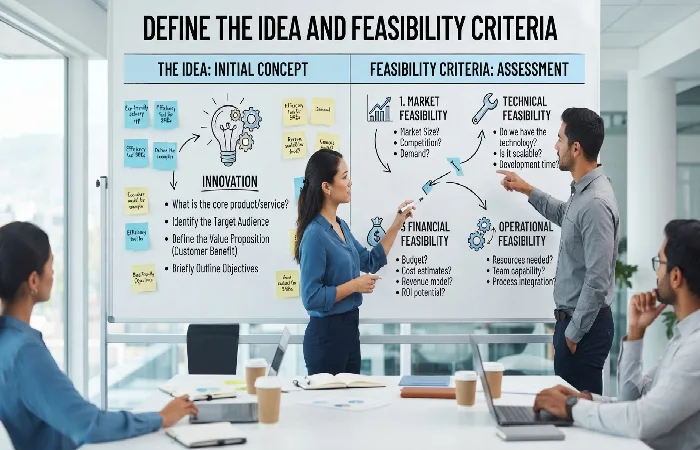
Typical criteria include:
- Is there a clearly identifiable customer problem?
- Can the target customers be reached?
- Are customers willing to pay for the proposed solution?
- Can the product or service be delivered reliably?
- What resources are required?
- How much capital is needed?
- Can the business potentially generate sustainable margins?
- Are there important legal or regulatory requirements?
- What risks could prevent the business from operating as planned?
One should also avoid having criteria that are wide-ranging or general enough that the study becomes a description of the concept. Logically, each criterion should lead to evidence that may be examined.
You can list out a straightforward feasibility checklist and can define each section supported, unsure or problematic.
This makes it clear to differentiate pre-existing knowledge from a piece of evidence that may need validation.
Assess Market and Commercial Feasibility
Market feasibility address the existance of enough potential customers for the new enterprise and feasibility of reaching out to them
Start out by defining who the customer should be, instead of using a large market-size figure as a starting point. Having millions of potential users is of no use unless the startup is able to target them profitably.
Research factors such as:
- Target customer characteristics
- Customer needs and buying behaviour
- Market size and growth assumptions
- Existing competitors
- Substitute products or services
- Typical pricing
- Purchasing processes
- Customer acquisition channels
- Barriers to switching
Customer research is particularly important. Speak with potential customers about their existing behaviour and purchasing decisions rather than asking only whether they like the proposed idea.
For example, if businesses already spend money on competing products, that can provide evidence that a commercial category exists. However, the startup still needs to understand why customers would consider an additional option.
Competitor research should also go beyond listing company names. Compare what alternatives offer, how they charge, which customers they target and where customers report limitations.
The objective is not to prove that competition is absent. Competition can indicate that customers already recognise the problem. The important question is whether the proposed startup has a realistic way to create and deliver value.
Review Technical and Operational Requirements
A business may have market demand but still be impractical to deliver.
Technical feasibility examines whether the required product or technology can be built or acquired within the available resources.
Consider:
- Required software or hardware
- Development skills
- Third-party services
- Integrations
- Data requirements
- Security considerations
- Infrastructure
- Maintenance
- Scalability
- Technical dependencies
For a software startup, you might need to determine whether an existing API can provide a required capability or whether a custom system must be developed.
Operational feasibility looks at how the business will actually deliver its product or service.
Questions include:
- Who performs the core work?
- What suppliers are required?
- How are customers onboarded?
- How is customer support handled?
- What equipment or facilities are necessary?
- What happens when demand increases?
- Which activities can be automated?
- Which activities require specialist staff?
Develop a simplistic workflow for customer acquisition, delivery and customer support. This can highlight operational needs which might be hard to identify at the initial stage.
A startup might estimate customer acquisition costs but not include the additional cost of staff to administer the onboarding and support.
Estimate Financial Needs and Identify Regulatory Questions
The financial feasibility connects the business model with the resources needed to operate it.
Calculate the startup and operational costs.
Startup expenses might include:
- Product development
- Equipment
- Initial inventory
- Website and software
- Professional services
- Licences or registrations
- Initial marketing
- Deposits and setup costs
Ongoing expenses may include:
- Salaries or contractor payments
- Rent and utilities
- Software subscriptions
- Hosting
- Marketing
- Insurance
- Customer support
- Accounting and legal costs
- Taxes and other applicable charges
Revenue assumptions should be equally specific. Estimate the expected number of customers, pricing structure, purchase frequency and other relevant revenue drivers.
Then create scenarios rather than relying on one forecast:
| Scenario | Customer growth | Costs | Purpose |
| Conservative | Slower | Higher | Test downside risk |
| Base | Expected | Expected | Main planning case |
| Higher | Faster | Controlled | Explore capacity requirements |
Do not treat projections as guaranteed outcomes. They are models based on assumptions.
Regulatory feasibility should also be investigated early, particularly for industries such as healthcare, finance, insurance, education, food, transportation and other regulated sectors.
Depending on the location and business model, questions may involve:
- Business registration
- Tax obligations
- Industry-specific licences
- Consumer protection
- Data protection and privacy
- Employment requirements
- Advertising rules
- Contracts and terms
- Intellectual property
- Insurance requirements
Regulatory questions should be verified with appropriate government agencies or qualified professional advisers when they could materially affect the business.
Write a Proceed, Revise or Stop Recommendation
The final stage is turning the research into a clear decision.
Rather than simply writing “the idea looks good,” summarise the evidence against the feasibility criteria.
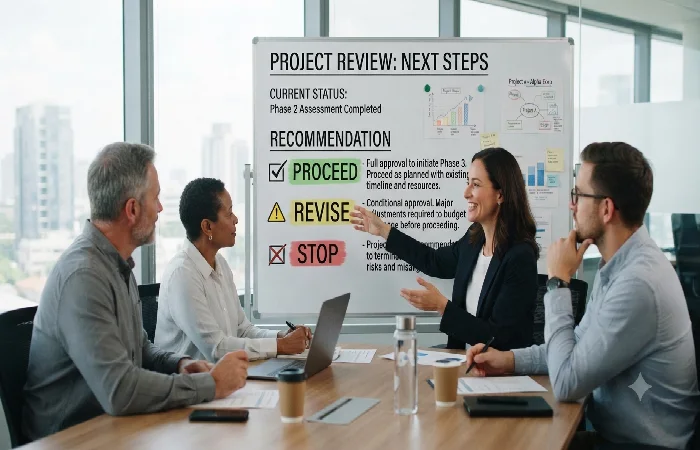
A useful structure is:
Proceed
Use this outcome when the major feasibility questions have sufficient supporting evidence and no unresolved issue creates an unacceptable barrier to the proposed next step.
The recommendation should specify what happens next, such as launching a pilot, developing a minimum viable product or approaching a defined customer segment.
Revise
Choose this outcome when the idea appears potentially workable but important assumptions remain weak or problematic.
For example, you may discover that customers want the outcome but not at the proposed price. The next step could be to change the pricing model, target a different segment or simplify the offering before testing again.
Stop
This outcome may be appropriate when evidence indicates that a critical assumption does not currently support the business and reasonable changes do not provide a credible path forward.
Stopping one version of an idea does not necessarily mean abandoning the underlying problem. The research may reveal a different customer segment, business model or solution worth investigating separately.
Your final recommendation should include:
- Key evidence
- Major assumptions
- Critical risks
- Financial requirements
- Regulatory or operational concerns
- Recommended next action
- Conditions that would change the decision
Conclusion
The purpose of a startup feasibility study is to establish the process for testing the viability of an idea before focusing large resources. By setting explicit standards, exploring the market, looking into technical/operational needs, assessing financial requirements, and exploring regulatory issues, entrepreneurs can find opportunities and limitations.
The ultimate objective is not so much to have a perfect forecast, but rather to make the next decision using the best facts available. A clear proceed, revise or stop recommendation helps founders avoid building on unsupported assumptions and shows exactly what needs to be tested or resolved before moving forward.