
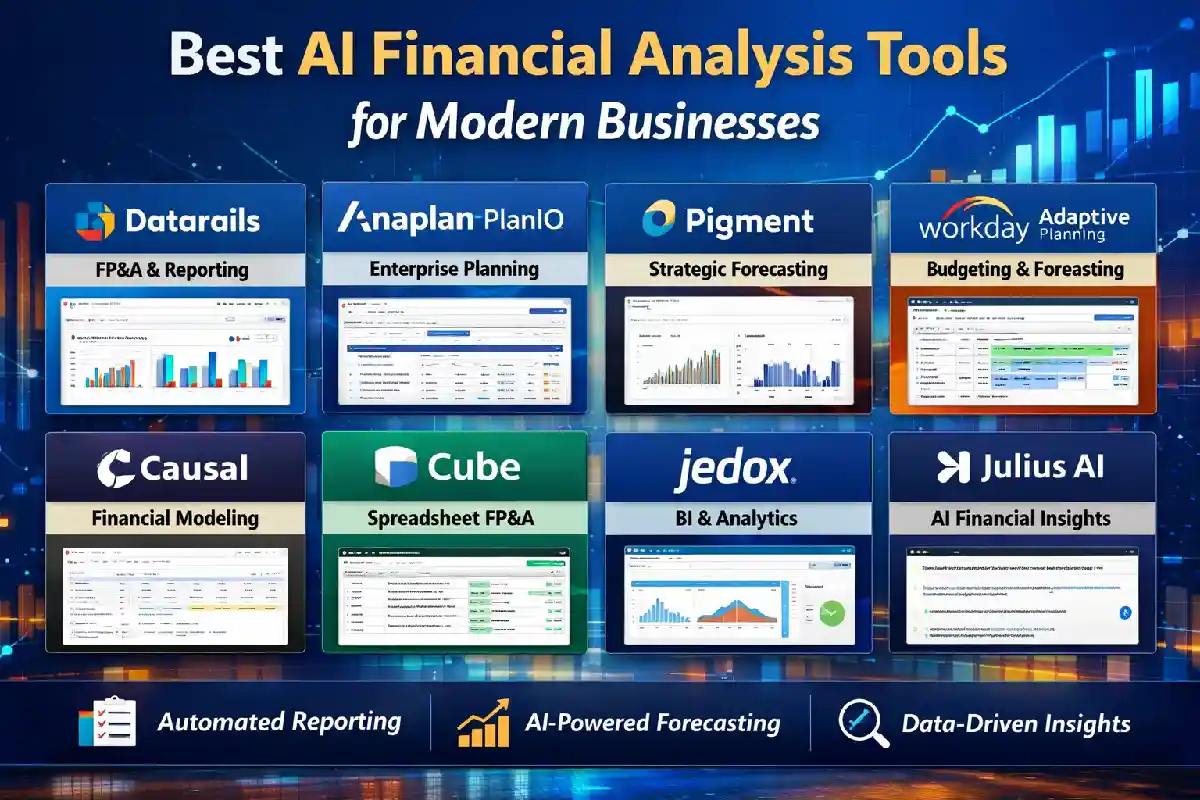
Best AI Financial Analysis Tools for Modern Businesses
Last Updated: June 17, 2026
Artificial intelligence is changing how businesses handle their finances. Using AI Financial Analysis Tools, companies can benefit from automated reports and predictive forecasting, analysing thousands of financial figures in a fraction of the time.
By 2026, finance teams will be more likely to utilise AI-enabled platforms to streamline labour-intensive activities, eliminate errors, enhance forecasting, and provide leverage on the happenings in the moment. As per the latest FP&A studies, 69% of CFOs see it as an integral to their finance transformation endeavours, making AI one of the maximum growing technologies in state-of-the-art finance.
This guide will show you how Artificial Intelligence is transforming financial analysis, provide you with a comparison of top AI tools, and point out the pluses and minuses that every business should be aware of.
What are AI Financial Analysis Tools?
AI financial analysis software tools, are generally software tools that employ:
- Machine Learning (ML)
- Natural Language Processing (NLP)
- Predictive Analytics
- Generative AI
- Data Automation
To help interpret financial information and come to decisions.
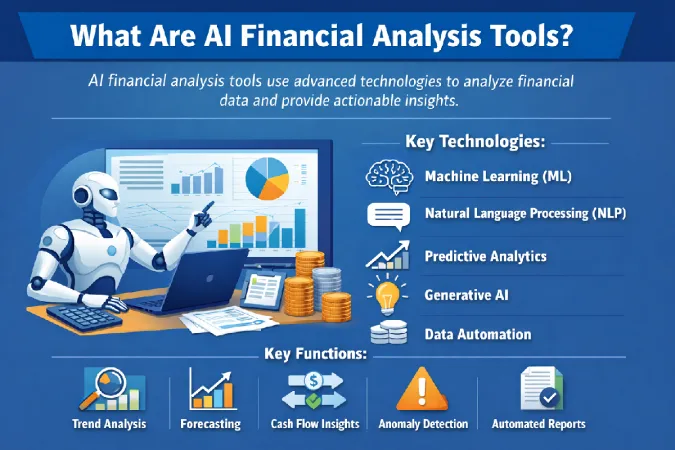
Instead of manually reviewing spreadsheets and reports, finance teams can use AI to:
- Identify trends
- Forecast revenue
- Analyze cash flow
- Detect anomalies
- Generate financial reports
- Support strategic planning
These tools enable companies to be proactive rather than reactive from their reporting.
How AI Is Changing Financial Analysis
Conventional financial reporting can take hours of data collection, updating various spreadsheets, and preparing reports.
This is where AI systems come into play: they automate this processing and delivers insights in near real time.
Key Transformations
| Traditional Finance | AI-Powered Finance |
| Manual data entry | Automated data collection |
| Historical reporting | Predictive forecasting |
| Spreadsheet analysis | AI-driven insights |
| Static dashboards | Real-time analytics |
| Human-only interpretation | AI-assisted recommendations |
Today, machine intelligence can detect the patterns from thousands of transactions and identify recommendations that analysts would take days to identify.
Top AI Tools for Business Finance in 2026
Comparison Table
| Tool | Best For | Key AI Features | Business Size | Official Resource |
| Datarails | FP&A & Financial Reporting | AI-generated reports, variance analysis, forecasting, Excel integration | SMB–Mid-Market | Datarails |
| Anaplan PlanIQ | Enterprise Financial Planning | AI forecasting, scenario planning, & predictive modeling | Enterprise | Anaplan PlanIQ |
| Workday Adaptive Planning | Budgeting & Forecasting | Machine learning forecasts, AI-driven insights, & variance explanations | Mid-Market–Enterprise | Workday Adaptive Planning |
| Pigment | Strategic Business Planning | AI anomaly detection, natural language queries, scenario generation | Mid-Market–Enterprise | Pigment |
| Planful Predict | Automated Forecasting | Predictive forecasting, anomaly detection, financial planning automation | Mid-Market | Planful |
| Causal | Financial Modeling | Driver-based forecasting, AI scenario planning, dynamic models | Startups & Growth Companies | Causal |
| Cube | Spreadsheet-Based FP&A | AI planning, forecasting, Excel and Google Sheets integration | SMB–Mid-Market | Cube Software |
| Jedox | Financial Analytics | AI-assisted planning, forecasting, & business intelligence | Mid-Market–Enterprise | Jedox |
| SAP Analytics Cloud | Enterprise Analytics | Predictive analytics, planning, & AI-driven business insights | Enterprise | SAP Analytics Cloud |
| Julius AI | Financial Data Analysis | Natural language querying, automated reporting, financial data visualization | Analysts & Finance Teams | Julius AI |
Benefits of Automated Financial Reporting
Another one of the biggest benefits of AI to finance is automated reporting.
Major Benefits
Faster Report Generation
It can generate reports within a matter of minutes.
Improved Accuracy
Automates and thus mitigates errors caused by the human factor in calculations and data transfer.
Real-Time Visibility
Executives are able to access up-to-date dashboards without waiting for the monthly reporting to arrive.
Better Compliance
Contemporary AI reporting systems have audit trails and documentation to meet regulatory requirements.
Cost Savings
Financial teams dedicate more time to analysis and less time on manual processes.
According to research, finance teams have traditionally invested the majority of their time collecting and reconciling data instead of examining it. AI changes that substantially by moving time over to more valuable decision-making.
AI-Powered Forecasting and Planning
That’s where AI is offering some of its best value.
Instead of relying solely on historical trends, AI systems can evaluate:
- Market conditions
- Customer behavior
- Sales performance
- Economic indicators
- Operational data
Example Forecasting Improvements
| Forecasting Area | Traditional Accuracy | AI-Assisted Accuracy |
| Revenue Forecasts | Medium | High |
| Cash Flow Planning | Medium | High |
| Expense Forecasting | Medium | High |
| Demand Planning | Low-Medium | High |
AI forecasting models are iteratively responsive to new inputs so that companies can quickly reschedule or re-operationalize their plans in response to everything else changing.
Real-World Use Cases
1. Budget Planning
AI enables finance teams to create flexible budgets in response to fluctuations in business.
2. Cash Flow Management
Provide a forecast of future cash flow shortfalls.
3. Financial Reporting
Automated systems create board-ready reports without making users do any work.
4. Investment Analysis
AI is used to analyze financial statements and market trends.
5. Risk Detection
Machine learning detects unusual transactions and types of financial risk.
Risks and Limitations of AI Tools
However, it is important to note that these tools are not infallible:
Data Quality Issues
You‘re only as good as the data you are given.
Regulatory Concerns
Financial decisions might also need human validation and adherence review.
Model Bias
Poorly trained models may generate misleading recommendations.
Security Risks
Under-trained models tend to suggest distorted suggestions.
Over-Reliance on Automation
Use AI as a decision support tool rather than a decision-making system.
Experts from the industry still consider governance, transparency and auditability as a must-have for any use case within finance.
AI Financial Analysis Tools Comparison Matrix
| Feature | Datarails | Causal | Pigment | Workiva |
| Forecasting | ✓ | ✓ | ✓ | ✓ |
| Reporting Automation | ✓ | Partial | ✓ | ✓ |
| Scenario Planning | ✓ | ✓ | ✓ | Partial |
| Compliance Reporting | Partial | No | Partial | ✓ |
| Excel Integration | ✓ | Partial | Partial | Partial |
| Enterprise Scalability | High | Medium | High | High |
FAQ
What are AI financial analysis tools?
They are platforms that use artificial intelligence for the automation of financial reporting, forecast, budget and data analysis.
Which AI tool is best for financial reporting?
Datarails, Workiva are few of the automated financial reporting solutions for 2026.
Can AI replace financial analysts?
No. While AI helps to make more productive and can even suggest ideas for helping to make decisions, the machine hasn‘t evolved enough to be making those decisions on its own and will still need human input and analysis.
Are AI financial tools suitable for small businesses?
Yes. There are many scalable options for startups and small businesses, such as Causal, FinanceGPT and other AI spreadsheets.
Is AI forecasting more accurate than traditional forecasting?
In a lot of situations, yes. AI models can leverage a lot more data than traditional models and discover trends that would otherwise be impossible to identify.
Conclusion
AI financial analysis tools are being embedded into organisations that are able to afford them, delivering swift insights, better forecasts and reduced reporting. With machine intelligence taking off in 2026, those organisations that scale up intelligent finance automation will be in a position for better planning, decision-making and efficiency.
One effective approach to achieving AI-powered automation is to use it with finance manpower. This enables finance functions to become more strategic, accurate and prepared for the future, simply by choosing the right AI financial analysis tool in addition to active governance.