

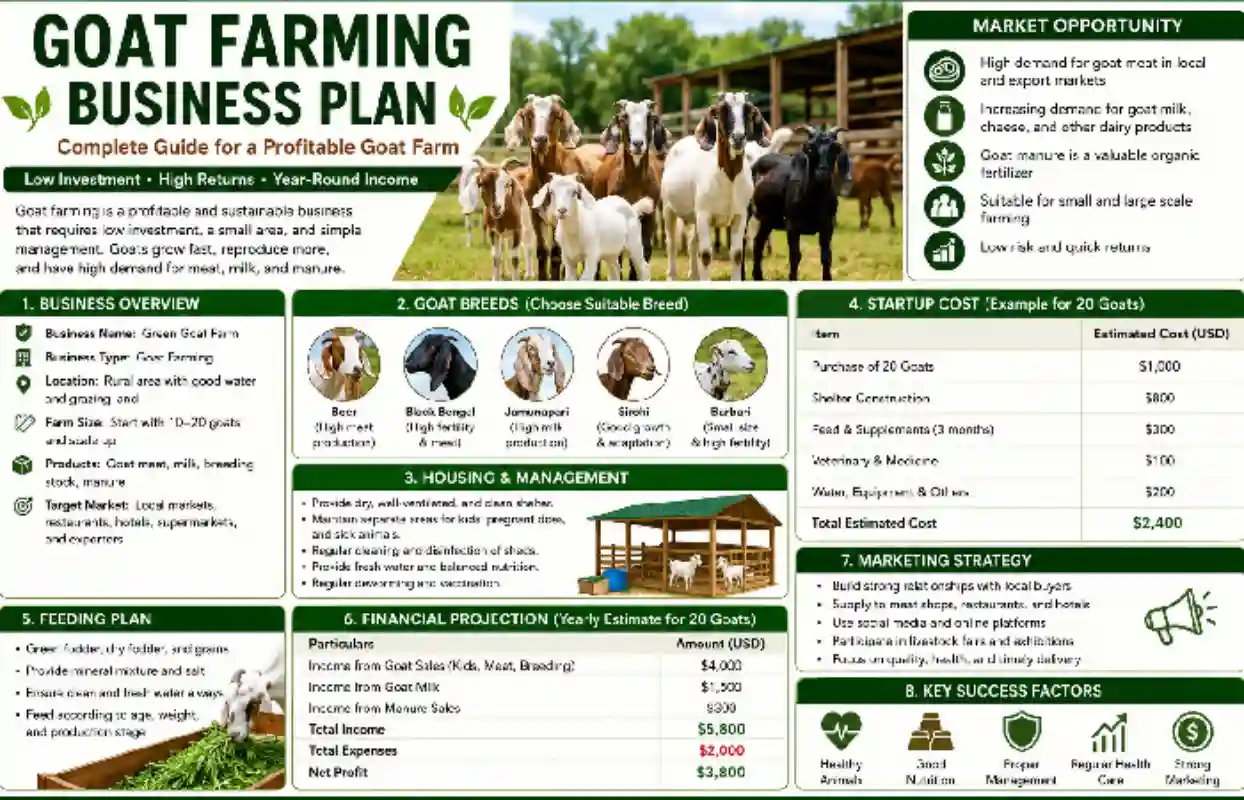
Goat Farming Business Plan: Complete Guide for a Profitable Goat Farm
Last Updated: July 12, 2026
A Goat Farming Business Plan is a plan of action to start, run and expand a goat farm profitably. This plan of action determines what goats to buy, where to keep them, the total capital, feeding, all the way up to how to minimize losses in Goat farming and how to scale your operation over the years. If you want a simple start-up guide while providing topical information, then this article is meant to fit those needs for you.
Goat farming is an attractive enterprise as a small start-up is possible, it fits well into land utilisation in the rural and semi-rural environment, and an income stream can be generated from meat, breeding animals, manure, and, depending on the model, milk. But profitability cannot be determined by simply buying animals. Success or failure relates to good house management, feed discipline, breed choice, and disease control.
What is a Goat Farming Business Plan
Goat farming business plan: A business plan is a written statement that describes how your goat enterprise will be established, financed, operated, and developed. It is your business blueprint that enables you to minimize risks and other things that would tempt you to make unwise decisions before you invest. It would also make it easier to convey your business idea to lenders, partners, and your family.
A complete plan normally includes:
- Farm purpose: meat, breeding, milk or mixed model.
- Initial number of goats.
- Housing and shed design.
- Feed and fodder policy
- Health and vaccination plan.
- Cost and profit estimation.
- Sales and marketing channels.
- Growth strategy.
That’s the best business plan. They don’t promise quick profit but show how to get through the initial time and set up problems.
How to Start a Goat Farming Business
The beginning of a goat farm is facilitated if you follow steps as opposed to purchasing animals without sufficient planning. Competitor content regularly highlights breeds, shed layout, feeding, and cost planning as the essential Starting points.
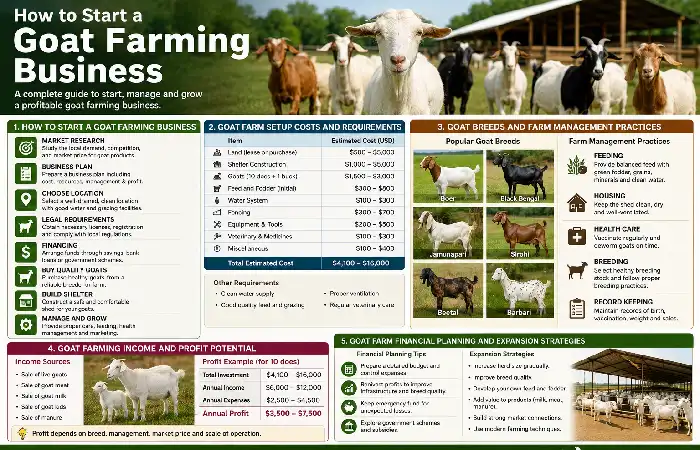
A step-by-step start-up framework
- Choose your farm model.
- Target your market.
- Choose goat breed.
- Plan the shed and infrastructure.
- Compute works and running funds.
- Arrange feed and fodder supplies.
- Establish vaccination and health services.
- Discover buyers before enlarging.
- Keep records and apply annually.
- Decision options using a farm model
Farm model options
| Model | Main income | Best for | Notes |
| Meat goats | Sale of goats for meat | Fast market turnover | Most common beginner model agricbusiness.com+1 |
| Breeding stock | Sale of kids and breeding animals | Higher-value farms | Needs better genetics and records |
| Dairy goats | Milk and milk products | Niche or specialized markets | Needs stronger management |
| Mixed farm | Multiple income streams | Risk diversification | More complex to manage |
If you are new, a simple meat-goat or breeding-focused unit is usually easier to manage than a multi-output dairy setup.
Goat Farm Setup Costs and Requirements
The “startup cost” is one of the most-searched topics in goat farming, as competitors place great importance on it. Your article should not stick to a single fixed number but should present a range, depending on herd size, housing type, and prices in your local area.
Main setup requirements
- Land or a lease.
- Goat house with air circulation and drainage.
- Feeding troughs and watering cans.
- Fencing and boundary protection.
- Buck area and kidding space.
- Storage of feed and fodder.
- Infrastructure for vaccination and record-keeping.
- Labour and transportation facilitation.
Typical cost heads
| Cost Item | What It Covers | Why It Matters |
| Shed construction | Animal housing | Protects animals and improves hygiene |
| Goats | Female goats and breeding buck | Core farm stock |
| Feed and fodder | Daily nutrition | Major recurring cost |
| Fence and security | Prevents escape and loss | Reduces risk |
| Medicine and vaccination | Disease prevention | Protects survival and profit |
| Tools and equipment | Feeders, buckets, cleaning tools | Improves daily operations |
Cost comparison table
| Farm size | Typical purpose | Cost profile |
| Small | Beginner or pilot unit | Lowest startup burden |
| Medium | Commercial family business | Balanced investment |
| Large | Scaled farm | Higher capital but stronger output |
For your final page, a comparison table like this helps readers judge the scale that fits their budget.
Visual setup idea
Include a real photo or screenshot of:
- Goat shed layout.
- Feed storage area.
- Fencing/boundary.
- Kidding pen.
- Vaccination log sheet.
The attached image looks like a title header for the article and can be used as a cover image or section banner.
Goat Breeds and Farm Management Practices
Breed choice is important as it affects growth rate, disease resistance, selling price, and feeding requirements. The majority of goat-keeping manuals will discuss the question of breed choice; the best ones will consider whether you are in a hot or cold country, whether you want the goat for milk and meat or meat alone, and the preferences of potential buyers.
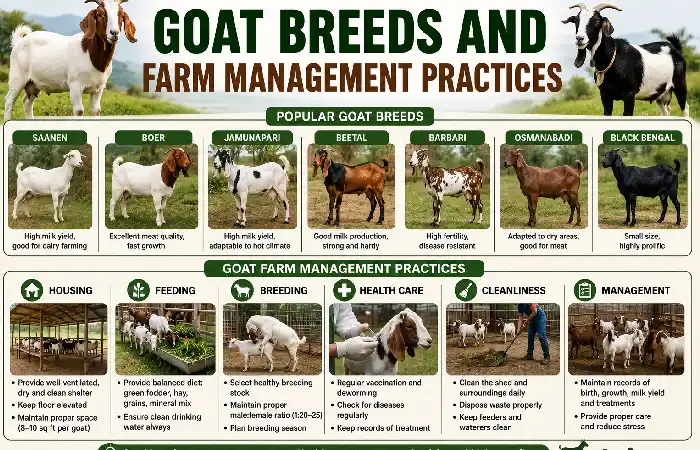
Which breeds to think about.
- Piece of local climate adaptiveness.
- Rate of growth.
- Number of offspring and mothering ability.
- Disease resistance.
- Meat yield and milk yield.
- Market demand in your area.
Breed selection table
| Breed type | Best for | Strength | Watch out for |
| Local hardy breeds | Beginner farms | Strong adaptability | Lower yield than elite breeds |
| Improved meat breeds | Meat production | Faster growth | Need better feeding |
| Dairy breeds | Milk-based income | Milk output | More care and nutrition |
| Crossbreeds | Balanced performance | Better output than local stock | Need good management |
Significant management is key.
Provide fresh water every day.
Put clean, dry bedding in.
- Castrate all sick animals separately.
- Deworm and vaccinate as scheduled.
- Do not saturate
- Monitor kidding and newborn care.
- Maintain feed consistency.
- Keep a log of daily lives.
Effective management is what separates a profit making, thriving farm from one which is merely surviving. Goat farms tend to go under when people build up their herd, throwing all their money into buying more animals but neglecting the everyday husbandry and disease control.
Goat Farming Income and Profit Potential
Income potential is yet another important search driver, and so lots of competitor pages talk about profit, or ROI many times. The best article should cover that profit is a result of breed quality, birth rate, sale price, feed cost and mortality control.
- Sources of income
- Sale of meat goats.
- Sale of breeding kids.
- Sale of breeding.
- Market for manure.
If you run a dairy, the sale of milk or if you have a mixed farm.
- Profit drivers
- Rapid gain weight.
- More children per breeding cycle.
- Less death.
- Less feed wastage.
- Offer improved buyer pricing.
- Uses less disease loss.
Profit comparison table
| Revenue stream | Profit speed | Margin potential | Complexity |
| Meat sales | Fast | Medium | Low to medium |
| Breeding stock | Medium | High | Medium |
| Milk sales | Regular | Medium to high | Higher management |
| Manure sales | Slow but steady | Low to medium | Low |
A realistic profit section should present ranges, not guaranteed figures. That makes the content more trustworthy and aligned with E-E-A-T.
Goat Farm Financial Planning and Expansion Strategies
Financial planning is where the business really becomes a going concern. Through it the business owner will be able to forecast cash flow, determine the break-even point, reinvestment and when the business will be ready for expansion. Competitors often reference costs and profit, but quality content will put these figures in context with real business growth plans.
Aspects of financial planning
- Start-up investment.
- Monthly running costs.
- Emergency reserve.
- Breeding replacement reserve.
- Forecast of income.
- Willingness to make loan repayments.
- Expansion trigger points.
| Financial element | Why it matters | Planning tip | |
| Startup cost | Initial setup | Separate one-time and recurring costs | |
| Running cost | Monthly survival | Track feed and medicine closely | |
| Emergency fund | Shock absorber | Keep reserves for disease or price issues | |
| Expansion capital | Growth stage | Reinvest only after stabilizing output |
Ideas for the expansion strategy
- Start with a small herd and give a demonstrated system.
- You make records of breeding, death and sales.
- Only expand after feed and health costs are well under control.
- Add breeding stock gradually not quickly.
- Build stronger buyer relationships before scaling.
The most powerful way to develop a topical hub is through how it integrates the setup, operation, profit, and growth.
Conclusion
A goat business plan that is profitable has the correct number, the breed type, disciplined in how you manage a herd. All the 2026 Guides who rank for this show the same thing-you can successfully sell the goats you breed if you plan for feeding, housing, breeding, sales and health care of the animals you have before growing the herd. You would be wise, if you have never raised goats before, to do it on a small scale, carefully record what it costs to feed, raise, and care for the animals you are working with. You are then ready to grow the operation of a profitable meat or breeding goat business or both.