

Restaurant Business Plan: Complete Blueprint for Restaurant Success
Last Updated: September 15, 2026
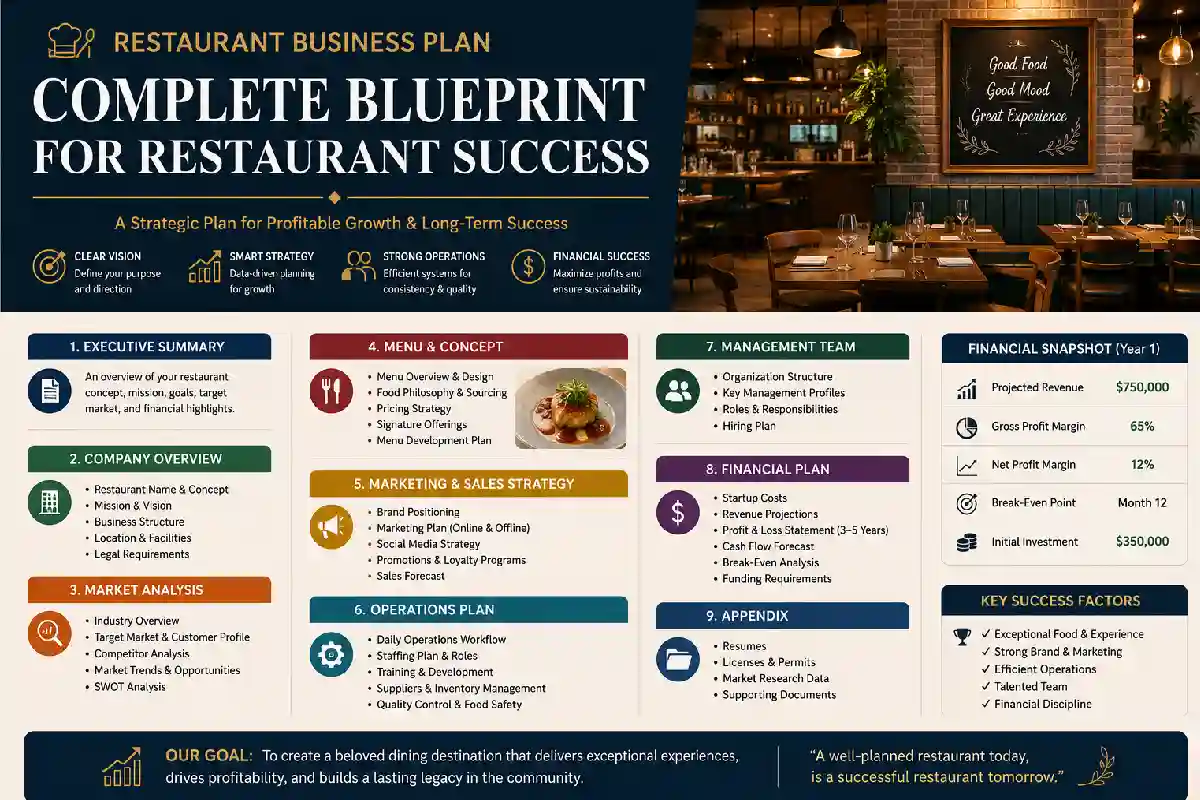
Restaurant Business Plan. Starting a restaurant is certainly an exciting journey, but it also takes plenty of research. A restaurant business plan, for example, will guide you to finalise your concept, estimate the initial investment, raise capital, and operate a successful restaurant. From fast-food, fine dining, café, cloud-kitchen, to other types of eatery, it is vital for long-term success.
Discover all the essential components of a restaurant business plan, including market research and financial projections. The process of translating from one language to another. This can be done individually, one by one, translating information from one language to another, or collectively (within a class or group) by translating material from one language to another, either at the same time or at different times.
What a Restaurant Business Plan is:
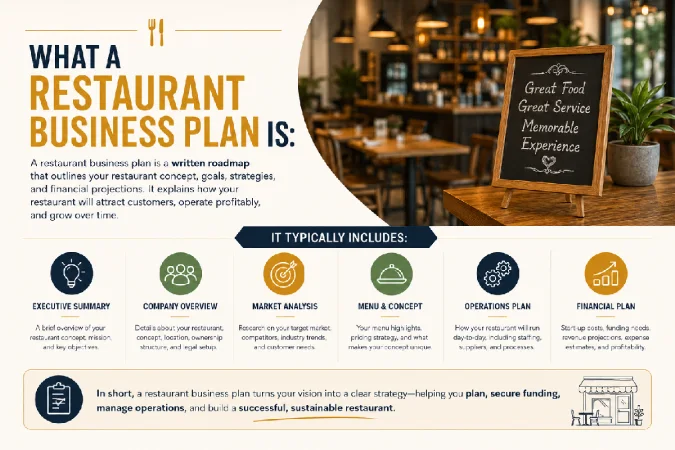
The restaurant business plan is a written presentation of the goals of your restaurant business, your concept and operation, your clients and competitors, your menu and marketing strategy, the operational plan, and the financial projections.
It is a roadmap that guides your business during startup and future growth.
A good restaurant business plan helps you:
- Obtain bank loans to
- Bringing the attention of investors to the region.
- Estimate startup costs
- Limit business risks
- Plan operations effectively
- Monitors business growth
- Enable customers to make better decisions
What is/are the method(s) to be used, supported by evidence or reasoning? What is the scientific and technological basis of the present innovation?
Why Every Restaurant Needs a Business Plan
Failure is common among restaurants early on, as they go without a plan.
A structured business plan helps you:
- buying into your market
- Recognize competitors.
- Create realistic financial goals
- Develop a creative pricing scheme
- Plan staffing needs
- Manages inventory
- Control the machine operating cost
Without a business plan, restaurants often overspend, underprice menus and make bad location choices.
How to Write a Restaurant Business Plan
A restaurant business plan is simply a plan that details your restaurant’s concept, target market, operations, marketing approach, and financial results. Starting a cafe, fine-dining restaurant, food truck, or cloud kitchen-whatever the type, a good business plan is vital in attracting investors and getting a business loan.
Here’s a guide on how to write a business plan for a restaurant professionally.
1. Write an Executive Summary
An executive summary is the opening part of your business plan but is generally written last. It should be a summary of your restaurant.
Include:
- The name of the restaurant:
- Business concept
- Mission statement
- Restaurant location
- Target market
- Unique Selling Proposition (USP)
- Business goals
- Benevolent funding (if necessary)
2. Describe Your Restaurant Concept
Specify precisely what will be on offer at your restaurant.
Include details such as:
- Types of restaurants (fine dining, café, fast food, buffet, food truck, cloud kitchen, etc.)
- Style of Cuisine
- Dining experience
- Theme & atmosphere
- Service model (dine-in, take-away, delivery)
Describe in simple terms why your restaurant will be different from the others.
3. Conduct Market Research
Market research: good research on the market gives a clearer picture of where you are in terms of what is in demand and where you stand in the market.
Target Audience
Define your ideal customers by:
- Age
- Income level.
- Occupation
- Lifestyle
- Eating patterns
- Preferences
Industry Analysis
Study:
- Develop the growth of the restaurant industry
- Food trends
- Buying behaviours of consumers
- Online delivery demand
- Opportunities throughout the year
Competitor Analysis
Research nearby restaurants and identify:
- Types of menus offered
- Pricing
- Customer reviews
- Strengths
- Discrepancies
- Marketing strategies
Seek avenues for your business to stand out.
4. Develop Your Menu
Your menu should be suitable for your concept and your guests.
Include:
- Signature dishes
- Appetizers
- Main courses
- Desserts
- Beverages
- Seasonal specials
5. Choose Your Business Structure
Detail how your restaurant will be legally structured.
Common structures include:
- Sole Proprietorship
- Partnership
- Limited Liability Company (LLC)
- Corporation
Also mention:
- Ownership details
- Business registration
- Necessary licenses and permits
6. Select the Right Location
Place is another factor in determining success in a restaurant.
Consider:
- Customer foot traffic
- Accessibility
- Availability of parking
- Nearby businesses
- Resident population
- Visibility
- Costs of rental
Restaurant Startup Costs and Funding Options
Starting a restaurant requires a hefty upfront investment, and knowing how much you need to start is important for preparing an accurate business plan. Having a clear budget will help you estimate how much capital you’ll need and guarantee that you’re financially ready to open your restaurant.
Estimate Your Startup Costs
The costs of opening a restaurant depend on the type, size, and location of the restaurant. Typical costs include:
Expense Category Typical Cost Allocation
| Expense Category | Typical Cost Allocation |
| Lease Deposit and Rent | 10–15% |
| Renovation and Interior Design | 15–25% |
| Kitchen Equipment | 20–30% |
| Furniture and Fixtures | 10–15% |
| Licenses and Permits | 2–5% |
| Initial Food Inventory | 5–10% |
| POS System and Technology | 2–5% |
| Marketing and Branding | 3–8% |
| Working Capital | 15–25% |
Common Startup Expenses
- Commercial kitchen equipment
- Refrigeration units.
- Dining furniture
- Interior decoration
- Restaurant website
- Starting inventory
- Staffing identification
- Utility deposits
- Insurance
- Legal and licensing fees
Always set a contingency budget (an additional 10–15%).
Restaurant Funding Options
Selecting the appropriate financing option will be determined by your budget, your enterprise’s goals and your credit history.
Personal Savings
Using your own means, you do not have to go into debt or pay interest, and ownership remains with you.
Advantages:
- No loan repayments
- Complete control of the business
- Quicker decision-making
Bank Loans
Typically, a restaurant may take out a conventional bank loan.
Benefits include:
- Varying interest rates Competitive interest rates
- Consistent repayment schedule
- A large font size is provided with room to include more funding information for larger startup investments
Government Programs
Numerous governments provide small business startup loans, grants or subsidized finance, particularly those that generate jobs or are in priority sectors.
Private Investors
Restaurants may be funded by angel investors or venture capital firms if they are new and innovative, with high growth potential.
Investors typically expect:
- EQUITY ownership
- Business growth strategy
- Viability of financial projections
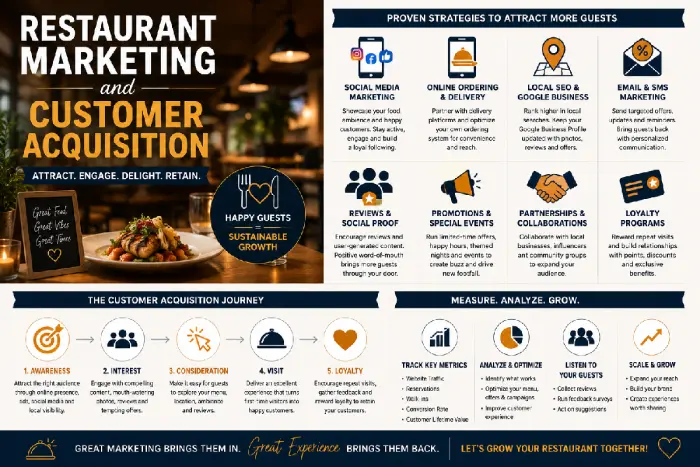
Restaurant Marketing and Customer Acquisition Strategies
A thriving restaurant is based not just on the nature of its menu and food but on the ability to draw in and sell to its customers. Good marketing will raise brand awareness, draw in more customers and keep them coming back.
Build a Strong Brand Identity
Create a memorable brand for your restaurant that fits its personality.
Your branding should include:
- Restaurant name.
- Logo
- Color scheme
- Interior design
- Staff uniforms
- Brand voice
Reliability across all points of contact with the customer reinforces recognition.
Create a Professional Website
Your website should include:
- Menu
- On-line booking
- Ordering system
- Address And Contact Telephone Number:
- Location map
- Customer reviews
- Business hours
Make the website mobile-friendly and SEO-optimized.
Restaurant Revenue Forecast and Profitability Analysis
Financial forecasting will assist you in identifying whether the profitability you are projecting at your restaurant is sustainable.
Estimate Monthly Revenue
Revenue depends on several factors:
- Number of customers
- Average value of each order
- Daily hours of operation
- Table turnover
- Seasonal demand
Example:
- Daily customers: 120
- Average spend: $20
- Revenue daily 2,400$
- Sales (30 days per month): $72,000
Modify these estimates according to your idea and your local market.
Estimate Operating Expenses
Common monthly expenses include:
- The cost of food is
- Payroll
- Rent
- Utilities
- Marketing
- Insurance
- Maintenance
- Software subscriptions
Monitoring expenses over time helps out in regular profit analysis.
Calculate Gross Profit
Gross Profit = Revenue Cost of Goods Sold (COGS)
Restaurants are often striving for something between 25% and 35% of their menu prices.
Calculate Net Profit
Net Profit = Total Revenue Total Operating Expenses
The net profit margin of 5% to 15% is common for many thriving restaurants, given the costs they incur to run their business.
Restaurant Operations and Management Plan
This operations plan will describe how your restaurant will operate on a typical day in an efficient manner while also providing quality food and service.
Daily Operations
Your daily workflow should cover:
- Opening procedures
- Meal preparation
- Stocktaking/Inventory
- Customer service
- Order processing
- Financial management
- Cleaning routines
- Closing procedures
Having SOPs means that processes happen the same for all shifts.
Inventory Management
Inventory management can be very costly and should be tightly controlled. Proper inventory control will eliminate excesses and shortages.
Best practices include:
- Stocks monitored daily
- First-In, First-Out (FIFO) rotation
- Periodic stock/take18
- Monitoring waste:
- Survey of Suppliers
Supplier Management
Build strong relationships with reliable suppliers by evaluating:
- Product quality,
- Delivery reliability
- *Price
- Terms of payment
- Consitancy
Keep backup suppliers to avoid delays.
Staffing Structure
A typical restaurant team includes:
- Manager of restaurants
- Head chef
- Sous chef
- Line cooks
- Kitchen Assistants
- Servers
- Cashies
- Barmen (if appropriate)
- Cleaning staff
Specify in detail each employee’s job function as well as the organization of reporting.
Employee Training
Provide ongoing training in:
- Food safety and hygiene
- Customer service
- Usage of ‘POS system’
- Emergency procedures
- Menu knowledge
- Upselling methods
Competent Representatives – Skilled and knowledgeable representatives will minimize errors and provide better service.
Conclusion
To be a successful restaurant, it is important to calculate the information on how to run it as well as financial planning, marketing, forecasting of revenue, and daily operation. By figuring out startup cost, choosing sources of money, applying acquirers for customers, monitoring profit, having sound operation procedures, your restaurant will be a strong point for growth in the future. Monitoring your business plan periodically and then adapt to mode will be an advantage for your business to keep smiling.