

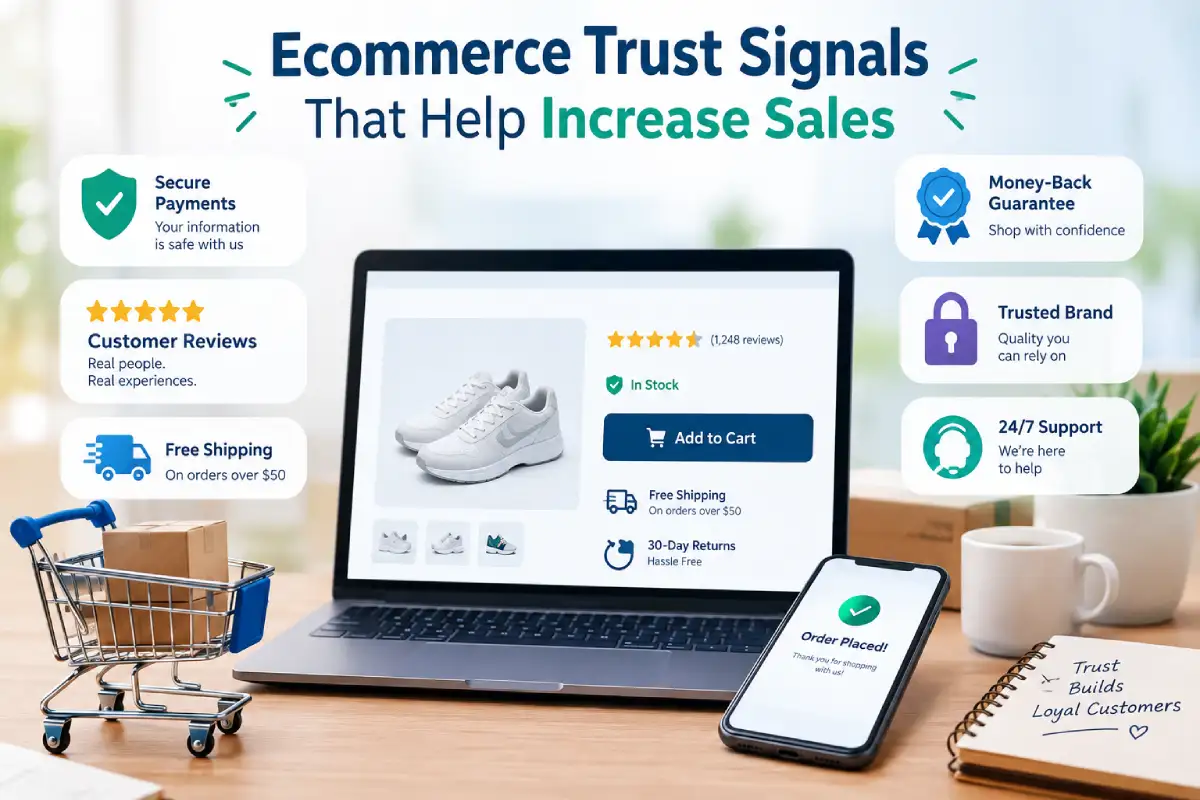
Ecommerce Trust Signals That Help Increase Sales
Last Updated: September 15, 2026
Trust Signals. Before consumers purchase anything online, they want assurance. With a physical shop, a consumer is unable to have firsthand access to view an item on display, have direct contact with a salesperson, or see the store environment, none of which consumers feel confident spending money online with ecommerce businesses lacking. Trust signals on websites provide customers with assurance about a certain ecommerce shop that they are secure, credible, safe, and customer-friendly by displaying some sort of guarantee.
Trust signals include customer reviews, badges on payment methods, explicit return policies, payment guarantees, shipping policies, contact pages, guaranteed service, and accepted and secure payment options. When trust signals were clearly visible, customers would overcome doubts about what they feel the trust they are shown may result in and therefore continue with their purchasing cycle.
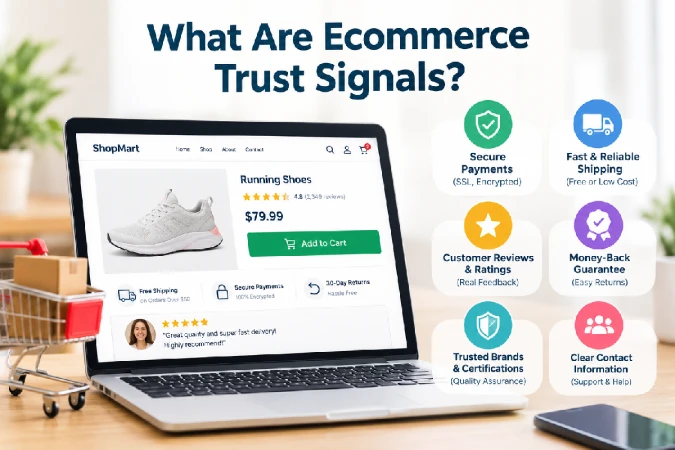
What Are Ecommerce Trust Signals?
E-commerce trust signals. Trust signals are either visual, informative, or functional cues that let the shopper know that the e-commerce site is safe and trustworthy.
Trust signals answer questions like:
- Is this a real website?
- Is my personal information safe?
- Will the item reach me by the specified delivery date?
- Is it returnable if it does not fit me or it is not working correctly?
- What are customers’ reviews on this item?
- Can I contact the company if it arrives broken?
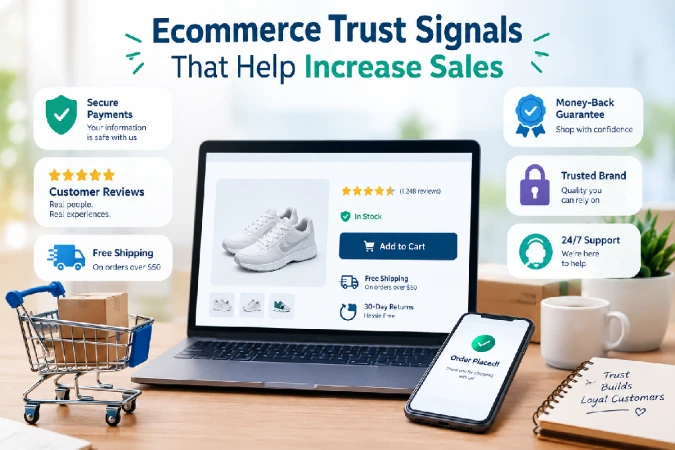
Common Ecommerce Trust Signals
| Trust Signal | What It Communicates | Where It Helps Most |
| Customer reviews | Other people have purchased and used the product | Product pages |
| Star ratings | Quick social proof | Product listings |
| Secure checkout badge | Payment information is protected | Checkout |
| Payment logos | Familiar payment options are available | Product and checkout pages |
| Return policy | Customers have options if unhappy | Product and checkout pages |
| Shipping information | Delivery expectations are clear | Product pages |
| Money-back guarantee | Lower purchase risk | Product pages |
| Contact information | The business is accessible | Header/footer |
| FAQ section | Common concerns are answered | Product and checkout pages |
| Warranty information | Product support is available | Product pages |
Trust signals don’t just get “bolted on” haphazardly. What will work best is right trust signaling at the point a customer is most likely to have that worry.
How Customer Reviews Build Ecommerce Trust?
Among other trust signals, customer reviews are incredibly helpful as social proof. People often care to know if other individuals were happy with the product or not. While product descriptions are directly from the seller, customer reviews of the product are from individuals who are already using it, making the reviews highly relatable.
Use Detailed Reviews
Short reviews, like”Great product!”, are a nice ego boost, but more in-depth commentary may also give you a lot of information to work from. A satisfied customer might have the following to add to their review:
- How they used the product
- Whether the product matched its description
- How long delivery took
- What they liked most
- Whether the product had any limitations
This information can allow buyers to be better informed.
Display Star Ratings Clearly
The stars allow shoppers to gain a basic understanding of customers’ feelings. For example:
| Rating | Possible Customer Impression |
| 4.5–5 stars | Very positive feedback |
| 4.0–4.4 stars | Generally positive |
| 3.5–3.9 stars | Mixed but potentially acceptable |
| Below 3.5 stars | May require closer investigation |
The ratings ought to be shown with a quantity in each category. Two 5-star ratings aren’t worth nearly as much in social proof as hundreds of strongly-rated verified buyers.
Use Verified Purchase Labels
A verified purchase marker can show that other customers actually purchased this product.
Stores may also allow the use of customer-uploaded photos and videos. User-created photos and videos add context to customers as to what the product would look like in real life as opposed to professional product shots.
Security and Payment Trust Signals for Online Stores
It is imperative for customers browsing an online shopping site that they are comfortable with the security measures in place regarding their financial and personal details.
It is essential that an expert ecommerce site not bombard the customer with all its Payment options but give them an outline of its practices.
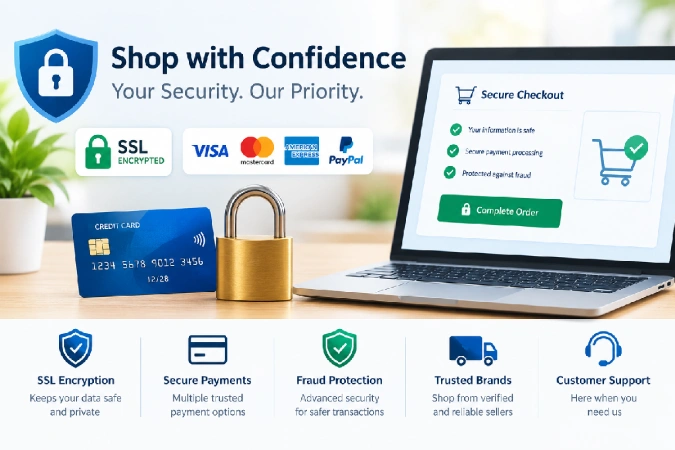
Important Security and Payment Signals
| Signal | Purpose |
| HTTPS connection | Shows that the website uses an encrypted connection |
| Recognizable payment methods | Gives customers familiar ways to pay |
| Secure checkout messaging | Reinforces payment confidence |
| Privacy policy | Explains how customer information is handled |
| Fraud protection information | Can reassure shoppers about transaction safety |
| Clear billing information | Reduces uncertainty before payment |
| Contact details | Gives customers a way to seek assistance |
The obvious payment method is good to show customers confidence, as it was easy for customers to complete the purchase on those known payment methods. The checkout page should not have too many distractions. Customers must be able to find their order total, delivery charges, payment type, and necessary conditions.
Shipping, Returns and Guarantee Trust Signals
Your customer loves your product, but the unknown around the delivery process or returns policy stops them from buying. Simple shipping and returns information would remove this obstacle.
Shipping Trust Signals
What would be valuable to them::
- When their order will arrive
- How much shipping costs
- Whether tracking is available
- Which areas the store serves
- Whether express delivery is available
- What happens if delivery is delayed
Replace vague language like “Fast Shipping” with factual information. A clear statement would provide details on shipping processing and estimated delivery time.
Return and Refund Policies
A transparent and easy-to-read returns policy can help put customers at ease when making purchases online.
The policy should describe:
- How many days customers have to request a return
- Which products are eligible
- Whether return shipping costs apply
- How refunds are processed
- Whether exchanges are available
- What condition the product must be in
Shipping and Return Trust Signals
| Customer Concern | Helpful Trust Signal |
| “When will my order arrive?” | Estimated delivery date |
| “How much is shipping?” | Clearly displayed shipping cost |
| “Can I track my order?” | Order tracking information |
| “What if I don’t like it?” | Clear return policy |
| “When will I get my refund?” | Refund timeline |
| “What if the product breaks?” | Warranty or guarantee |
| “Can I contact someone?” | Customer support details |
Guarantees and Warranties
The fact of money-back, product warranty, or satisfaction guarantee can make consumers perceive less of a purchasing risk if it truly applies to them. However, companies ought not to provide guarantees in fine print or those they expect the consumer to never understand the conditions of, because the higher they build our trust when they tell the truth about conditions for such assurances.
Where to Place Trust Signals on an Ecommerce Website
Location of trust signals. A customer needs to see trust signals in relevance to what may induce doubt before they are in a position to become suspicious and abandon the purchase.
Recommended Trust Signal Placement
| Website Area | Useful Trust Signals |
| Homepage | Reviews, guarantees, security information, customer numbers |
| Navigation/header | Contact information, support access |
| Category pages | Ratings, review counts, delivery information |
| Product pages | Reviews, ratings, shipping, returns, warranty |
| Shopping cart | Shipping costs, returns, secure checkout message |
| Checkout | Payment options, security information, support |
| Footer | Contact details, policies, payment methods |
| FAQ page | Shipping, returns, payments and product questions |
Homepage
Homepage- Generally the main first opportunity to build trust. You could display customer testimonials, assurances, different payment options, badges and awards you are legitimately entitled to, and clear customer service details.
Product Pages
Product Pages. “This section is vital. Product Pages represent where all the purchase decisions will be made.
Include trust signals on Product Pages around the product title, product price, add to cart button, and ordering details.
Good elements could be:
- Star rating
- Review count
- Shipping estimate
- Return policy link
- Warranty information
- Secure payment message
- Customer support option
Checkout Page
Checkout customers need validation while being “un-faked”. Ensure that all of their required and relevant information, including what payment methods they could use (or can’t use), what they bought, the total shipping costs, and their security information, remains in the user’s view.
Best Practices for Using Ecommerce Trust Signals
The most effective trust signals are authentic, pertinent, and simple. A cluttered website with many dozens of badges and claims will more likely be seen as an untrustworthy site than the opposite.
Here are best practices:
- Use genuine customer reviews.
- Keep return and shipping policies easy to find.
- Display familiar payment methods.
- Avoid fake urgency or misleading claims.
- Make contact information accessible.
- Explain guarantees clearly.
- Use security messaging accurately.
- Place trust signals near important conversion points.
- Keep checkout simple.
- Update outdated policies and information.
Trust Signal Checklist
| Check | Recommended Action |
| Reviews | Display authentic reviews and ratings |
| Payments | Show available payment methods clearly |
| Security | Use accurate security information |
| Shipping | Provide realistic delivery estimates |
| Returns | Make return conditions easy to understand |
| Guarantees | Explain eligibility and limitations |
| Support | Provide accessible contact options |
| Checkout | Keep reassurance visible but unobtrusive |
| Mobile | Make trust signals easy to see on smaller screens |
| Consistency | Use the same policies and claims throughout the site |
Final Thoughts
Ecommerce trust signals can make shoppers feel more secure about proceeding with their order, as well as contributing to conversion rates in other ways: the social proof of customer reviews and clear information about the security features that secure transactions. The clarity of the policies regarding shipping, returns, and guarantees eliminates the uncertainty related to shopping. The approach should not be to clutter each page with numerous badges, logos, and advertising jargon.
Instead, address customer concerns at different stages of their buying journey and provide concrete information that addresses those questions at the most relevant points.
With an online shopping presence that brings together actual customer reviews with solid, transparent information about the security of their online transactions and support to back them up, the shopper will be even more confident that proceeding with the purchase will not pose any risks.