

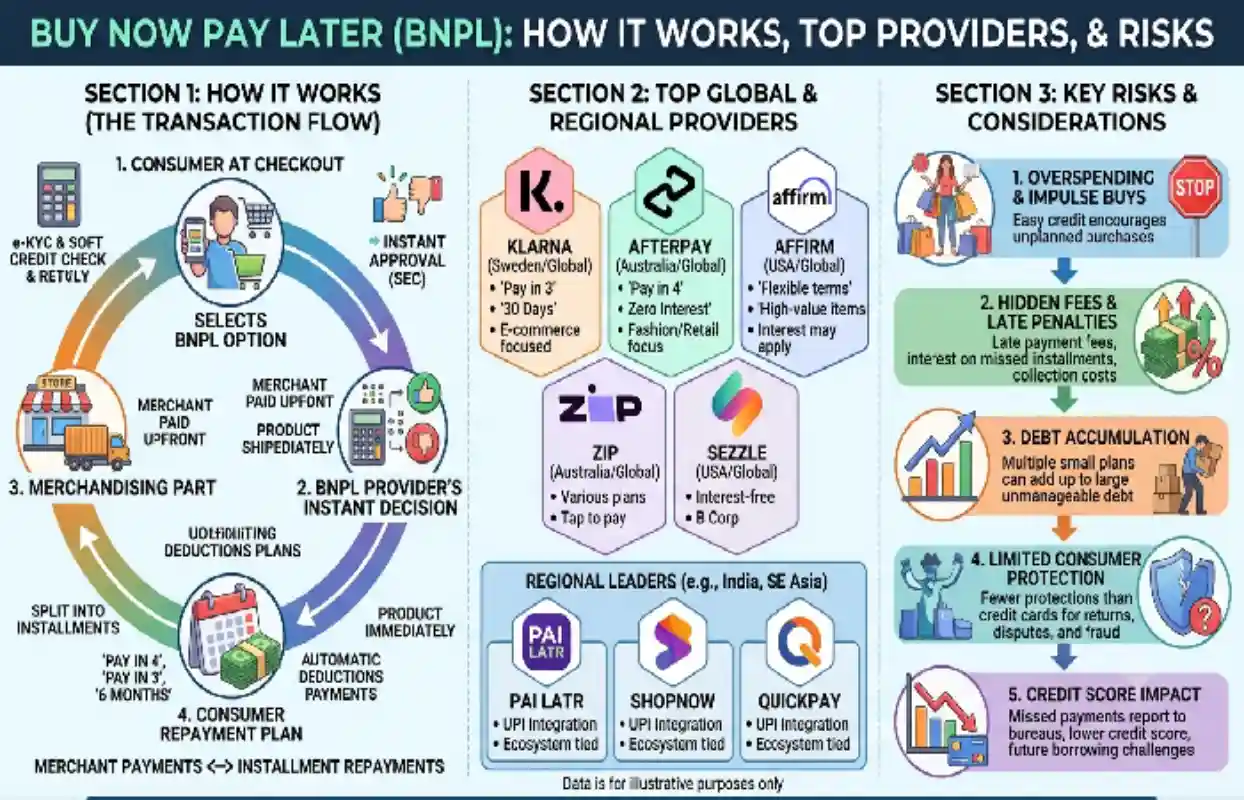
Buy Now Pay Later (BNPL): How It Works, Top Providers, and Risks
Last Updated: September 21, 2026
Buy Now Pay Later (BNPL) has gained popularity as an alternative credit solution for consumers who want to manage a larger purchase over multiple payments. Rather than settling the full sum at checkout, customers have the option to distribute their purchases across a number of predetermined payments.
BNPL services are sometimes featured at online checkouts and are more and more common at the physical checkout. It can help make bigger purchases much more affordable but it is not without its risks for the customer. It is important to remember to always make payments on time, that late payments may result in fees, that the service may tempt users into overspending and that there could be collateral problems with credit.
For consumers or businesses, it is valuable to learn how BNPL works, and thus help them to decide whether it is a helpful way of payment method or simply a costly financial practice.
How BNPL Services Work
The basic BNPL process is relatively simple.
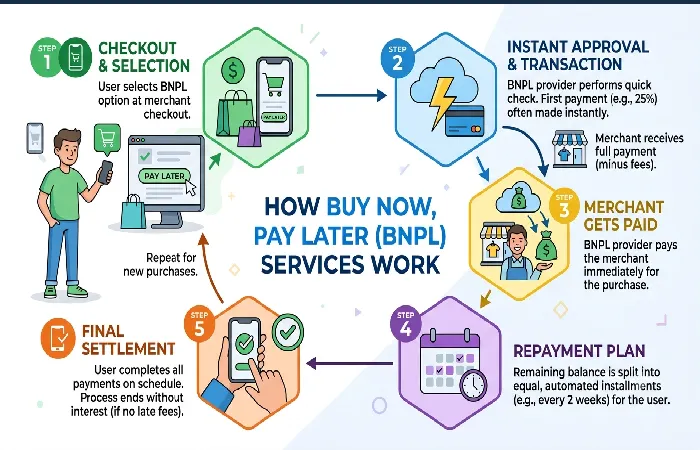
When shopping online or in a participating store, a customer selects a BNPL provider at checkout. The provider may conduct an eligibility or credit assessment and, if approved, allows the customer to complete the purchase while paying the provider over time.
A typical transaction works like this:
- Choose BNPL at checkout.
- Apply or receive an eligibility decision.
- Pay an initial installment, depending on the plan.
- Receive the product immediately.
- Make the remaining scheduled payments.
One common structure is the “pay in four” model, where the purchase is divided into four installments over a relatively short period. However, providers may also offer longer-term financing for larger purchases.
Whether BNPL is interest-free depends on the specific plan. Some short-term products may advertise no interest, while longer financing arrangements can carry interest charges or other costs.
Consumers should therefore check:
- Annual percentage rate (APR), if applicable
- Late-payment fees
- Payment schedule
- Down-payment requirements
- Refund and cancellation policies
- Credit-reporting practices
- Consequences of missed payments
BNPL isn’t free simply because a particular plan doesn’t charge interest. A missed payment or unnecessary purchase can still create financial problems.
Top BNPL Providers: Klarna, Afterpay, and Affirm
Several companies have become prominent names in the BNPL market.
Klarna
Klarna offers payment options that can allow eligible shoppers to split purchases into installments or use longer-term financing for certain purchases.
Its services and terms vary depending on the country, merchant, product, and consumer eligibility.
Afterpay
Afterpay is widely associated with installment-based shopping. Its core model allows eligible customers to divide qualifying purchases into scheduled payments.
Afterpay’s availability, fees, payment structures, and credit-reporting practices can vary by market and product.
Affirm
Affirm provides point-of-sale financing for purchases through participating merchants. Depending on the transaction, consumers may receive different repayment periods and interest rates.
Unlike a simple short-term installment plan, some Affirm financing options can involve interest, making it particularly important to review the terms before accepting an offer.
Comparing BNPL Providers
| Provider | Typical Model | Interest | Best Known For |
| Klarna | Installments and financing | Depends on plan | Flexible digital checkout options |
| Afterpay | Scheduled installments | Depends on market/product | Short-term installment payments |
| Affirm | Installment financing | Can apply | Flexible financing for larger purchases |
The “best” BNPL provider depends on the purchase, location, eligibility, repayment terms, and total cost—not simply the brand name.
BNPL vs. Credit Cards
BNPL and credit cards both allow consumers to purchase something without paying the entire amount immediately, but their structures are different.
| Feature | BNPL | Credit Card |
| Repayment | Usually fixed installments | Flexible minimum payments |
| Interest | May be zero or charged depending on plan | Usually charged when balance isn’t paid in full |
| Credit limit | Usually transaction/account based | Revolving credit limit |
| Rewards | Limited or provider-specific | Often available |
| Long-term borrowing | Usually limited | Widely available |
| Payment schedule | Predetermined | Usually monthly |
| Overspending risk | Can encourage frequent installment purchases | Can encourage revolving debt |
A major advantage of BNPL is predictability. A shopper may know exactly how much will be deducted and when.
Credit cards, however, can offer broader benefits, including rewards, fraud protections, established credit-building opportunities, and greater flexibility.
The downside of credit cards is that carrying balances can result in significant interest charges.
BNPL isn’t automatically better or worse. Consumers should compare the total repayment amount and consider whether the purchase is affordable without financing.
Impact of BNPL on Credit Score
One of the most frequently asked questions is: Does BNPL affect your credit score?
The answer is: it depends on the provider, product, country, and whether the provider reports activity to credit bureaus.
Some BNPL applications may involve a soft credit check, which generally doesn’t affect a consumer’s credit score in the same way as a hard inquiry. Other financing products may involve a hard inquiry.
BNPL payment activity can also be treated differently depending on the provider.
Potential scenarios include:
- No regular reporting of short-term BNPL payments
- Reporting of certain financing products
- Hard or soft credit checks depending on the application
- Negative consequences if unpaid balances are sent to collections
- Different treatment across countries and credit-reporting systems
Consumers shouldn’t assume that “BNPL doesn’t affect your credit” universally applies.
Before using a service, read its current credit-reporting policy. Paying on time is still important even when routine payments aren’t reported, because missed payments can lead to fees, account restrictions, collections activity, or other financial consequences.
BNPL for Merchants and Businesses
BNPL isn’t only a consumer-finance product. It has also become a tool for merchants looking to improve the shopping experience.
When businesses offer BNPL at checkout, customers may be more willing to purchase higher-priced products because the cost can be spread across multiple payments.
Potential merchant benefits include:
- Higher average order values
- Greater purchasing flexibility for customers
- Potential improvements in checkout conversion
- Access to customers who prefer installment payments
- Competitive differentiation
- Additional payment options
However, merchants don’t receive these benefits for free.
Businesses should evaluate:
- Merchant transaction fees
- Settlement timing
- Refund procedures
- Integration costs
- Customer-service responsibilities
- Fraud and dispute processes
- Regulatory requirements
- Impact on profit margins
A BNPL option that increases sales but significantly reduces margins may not improve the business financially.
Risks of Buy Now Pay Later
BNPL can be convenient, but it can also make spending feel less expensive than it actually is.
1. Encourages Overspending
Seeing a $400 purchase presented as four $100 payments can make the purchase psychologically easier to justify.
2. Multiple Payment Plans Can Add Up
A consumer may have several BNPL purchases running simultaneously. Each individual payment might look affordable, but the combined obligation can become difficult to manage.
3. Missed Payments
Late payments can potentially result in fees, account restrictions, collections activity, or credit consequences depending on the provider and product.
4. Interest on Some Plans
Not every BNPL product is interest-free. Longer-term financing can carry an APR.
5. Refund Complications
Returning an item doesn’t necessarily mean all future payment obligations disappear immediately. Consumers should understand the provider’s refund process and wait for confirmation that the payment schedule has been adjusted.
How to Use BNPL Responsibly
BNPL can be useful when used as a payment-management tool rather than a way to purchase things you cannot afford.
Before choosing BNPL:
- Check the total amount you’ll repay.
- Confirm whether interest applies.
- Review late-payment policies.
- Make sure future installments fit your budget.
- Avoid stacking too many BNPL plans.
- Check whether the service reports to credit bureaus.
- Read the refund and cancellation terms.
- Don’t use installments to justify unnecessary purchases.
A simple rule is useful: if you couldn’t reasonably afford the purchase without BNPL, consider whether you should be making the purchase at all.
The Future of BNPL
BNPL is widely integrated into digital shopping and advanced payment schemes nowadays. In the face of growing competition, providers branch out from basic four-amenity products to more long-term loans, financial management, merchant solutions, and digital-payment environment.
Buyers: the biggest benefit is convenience and predictable installments payments. For sellers, the benefits could be improved conversion rates and enabling larger shopping.
However, convenience shouldn‘t stand in for financial prudence. Buy Now Pay Later is most effective when consumers are clear about the repayment schedule, adopt a cautious approach to borrowing, and think of installment payments as a financial responsibility rather than an opportunity to be handed out cash.
Final Thoughts
Buy Now Pay Later offers an easy way to ‘pay over time’ for purchases, but it doesn‘t come without caveats. Different providers like Klarna, Afterpay, Affirm have varying plans, charges, qualifying criteria, and credit-reporting practices.
Before using it, compare the total price, the payment frequency, interest, charges, effects on your credit score & refund policy. Businesses should decide by fees charged & if sales growth surpasses the costs.
Used responsibly, BNPL can be a flexible payment option. Used repeatedly without a clear budget, however, multiple installment plans can quickly turn convenience into financial stress.