

Peer-to-Peer (P2P) Lending: How It Works, Returns, and Top Platforms
Last Updated: September 21, 2026
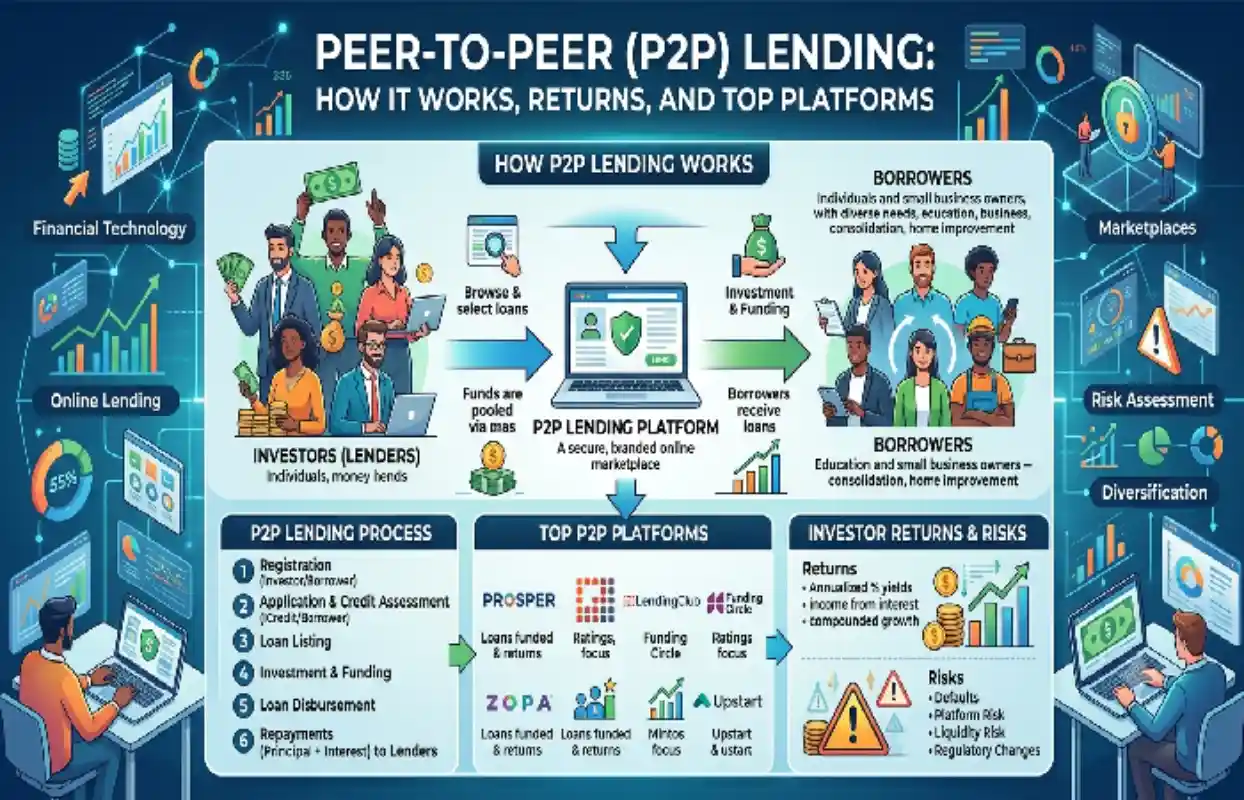
So, how does P2P lending work? P2P lending is also becoming an available income source; it involves individuals and businesses borrowing cash from individuals like you on their own web platform. This essentially means that when you deposit into P2P lending, you are not having the entire amount sitting idle as cash and invested through a market of instruments related to it. In this case, you are able to have some part of your cash working, having potential earnings from lending it and being repaid principal and interest at scheduled intervals.
But with increased possible returns comes added risk.
There is also a risk of loan default.
In the Indian case of P2P lending, it’s functioning under the NBFC-P2P classification based on a particular regulatory regime by the Reserve Bank of India (RBI). The intention here is to demonstrate how P2P lending works, including returns and risks, its diversifications, and what factors should be taken into consideration before you choose a P2P platform.
What is P2P Lending?
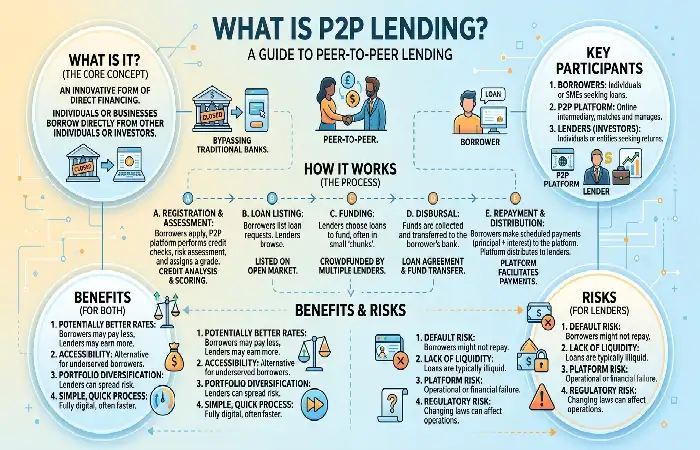
P2P lending is where those seeking an investment (lenders) are directly linked to those who need to raise money (borrowers). Unlike traditional lenders who loan their own capital, the service acts simply as a platform. An example would be an investor making many small loans to a number of individual borrowers. Each borrower repays the amount and any interest charged under the loan terms.
| Participant | Role |
| Lender | Provides money and earns interest |
| Borrower | Receives a loan and repays it |
| P2P platform | Facilitates matching, servicing, and transactions |
| Escrow mechanism | Helps route participant funds |
To set up an NBFC-P2P platform in India, one needs to get registration from RBI. The prevailing norms suggest that the mandatory net owned fund would be 2 crores for the purpose of registration.
How P2P Lending Platforms Work?
In investor terms, the whole business is quite straightforward.
Step 1: Register on a Platform
You create an account and complete the platform’s required identity and compliance checks.
Step 2: Add Funds
Money is transferred through the permitted banking and escrow mechanisms rather than being treated as a normal deposit with the P2P company.
Step 3: Select Lending Opportunities
With the specific investment provider, it may be possible to choose individual investors, classes of loans, investment styles, or preset investment strategies.
Step 4: Money Is Lent to Borrowers
Your investment is allocated to eligible loans. There are also some of these lending platforms that permit “fractional” lending. This means relatively small sums are lent to quite a large number of borrowers.
Step 5: Receive Repayments
Borrowers generally make periodic payments consisting of principal and interest. You can withdraw the money or reinvest repayments, depending on the platform’s terms.
Important: A P2P platform is not a bank deposit, and the platform does not necessarily guarantee repayment. RBI-related guidance specifically recognizes the possibility of losing the entire principal if a borrower defaults.
P2P Lending Returns and Risks
The biggest attraction of P2P lending is the possibility of earning returns that may be higher than traditional savings products. However, advertised or historical returns should never be treated as guaranteed returns.
Actual results can be affected by borrower defaults, delays, fees, taxes, and the time your money remains uninvested.
Potential Benefits
- Potentially higher interest income
- Access to an alternative investment category
- Ability to spread money across multiple loans
- Regular repayment cash flow
- Online account management
Major Risks
| Risk | What It Means |
| Default risk | A borrower may fail to repay |
| Principal loss | You can potentially lose part or all of an individual loan |
| Liquidity risk | Your money may be tied up until repayments occur |
| Concentration risk | Too much money in one borrower can increase losses |
| Platform risk | Operational problems can affect servicing |
| Tax risk | Interest income may create a tax liability |
| Return variability | Actual returns can differ from advertised rates |
A better way to think about P2P returns than just headlines for interest is to think about your net return.
For example:
Net return = Interest received − defaults − platform fees − applicable taxes
Then you get a real idea of what you truly make.
Top P2P Lending Platforms
There is no single “best” P2P platform for all investors. This ultimately depends on your level of risk tolerance, your desired size of investment, the types of loans you want to fund, the fees you’re comfortable with, the transparency of the platform, and the opportunity to diversify your portfolio across many investors/loans. Some platforms currently functioning in India’s P2P network include LenDenClub, Faircent, Lendbox, LiquiLoans, IndiaP2P, and Rang De. Indian Government websites, in its lists and information on P2P lending in the past, have included Faircent, i2ifunding, Lendbox, and LenDenClub.
Recent platform disclosures and industry directories show differences in minimum investment amounts, loan tenures, and targeted returns, so investors should verify current figures directly before investing.
| Platform | What to Check | Suitable For |
| LenDenClub | Loan diversification, fees, performance data | Investors exploring consumer lending |
| Faircent | Borrower information and risk categories | Investors wanting loan selection |
| Lendbox | Portfolio options and historical performance | Investors seeking diversified lending |
| LiquiLoans | Product structure and fees | Investors comparing managed options |
| IndiaP2P | Portfolio performance and diversification | Investors looking for structured strategies |
| Rang De | Social-investing model and loan opportunities | Investors interested in social impact |
Make sure to double-check the current RBI registration and latest disclosures from the platform before investing funds. RBI registration only governs the functioning of the platform; it does not guarantee your investment or returns.
Diversifying P2P Investments
Diversification is a core concept in lending through P2P. The risk profile for lending 1 lakh to a single borrower would remain very distinct from 1 lakh distributed over dozens or even hundreds of loans.
A Simple Diversification Approach
| Strategy | Example |
| Multiple borrowers | Spread money across many loans |
| Different risk grades | Avoid concentrating only in high-risk loans |
| Different loan categories | Mix eligible consumer/business exposures where available |
| Different maturities | Use varying loan durations |
| Platform diversification | Consider whether spreading exposure across platforms makes sense |
| Reinvestment | Reinvest repayments gradually rather than concentrating new money |
Instead of putting 50,000 into a single loan, a trader might split the capital across many loans. Don’t Chase the Highest Interest Rate
In particular, if an offered loan rate seems substantially above the norm, it warrants closer examination. Higher rates can reflect higher borrower risk.
Before investing, look at:
- Borrower credit information
- Historical delinquency/default data
- Loan tenure
- Platform fees
- Recovery procedures
- Portfolio-level performance
- Concentration limits
- Liquidity provisions
The aim is not the highest advertising return.
P2P Lending Regulations and Taxes
P2P lending in India is a regulated system under RBI guidelines through the framework of NBFC-P2P.
Platforms cannot operate as P2P businesses without the appropriate RBI registration. The RBI’s 2025 directions provide the regulatory framework covering registration, permissible activities, governance, prudential requirements, and other operational matters.
The regulatory framework also requires mechanisms for handling participant funds and emphasizes that platforms should not provide assurances of loan recovery.
What About Taxes?
Interest earned from P2P lending can have tax implications. Your actual tax treatment depends on your circumstances and the applicable income-tax rules.
Keep records of:
- Interest received
- Principal repayments
- Platform fees
- Defaults or losses
- Tax deducted at source, if applicable
- Annual statements supplied by the platform
Don’t assume that a platform’s advertised return is the amount you will ultimately keep after taxes.
For significant investments, it can be useful to consult a qualified tax professional about the appropriate treatment for your specific situation.
P2P Lending vs Traditional Investments
| Factor | P2P Lending | Bank Fixed Deposit | Equity |
| Potential return | Moderate to high | Generally predictable | Potentially high |
| Capital guarantee | No | Subject to applicable deposit protection/rules | No |
| Default risk | Borrower-dependent | Generally lower | Company/market-dependent |
| Liquidity | Often limited | Usually better | Generally high |
| Market volatility | Lower visible volatility | Low | High |
| Diversification | Loan-based | Bank-based | Market-based |
Consequently, an investment in peer to peer lending will occupy a different space in the structure of a portfolio to accounts, deposits, shares and equities.
Final Takeaway
Peer-to-peer lending is a different opportunity to create interest returns, though this must not remain understood as an investment guarantee. Credit risk, the regulatory authority of the platforms used, spreading loans among others, reading “net” and not “headline” return, as well as only investing disposable funds for the loan period, is of paramount importance.
To briefly sum this up, increased return potential in P2P lending corresponds with higher credit and liquidity risk. Disciplined investing and lending to a diversification of parties will probably seem more rational than chasing the highest advertised interest rate.