

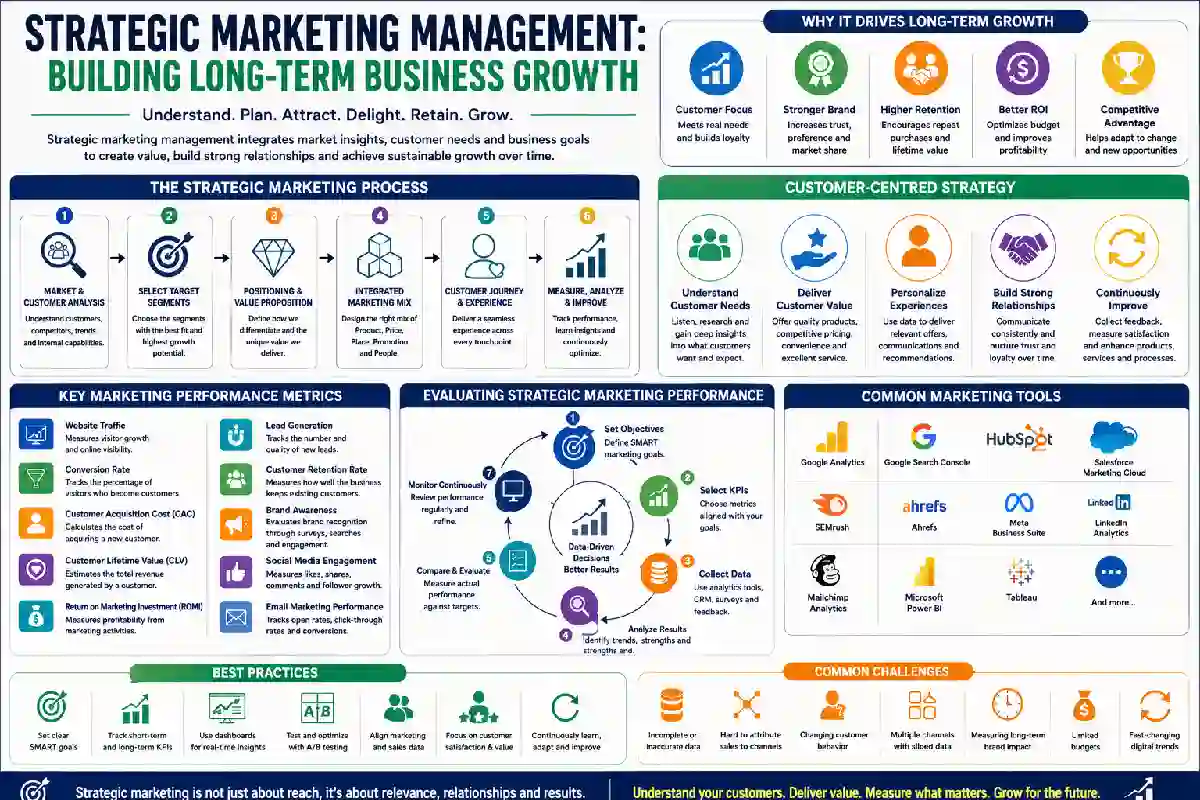
Strategic Marketing Management: Building Long-Term Business Growth
Last Updated: July 12, 2026
Strategic marketing management is about integrating marketing decisions that impact both the past and the future so that a company is capable of sustainable growth, not short-term sales. It is about acquiring knowledge about customers, competition and marketplace movements, then translating this into building a sustainable competitive advantage and stronger customer relationships.
Strategic Marketing Management contains
- Market/customer analysis to identify real demand, unmet needs, and profitable segments.
- Increasing loyalty, repeat purchase and lifetime value through brand building and relationship management.
- Long-term planning in relation to product, price, distribution and promotion, so that marketing is positioned to support the entire business plan.
Why does it contribute to growth?
Strategic marketing enables a ‘business to step out of examples of punchy campaigns’ into a ‘repeatable, scalable, business-building’ system. It sustains profitability and competitiveness by emphasising the needs of a customer, positioning the company accordingly and growing the share of mind and wallet. It also enables firms to prepare for a range of subsequent developments, such as digital media, changing customer behaviour and new market opportunities, without losing focus.
- Market analysis: customers, competitors, trends and more internal capabilities.
- Decide on target segments that will best fit and have high growth.
- Positioning and value proposition should be defined to distinguish one’s offer from the others.
- Create an integrated marketing mix and customer journey plan.
- Measure retention, customer lifetime value, brand health, and growth efficiency.
What is it? Strategic Marketing Management
Strategic marketing management is the design, implementation, and control of a coherent mix of activities tailored to provide value for the mission, targeted customers, and market opportunities of an organisation by using marketing resources and effectiveness so as to achieve business objectives over time.
Main concept.
It begins with a comprehension of the marketplace, followed by selecting the appropriate target market and finalising positioning strategies. Following these steps, the firm adjusts product, price, distribution and promotion in order to deliver value products over time.
Significance of the research
Strategic marketing management is also used to drive up sales and help the organisation meet its future needs. It is used when we want to achieve sales growth over a period of time.
Strategic marketing planning
Strategic marketing planning is defining long-term marketing objectives and determining the marketing mix to be used to achieve them, (target markets, value position and mix). An operational plan, should as a minimum, identify: the conditions faced, the target market, the value position, and how it will position itself and achieve its objectives.
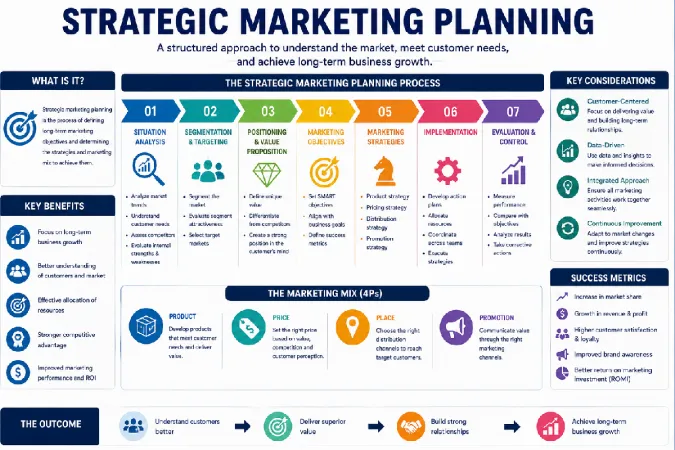
Competitive analysis and positioning
Competitive analysis- placing a product in a category, studying direct and indirect competitors, examine their strengths and weaknesses, their prices, communication, and market share, until appropriate Positioning. Market positioning is defining how your product must be differentiated in the mind of the customer, bridging a gap left by the competitors.
Customer-Centred Strategy
Customer-centred strategy is a kind of business strategy that put consumers first in every aspect of a company’s operation,products,services and marketing. The strategy is not only targeted at selling products but also focus on customers’ needs, wants, behaviour, and expectations to offer better value and long-term relationship. Companies running a customer-centred strategy value loyal customers, customer satisfaction,and life-long value which result in continuing development and competitive advantage.
Importance of a Customer-Centred Strategy
In today’s world, customers are more powerful than ever and have a huge choice of options. Those that deliver the same experience everywhere and actually address customer needs will be those to win long term customers. The use of customer-centric approaches can enable companies to:
- Enhance customer satisfaction.
- Build long-term customer loyalty.
- Higher customer retention rates.
- Create positive word-of-mouth recommendations.
- Improve the reputation of the brand.
- Maximise sales and profit.
- Gain a competitive edge.
Evaluating Strategic Marketing Performance
Strategic marketing performance evaluation is the process of providing management with data on how well or how poorly the marketing strategy is achieving the organization’s business objectives. It allows the organization to determine if its marketing activities are creating strengthened brand awareness and added value, attracting more customers and earning revenues, and returning a positive return on marketing investment.
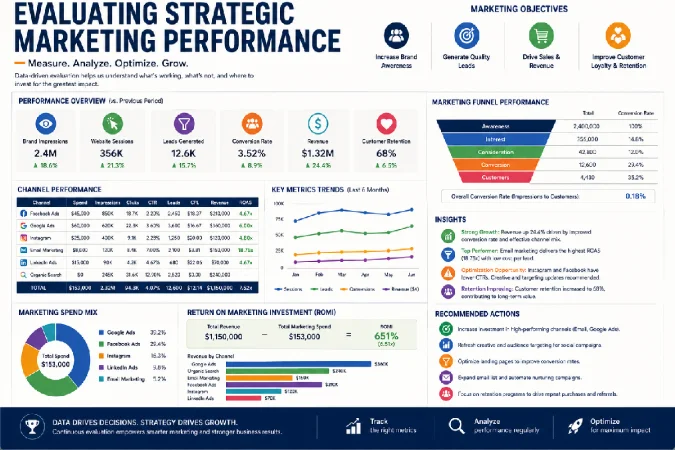
Why Strategic Marketing Performance Matters
Performance measurement helps guarantee that all marketing efforts are directed towards serving general business objectives. Measuring outcome allows organizations to avoid throwing good money after bad on road-destined endeavors and to take full advantage of chances to expand. When applied systematically, it is usually designed to enable companies to:
- Evaluate marketing strategies.
- Enhance the acquisition and retention of customers
- Optimise marketing budgets.
- Improve the return on investment in marketing (ROMI).
- Help in making decisions based on data.
- Best a competitive touch.
Key Marketing Performance Metrics
Businesses use a variety of Key Performance Indicators (KPIs) to evaluate marketing effectiveness.
| KPI | Purpose |
| Website Traffic | Measures visitor growth and online visibility. |
| Conversion Rate | Tracks the percentage of visitors who become customers. |
| Customer Acquisition Cost (CAC) | Calculates the cost of acquiring a new customer. |
| Customer Lifetime Value (CLV) | Estimates the total revenue generated by a customer over time. |
| Return on Marketing Investment (ROMI) | Measures profitability from marketing activities. |
| Lead Generation | Tracks the number and quality of new leads. |
| Customer Retention Rate | Measures how well the business keeps existing customers. |
| Brand Awareness | Evaluates brand recognition through surveys, searches, and social engagement. |
| Social Media Engagement | Measures likes, shares, comments, and follower growth. |
| Email Marketing Performance | Tracks open rates, click-through rates, and conversions. |
Methods for Evaluating Marketing Performance
A successful business will use a combination of evaluation methods to get a complete picture.
Campaign Performance Analysis
Individually evaluate each marketing campaign by comparing the goal of the campaign against what truly happened. The campaign has to be looked at individually by examining impressions, clicks, conversions and revenues.
Customer Analytics
You analyze customer behavior during each stage of the buying cycle using CRM, website analytics and customer questionnaires. Customer insight is useful for future marketing campaigns.
Sales Performance Evaluation
Match marketing activities with sales results and see which groups of campaigns influence the figure sales sales volume or value.
Competitive Benchmarking
Compare your marketing effectiveness to competitors by ranking yourself in terms of market share, pricing plan, customer engagement, and online presence.
Financial Performance Analysis
Assess profitability based on a comparison of marketing expenses with generated revenues. ROI, ROMI, and profit margin are some measures that help analyse financial effectiveness.
Marketing Evaluation Framework
An effective evaluation process typically follows these steps:
- Establish Specific Objectives set quantifiable marketing goals.
- Select KPIs that are relevant and aligned with your business goals.
- Gather data. Collect data from analytics software, CRM, surveys, or other outbound feedback from customers.
- Analyse Results – Spot trends, strengths, and weaknesses.
- Compare against targets- real performance versus planned performance.
- Improvements to be made: Use the insights gained to make adjustments to the marketing approaches.
- Use Monitoring – consistently review performance so long as it continues to be successful.
Common Marketing Analytics Tools
Businesses rely on various tools to monitor and evaluate performance, including:
- Google Analytics
- Google Search Console
- HubSpot
- Salesforce Marketing Cloud
- SEMrush
- Ahrefs
- Meta Business Suite
- LinkedIn Analytics
- Mailchimp Analytics
- Microsoft Power BI
- Tableau
Common Challenges
Organizations often face challenges when evaluating marketing performance, including:
- Data that is either incomplete or not tracked correctly.
- We find it harder to pinpoint sales by marketing channel.
- Alter the nature of consumer behavior.
- Several marketing channels with incoherent data.
- Long-term brand impact measurement.
- Limited marketing budgets.
- Trends in digital marketing that are changing very fast.
Best Practices
To improve strategic marketing evaluation:
- Set SMART marketing goals.
- Monitor all short- and long-term KPIs.
- Use dashboards for immediate reporting.
- Update the review performance periodically.
- Test and optimize campaigns by using A/B testing.
- Combine the marketing and sales figures.
- Pay attention to customer-oriented satisfaction along with income.
- In need to identify the benefit of continually learning and improving.
Conclusion
In conclusion, strategic marketing management is not a one-off activity but rather a continuous process of planning, execution, control and continuous improvement. Entities that develop and maintain a customer-oriented attitude, bring the necessary resources to harness market research, learn how to use it effectively and adapt to business conditions in an agile fashion will be able to attain lifelong profitability, secure optimal corporate development and success.