

SEO Marketing Strategies to Rank Higher on Google in 2026
Last Updated: September 15, 2026
SEO Marketing Tactics to Rank Higher on Google in 2026 are much more radically different today than they were even 2 years ago. With the escalation of AI-created content, Google’s 2026 algorithm goes out of its way to reward content that is experience-based, has E-E-A-T signals, and has real value to the end user.
This step-by-step manual explains precise SEO tactics that will be effective in 2026 and exactly how to implement them, from on-page optimization, off-page strategies, local SEO tactics, through technical SEO best practices and keyword research approaches. It is perfect for small-business owners, marketers, and SEO novices alike; you’ll find concrete action plans, real 2026 data, and clear direction to enhance your positioning.
Core SEO Strategies That Work in 2026
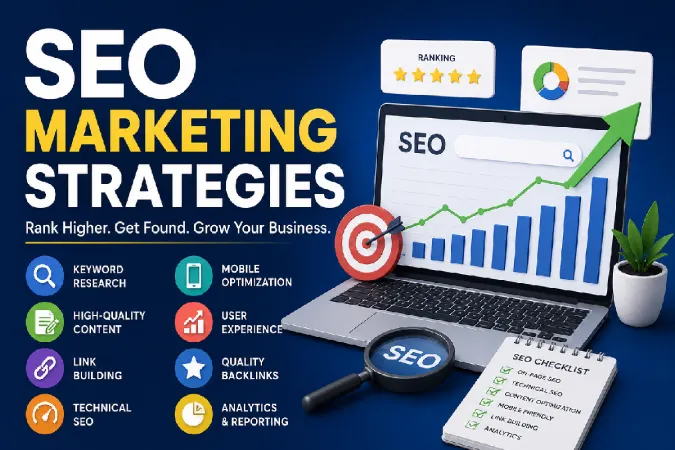
Strategy 1: Topical Authority Over Keyword Targeting
What it is: Instead of working on hundreds of individual keywords, focus on building full-topic authority using pillar pages and cluster content.
What will happen in 2026: Google’s entity-based algorithms now favour sites with established depth in one particular topic area.
How to implement:
- Identify 3-5 key themes for your business
- Create Pillar guides that are fairly in-depth and comprehensive
- Write 10-20 cluster posts in favor of each pillar.
- Interlink strategically, cluster to cluster, pillar to pillar, cluster to pillar
- Revised quarterly with new data and information
Strategy 2: E-E-A-T Optimization
What: Demonstrating experience, Expertise, Authoritativeness, and Trustworthiness in your content.
Data: Sites with strong E-E-A-T signals saw 34-67% higher rankings after the March 2026 core update.
How to optimize:
- Add author bylines with credentials and expertise
- Include “Last Updated” dates on all content
- Cite sources and link to authoritative references
- Showcase real case studies with specific results
- Add schema markup (Author, Article, FAQ)
- Display trust signals (certifications, awards, customer reviews)
Strategy 3: AI Overview Optimization (Formerly SGE)
What it is: (Haven‘t been able to observe this) The process of optimizing content to be selected as a cited source in Google‘s AI Overviews, which shows in 7-12% of search results.
Why it‘s important: AI Overviews show above the organic rankings, even at non-#1 positions it still receives huge visibility.
How to optimize:
- Structure content with clear definitions and numbered lists
- Use FAQ format with direct, concise answers
- Include data tables and statistics (AI loves citing numbers)
- Moreover be one who takes the initiative to questions.
Strategy 4: Core Web Vitals & Page Experience
What it is: Google‘s signals for user experience that directly affect rankings.
2026 Metrics:
- LCP: less than 2.5 seconds
- INP (Interaction to Next Paint): <200 ms.
- CLS (Cumulative Layout Shift): <0.1
How to optimize:
- Install and use only lightweight themes and minimal plugins10
- Compress the images (WebP format, lazy loading)
- Implement CDN (Cloudflare, BunnyCDN)
- Minimize render-blocking JavaScriptYes.
- Use server side caching
- Test with Google PageSpeed Insights (90+ score target)
Strategy 5: Content Depth & Information Gain
What it is: Making content that delivers more value than other pages what Google terms “information gain.
2026 The reality: lightweight articles of 500 words are not ranking any more.
How to add information gain:
- Include original data, research, or case studies
- Add unique insights from personal experience
- Provide walkthroughs (not just theory).
- Come up with real examples + numbers.
- Responsively deal with counter-arguments and frequent points of contention;
- Actualize information with 2026 figures and projections
On-Page SEO Checklist 2026
Follow this complete checklist to optimize every page:
Title Tags & Meta Descriptions
| Element | Best Practice | 2026 Update |
| Title Tag | 50-60 characters, keyword near front | Include year (2026) for时效性 queries |
| Meta Description | 150-160 characters, compelling CTA | Write for humans, not just search engines |
| URL Structure | Short, descriptive, keyword-included | Use hyphens, avoid numbers/dates in URL |
Content Optimization
| Element | Best Practice |
| H1 Tag | One per page, includes primary keyword |
| H2-H6 Tags | Logical hierarchy, descriptive subheadings |
| Keyword Density | Natural usage (1-2%), focus on semantic relevance |
| Internal Links | 3-5 links to related content per article |
| External Links | 2-3 links to authoritative sources |
| Image Alt Text | Descriptive, keyword-relevant (accessibility-first) |
| Content Length | Minimum 1,500 words for competitive topics |
| Readability | Short paragraphs, bullet points, simple language |
Local SEO for Small Business 2026
If you serve local customers, these strategies are non-negotiable:
Complete these steps:
- Claim and verify your listing on GBP
- Carefully select primary category (most specific option available).
- Provide secondary categories for all services.
- Write keyword-rich description (750 characters, mention city and services)
- Upload good quality photographs (at least 10: interior, exterior, team, products)
- Add service menu with description
- Set service areas 100% accurately (specifically defined service areas not broad metro areas, etc.)
- Messaging can be activated and cell phone will reply within 24 hours
- Post weekly updates (events, promotions, news)
- Seed Q&A section with common questions and answers
Technical SEO Best Practices 2026
Technical SEO Make sure search engines can Crawl, Understand and Index your website.
robots.txt:
- Allow critical paths (/, /blog, /services)
- Disallow admin areas, faceted filters, infinite-calendar.
- Block rendering CSS/JS assets you require to render.
XML Sitemaps:
- There are various way to specify the URLs, make sure you, use only canonical URLs.
- Segment of type (blog, product, category)
- Number of URLs should not exceed 50,000 per sitemap. Use multiple (if necessary) sitemaps.
- Will automatically update on content changes
Internal Linking:
- Send PageRank to all popular pages from navigation
- Use descriptive anchor text (rather than click here)
- Don‘t have pages that have no internal links to them that is, every page should have at least 1 internal link.
- The in-depth pillar pages, relevant summaries and referring related page are designed to create topic clusters.
Site Architecture
Best practices:
- Retain simple URL structure (no more than 3-4 sub directories)
- Add descriptive, keyword rich URLs
- Use breadcrumbs navigation
- Having mobile responsive, mobile first index.
- Convert the HTTP:// to HTTPS(to use the SSL certificate) throughout the whole website.
JavaScript & Rendering
2026 Reality: Google can run JavaScript, but its a lot slower and less stable.
Best approaches:
- Prefer SSR or SSG back-end for important content
- Refusing to do client side rendering on all or some of these critical SEO factors (titles, h1‘s, meta tags. Etc.)
- Run Tests to check rendering using Google‘s URL Inspection Tool
- Use progressive enhancement (content works without JS)
Core Web Vitals Optimization
LCP (Largest Contentful Paint):
- Preload primary hero images and essential CSS
- Use the image sizes (serving the high resolution image for each device)
- Minimize the number of render-blocking resources
- Use CDN for quicker worldwide delivery.
INP (Interaction to Next Paint):
- Cut back on main thread JavaScript tasks
- Divide large JS bundle.
- Defer non-critical JavaScript
- Use web workers for heavy computation.
CLS (Cumulative Layout Shift):
- Reserve space for images/videos using width/height attributes
- No advertisements or content should be placed in a higher position than the current content.
- Font-display: swap is recommended for web fonts
- Preload essential fonts
SEO Tools Comparison 2026
| Feature | Ahrefs | Semrush | Moz |
| Keyword Database | 22.5B keywords | 25.5B keywords | 500M+ keywords |
| Backlink Discovery | Excellent (fastest index) | Very Good | Good |
| Keyword Difficulty | Very accurate | 89% correlation to actual rankings | Good for beginners |
| Rank Tracking | Very Good (daily updates) | Excellent (granular locations, devices) | Good (basic tracking) |
| Site Audit | Excellent | Excellent | Good |
| User Interface | Excellent | Good | Excellent (most intuitive) |
| Best For | Link building, content research | All-in-one marketing | Beginners, local SEO |
| Pricing | $99-999/mo | $129-499/mo | $99-599/mo |
Conclusion
The SEO Marketing Strategies to Rank Higher on Google in 2026, from keyword-centric methods to value-centric, experience-centric search engines. The winning sites for 2026 have the following characteristics: showed authentic expertise, have E-E-A-T signals, comprehensive topical coverage, AI Overviews optimized, outstanding user experiences.
Becoming an SEO in 2026 will be all about trusting the quality of the website not falling into black hat techniques, but what is gonna happen anyway if you a adhere to the best practices and make sure to keep user experience in mind. Giving a real value, authentically showing your real expertise and broad knowledge will definitely be your advantage. Users like connecting to experts behind a website, not to a website which providing them nothing but big bunches of unoriginal thin hosted content. Websites using auto-generated content or keyword stuffing will not rank.
Begin by using the strategies in this guide to create your pillar-cluster architecture, and then be consistent and persistent over the long term. SEO isn’t a sprint; it‘s a marathon. The most valuable, trustworthy content wins over the long haul.