


Startup Project Management for Small Teams
Last Updated: September 25, 2026
Startups usually have big dreams but limited resources(timelines, people, capital ).In the absence of an effective process, vital activities get lost in chats, spread sheets, mails, meetings etc where missed deadlines, shifting priorities and non clarity of ownership of the next action item may become norm.
In practical terms, this implies that startup project management simply agrees what business measures you want to achieve, translates this into structured project, allocates responsabilities and deadlines, and brings work forward without playing the bureaucracy game.
For small teams, the ideal is lightweight. Since the team is small, there needs to be something that provides visibility and accountability, but it shouldn‘t be so heavy that managing the project is the job!
Turn Business Goals into Deliverable Projects
The beginning involves linking your daily work to a business objective. Do not approach a project just because you have a task that needs doing;ask yourself what outcome the business requires.
For instance, some of the startup objectives could be to enhance qualified leads. That goal could become several projects:
- Launch a new landing page
- Create a lead-generation campaign
- Improve website conversion rates
- Build an email nurture sequence
The project should have a specific output. A good project statement defines what will be supplied, who will use it and at what time.
Divide your project into simpler deliverables and activities. For a website launch, these could be page copywriting, web page designing, coding, quality testing, web analytics setup, launching.
This levels of goals makes large objectives more controllable and helps the team clearly understand what is to be shown in the progress.
Choose a Lightweight Workflow
For most small startups the simple workflow is all they need. As most projects are straight forward a complicated project management system will rarely be necessary.
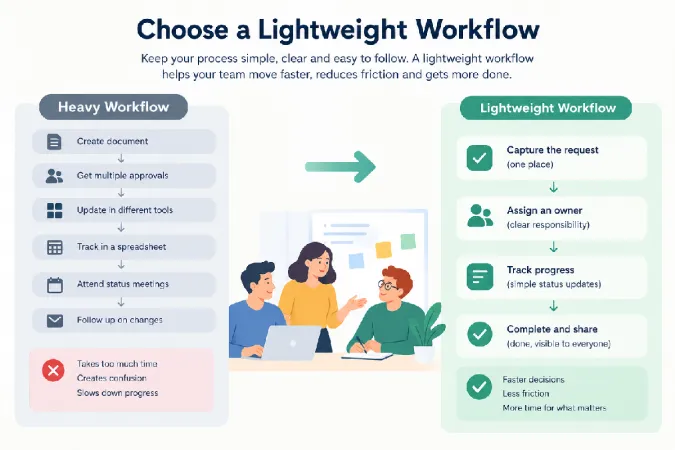
A basic Kanban-style workflow might include:
Backlog → To Do → In Progress → Review → Done
Backlog is future ideas and tasks. To do is tasks that are ready to start working on. In progress indicates work which is currently being done. Review shows tests and approval needed. Done is completed work.
Another solution could be a very simple weekly planning. At the beginning of the week, the team determines which will be top priority and where they will be delegated. During the week, team members updates progress and unblockers blockers.
It‘s all about consistency. Decide on a workflow that you want to follow, then make sure the whole team understands it.
Please do not create dual-tracking systems just because it seems necessary. Having several places where a task exists-a project management system, a spreadsheet, emails, a chat room, and paper documents keeping track of information can become lost and outdated very quickly.
Assign Owners, Priorities and Deadlines
Evey worthwhile task should have just one accountable owner.
A team can work in a task, but who is responsible when everyone is? When everyone shares the responsibility, accountability is lost. Assign one individual to take responsibility for the result and other team members separately.
Priorities should also be visible. A simple system such as:
- High: Directly affects an important business goal or deadline
- Medium: Important but not immediately urgent
- Low: Useful but can wait
Deadlines should be realistic and connected to the overall project schedule. Avoid assigning arbitrary dates simply to make a task appear urgent.
A useful task description should answer:
- What needs to be done?
- Who owns it?
- What is the deadline?
- What does completion look like?
- Is anything blocking the work?
For example, instead of writing “Update website,” create a more specific task such as “Publish the new pricing page after copy and QA approval by Friday.”
Clear tasks reduce back-and-forth communication and make progress easier to measure.
Manage Dependencies and Scope Changes
Dependencies are tasks that cannot move forward until another task is completed.
For example, a developer may be unable to publish a landing page until the final copy and design are approved. If that dependency is not visible, the development task may appear late even though the real issue happened earlier.
Identify important dependencies during project planning. Ask:
- What needs to happen first?
- Which tasks depend on another person’s work?
- Are there external approvals?
- What could block the deadline?
Scope changes are another common startup challenge. Because startups operate in changing environments, new ideas and requirements will inevitably appear.
Instead of automatically adding every request to the current project, assess its impact.
A simple approach is to ask:
What changes if we add this?
Consider the effect on time, resources, cost, priorities, and the original goal. If the new request is important, decide whether another task should be removed or the deadline should change.
This prevents “scope creep,” where a small project gradually becomes much larger without anyone formally recognizing the change.
Review Delivery and Remove Recurring Bottlenecks
Finishing a project should not be the end of the process. Small teams can improve quickly by reviewing what happened after major deliveries.
A short project review can ask:
- What went well?
- What took longer than expected?
- Where did work get blocked?
- Which decisions were unclear?
- What should we change next time?
Identify new recurring bottlenecks instead of blaming people.
If design approval slows down the project monthly, maybe design approval process needs to be simplified. The developers are always looking for content, maybe content deadlines should be advanced. If the priorities are changing every 2 days or so, may be a clear process for new requests should be defined for the leadership.
Track a few practical metrics where useful, such as:
- Percentage of projects delivered on time
- Number of overdue tasks
- Average project completion time
- Number of scope changes
- Time spent blocked
- Recurring causes of delays
The purpose of these metrics is not to create pressure or excessive reporting. They should help the team identify patterns and make better decisions.
A Simple Startup Project Management Process
A practical process for a small startup can be summarized in six steps:
- Define the business outcome
Know why the project matters. - Define the deliverables
Break the outcome into concrete pieces of work. - Assign owners and deadlines
Make accountability visible. - Identify dependencies and risks
Find potential blockers before they become delays. - Track work with a lightweight workflow
Keep the team’s current priorities visible. - Review and improve
Build upon finished projects by using them to enhance the subsequent one.
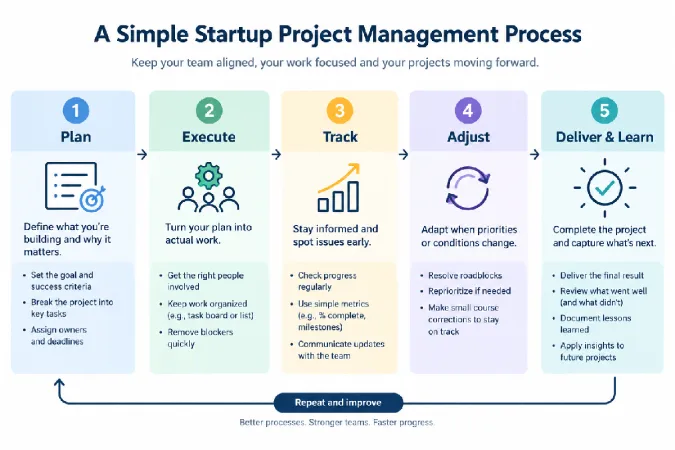
Startup project management aims not to generate additional papers, meetings, or procedures, but to make sure a small team can use its scarce resources on the most relevant activities.
With clear visibility to goals, owners, priorities, deadlines, and dependencies, the team accelerates while avoiding confusion. Use a simple system; keep it simple and consistent
Conclusion
Good startup project management doesn‘t need sophisticated systems, nice spreadsheets, multiple layers of bureaucracy or formal process. All you need for a small team is a simple system that links business goals to explicit deliverables, owners, priorities, due dates and dependencies. by keeping work in sight, preventing scope creep, catching blockers early and practicing retrospectives on even small projects, startups know what they are doing and can adapt quickly. The right project management process for the team is the process the team can deliver on day after day without spending more time managing it than the work itself.