
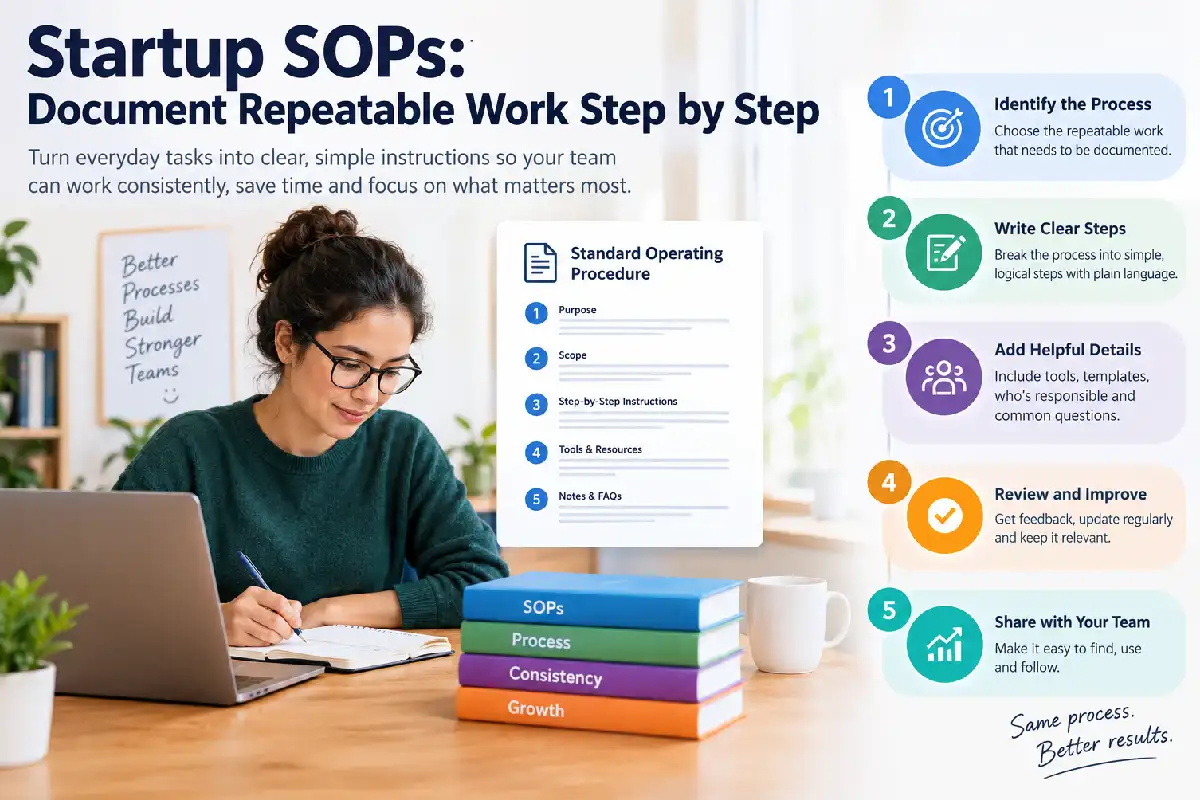
Startup SOPs: Document Repeatable Work Step by Step
Last Updated: September 25, 2026
Startups are often very fast and, in the beginning, that speed can hide an insidious problem. Employees do the same thing in different ways. One is using a proven method, another is always keying data on one screen, another is doing it from memory. Consistency breaks down eventually, leading to diluted quality, missed steps, training issues, and over-reliance on certain employees.
Standard operating procedures (SOPs) offer a good answer. This is a set of instructions to show how a common, repeatable task is to be performed so that employees can reliably repeat it. However, SOPs for start-ups need not be extensive or complex. The guidance may simply be presented on a single page and still be more of an asset than a detailed instruction manual unread by staff.
Not to record all activities in the business, but entrepreneurs and startup should emphasize on critical, measurable and replicable processes, author them easily, validated by the people doing those processes and adjust them as the business change.
Choose Which Processes to Document First
Not every startup process needs an SOP immediately. Attempting to record everything at one time can generate unnecessary procedures.
Begin work with those processes which are most common, critical, error prone or complex to learn. These are the task where standardizing will deliver the biggest gains.
Examples include:
- Customer onboarding
- Processing orders or invoices
- Responding to customer support requests
- Publishing content
- Sales lead qualification
- Employee onboarding
- Expense approval
- Product quality checks
- Handling refunds or complaints
- Updating customer records
A useful way to prioritize processes is to consider three questions:
How often does this occur? Repeated tasks tend to be a prime candidate for documentation.
What if it‘s an error?Customer, fund, compliance, and product quality processes deserve additional focus.
Would the task be problematic for a new worker?If an individual requires detailed spoken direction for performing a standard task, it is a candidate for an SOP.
Begin with a few high value procedures rather than creating dozens of documents all at once.
Use a Simple Standard Operating Procedure Template
Having the same SOP template throughout makes all documentation simple to produce, locate and understand.
A basic startup SOP can include:
- SOP title: Provide a short title for the procedure and leave a space below.
- Purpose: Towards what does the process aim?
- Owner: Who looks after the procedure? Who is the owner?
- When to use it: Indicate the condition or event that will trigger the procedure.
- Required tools: List of software, documents, accounts, equipment, information Etc., needed.
- Steps: List all the steps involved in the process under the order.
- Quality checks: Interpreting and indicating what should be checked before the task completion.
- Exceptions: Made a note of what actions should be taken if the regular procedure is not followed.
- Last reviewed: Enter the most recent date the SOP was reviewed.
Keep it simple. Use short (numbered) instructions for actions, and sub-bullets for supporting messages. Screenshots, sample documents, check lists, or brief videos may also be very helpful in setting out a procedure when it depends on a piece of software or involves visual choices.
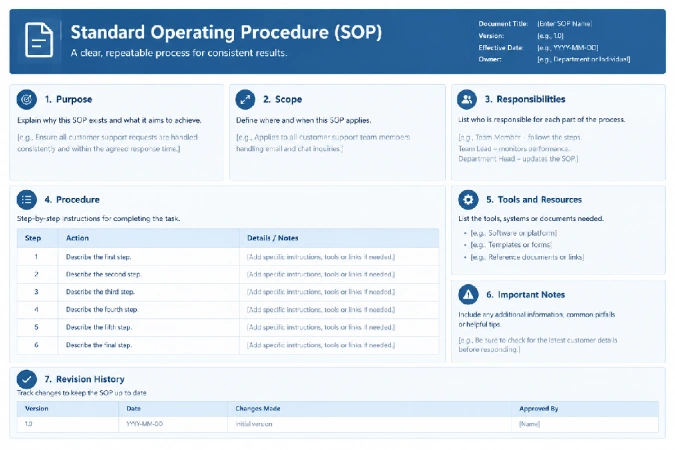
The most effective SOP template is one that workers will fill out.
Document Steps, Owners and Quality Checks
An effective SOP should reveal three points. First, what is to be done Second, who shall do it and, Third, method of verifying the output.
Write each step as a command or action rather than a command or instruction.
Instead of:
Review the customer information.
Use something more specific:
“Open the customer record and confirm the name, email address, billing details, and requested service.”
Specific instructions reduce ambiguity and make training easier.
Assign ownership at the appropriate level. Perhaps it is not the owner himself who needs to do each stage, his role consists of maintaining the operation and ccuracy of it, and keeping it up to date.
Quality inspections carry as much weight. Any procedure must describe how employees will assume that the work has been finished properly.
For example, a customer onboarding SOP might include checks such as:
- Required customer information is complete.
- The correct service package is selected.
- Payment status is confirmed.
- The welcome email has been sent.
- The customer record has been updated.
These checks turn an SOP from a simple list of instructions into a repeatable quality-control system.
Test Procedures with the People Doing the Work
One of the biggest mistakes startups make is documenting a process based solely on how management thinks the work happens.
The employee actually performing the task may know about exceptions, shortcuts, customer situations, or software limitations that are not obvious to the person writing the SOP.
Before finalizing a procedure, ask the person who performs the work to follow the document from beginning to end.
Watch for questions such as:
- Is any step unclear?
- Is information missing?
- Are the instructions in the correct order?
- Does the employee need access to a tool that wasn’t mentioned?
- Are there common exceptions?
- Can someone unfamiliar with the task understand the instructions?
A useful test is to give the SOP to someone who knows the general role but has not performed that specific process before. If they can complete the task without repeatedly asking for clarification, the documentation is likely becoming effective.
Treat employee feedback as part of the documentation process rather than as criticism.
Keep SOPs Current as Your Startup Changes
An SOP is only useful when it reflects the way work is actually performed.
Startups change frequently. Software gets replaced, responsibilities move between employees, products change, and new customer requirements appear. A procedure that was accurate six months ago may no longer be correct.
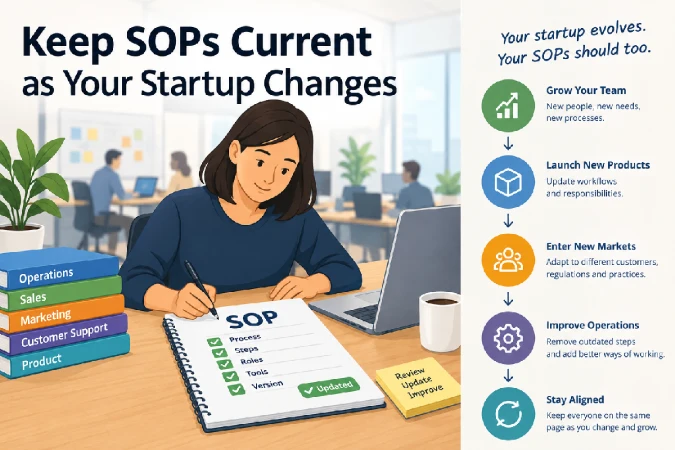
Assign an owner to every important SOP and establish a simple review routine.
For example:
- Review critical SOPs every quarter.
- Review lower-risk procedures every six months.
- Update documentation whenever a major process changes.
- Remove outdated versions so employees do not accidentally follow them.
- Record the date and reason for significant changes.
It can also help to maintain a central location for SOPs, such as a company knowledge base or shared documentation system. Organize procedures by department or function so employees can quickly find what they need.
Avoid creating multiple versions of the same procedure in different locations. A single source of truth reduces confusion and makes updates easier.
Build an SOP System That Supports Growth
Startup SOPs are not about introducing red tape, they are about making a predictable system out of familiar processes.
Begin with recording the most critical processes. Employ a straightforward standard operation procedure template, specify each process step as well as the ownership, integrate the quality check, and validate the procedures with the actual outworkers. Following that keep the documentation up-to-date with the company.
When executed successfully, SOPs can speed up the onboarding time, minimize preventable errors, enhance uniformity and enable founders to delegate daily tasks more assuredly.
The goal is easy: allow critical work to be easily re-done in a manner independent of the individual providing the original instruction.
Conclusion
The purpose of startup SOPs is to codify ways of working that are repeatable, cohesive, and easy for the team to follow without having to remember or ask the founders. Start for the core operations with the biggest pain points in the current workflows, and use a straightforward template, clarify ownership and quality control, and pilots every procedure with the actual workers involved.
As a startup scales, SOPs should evolve, so that the documentation remains relevant, so that the team continues to learn in implementation, and so the company long-term can feel solid.