

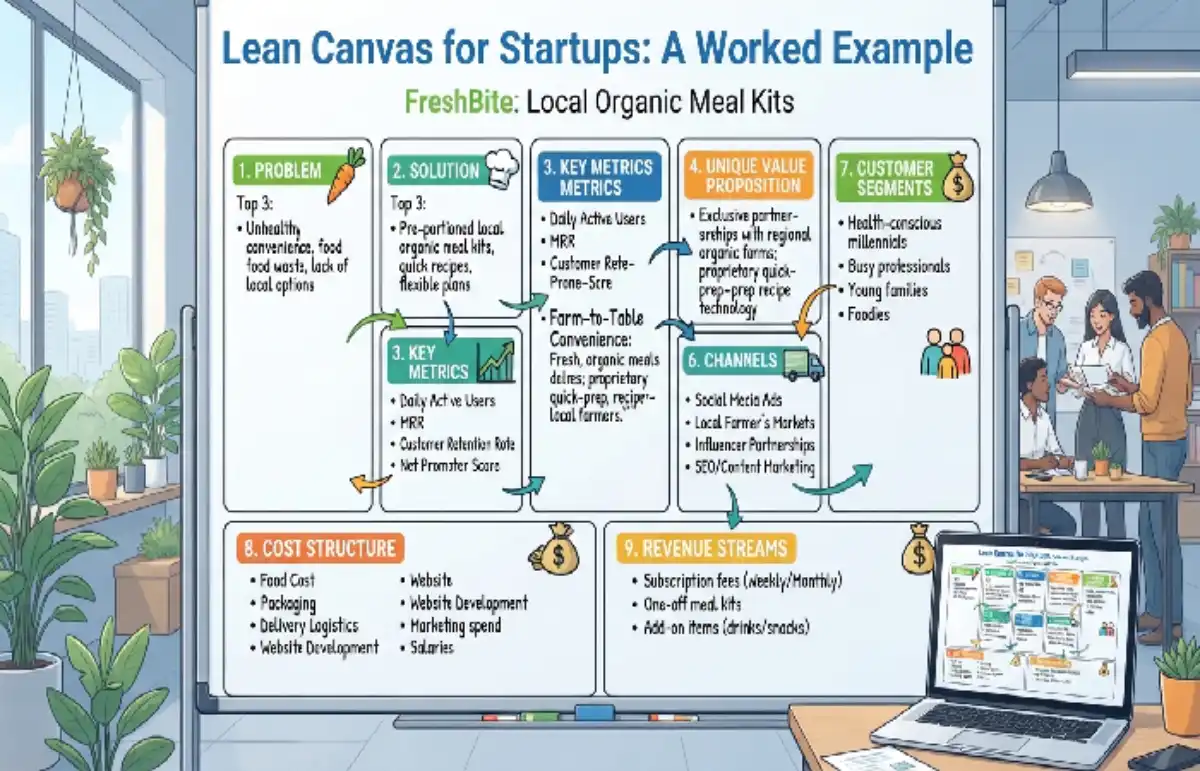
Lean Canvas for Startups: A Worked Example
Last Updated: September 29, 2026
A Lean Canvas enables startup entrepreneurs to quickly frame their startup idea, pinpoint the most significant risks and determine what should be tested first. Rather than investing time in a detailed business plan before talking to customers, founders can quickly jot down the key elements of a startup on one sheet:
This is very valuable at the beginning of the new venture as the assumptions on who your customers are, what problems they have, what your pricing and distribution should be can all change rapidly. The Lean Canvas exposes these assumptions so they can be easily discussed, tested and amended.
Let us take one example of a simple startup (a hypothetical one) Invoice Flow, a software solution to help small companies keep track of overdue invoices and reach out to customers.
Understand the Nine Lean Canvas Sections
A Lean Canvas contains nine sections covering the main assumptions behind a startup:
- Problem
- Customer segments
- Unique value proposition
- Solution
- Channels
- Revenue streams
- Cost structure
- Key metrics
- Unfair advantage
Each section should be concise. The purpose is not to explain every detail of the business but to create a useful snapshot that can guide research and experimentation.
For Invoice Flow, the initial canvas might look like this:
| Lean Canvas Section | Worked Example: Invoice Flow |
| Problem | Late payments, manual invoice follow-ups, unpredictable cash flow |
| Customer Segments | Small service businesses and freelancers |
| Unique Value Proposition | Make invoice follow-up simpler so businesses can get paid on time |
| Solution | Automated reminders, payment tracking and follow-up scheduling |
| Channels | Search, partnerships, content marketing and direct outreach |
| Revenue Streams | Monthly subscription |
| Cost Structure | Software development, hosting, marketing and customer support |
| Key Metrics | Active customers, paid conversions, retention and invoices followed up |
| Unfair Advantage | Proprietary workflow data and specialised industry relationships |
This first version is a collection of hypotheses rather than established facts.
Map Problems, Customers and Existing Alternatives
The problem and customer sections should be developed together because not every customer experiences the same problem with the same intensity.
For Invoice Flow, the founder could begin with professionals and small service companies with frequent invoicing but lacked special accounts-receivable personnel.
The following step is for us to determine the most significant problems.
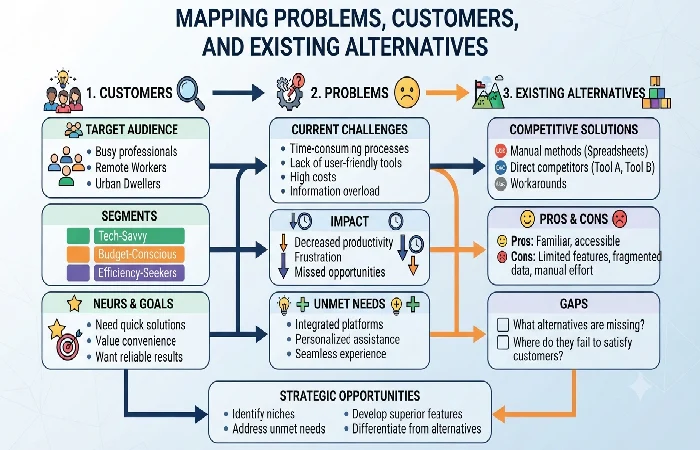
Possible problems include:
- Customers paying invoices late
- Business owners manually sending reminders
- Difficulty knowing which invoices need follow-up
- Uncertainty about expected cash inflows
However, founders should not assume these are equally important. Customer interviews can reveal which problems happen frequently and which have meaningful financial consequences.
It is also important to document existing alternatives. Customers may already use accounting software, spreadsheets, email reminders, messaging apps or outsourced bookkeeping services.
A startup does not compete only with companies selling similar products. Doing nothing, using a spreadsheet or continuing a manual process can also be an alternative.
The key questions are:
- How do customers solve the problem today?
- What does the current solution cost?
- What do customers dislike about it?
- Why have they not switched already?
- How frequently does the problem occur?
These answers can change the direction of the Lean Canvas.
Define Your Solution and Unique Value Proposition
Once the problem is clearer, describe the proposed solution.
For Invoice Flow, the solution might include automated reminders, payment-status tracking and scheduled follow-ups. However, the founder should avoid filling this section with a long list of features.
Focus on the smallest solution capable of addressing the most important problem.
The unique value proposition (UVP) explains why the intended customer should pay attention to the product.
A weak statement might be:
“An innovative all-in-one financial management platform for modern businesses.”
It is broad and does not clearly communicate the customer problem.
A more focused proposition could be:
“Automate invoice follow-ups so small businesses spend less time chasing payments.”
The UVP should connect the target customer, problem and desired outcome.
It should also remain a hypothesis until customers respond to it. If interviews show that customers care more about predicting cash flow than sending reminders, the positioning may need to change.
Estimate Channels, Costs and Revenue Streams
A startup also needs a practical route to customers.
Possible channels for InvoiceFlow include:
- Organic search
- Educational content
- Accounting partnerships
- Direct outreach
- Industry communities
- Referral programmes
Do not assume that every possible channel should be used. Early-stage founders should test a small number of channels and measure whether they can attract qualified prospects at a reasonable cost.
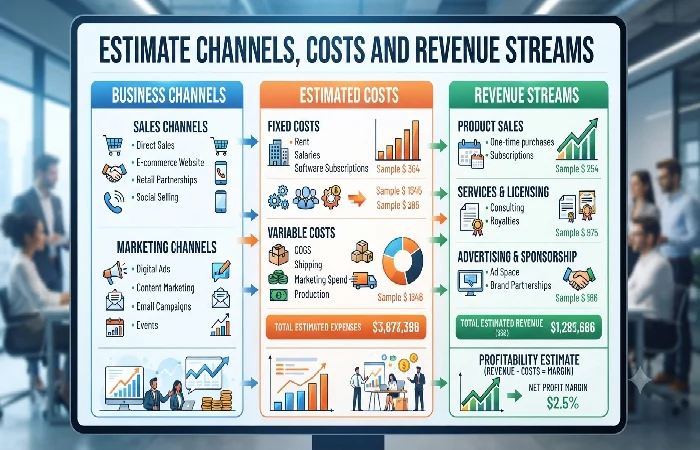
The cost structure should include the major resources required to operate the business. For a software startup, this could include development, hosting, customer support, software subscriptions and marketing.
Revenue assumptions should be equally specific.
For example, Invoice Flow might consider a monthly subscription rather than a one-time payment. The founder could then estimate:
Monthly revenue = number of paying customers × average monthly subscription
But these figures should initially be treated as assumptions rather than forecasts with false precision.
Key measures section clearly indicates what measurements will be used to determine if the business is on its way to success. It varies by the start-up, but can be measured by lead qualification, activation, conversion, retention, recurring revenue or acquisition costs.
Update Your Canvas as New Evidence Arrives
If a Lean Canvas is filled once, it should not be left the way it is.
While the founder interviews customers, tests messaging, launches experiments and collects sales data, some assumptions may prove more valid than expected while others may fail.
For example, Invoice Flow may initially assume that freelancers are its primary customers. After interviews, the founder might discover that small agencies have a larger problem because they manage dozens of client invoices every month.
The customer segment could therefore change.
The same process applies to pricing. If customers show little interest in a low-priced self-service product but several businesses request a managed service, the revenue model may need to be reconsidered.
Keep a record of major changes and the evidence behind them. This creates a connection between research and business decisions.
A useful update cycle is:
Assumption → Test → Evidence → Decision → Updated Canvas
Avoid changing the canvas simply because a particular result is inconvenient. Update it when credible evidence provides a reason to change an assumption.
Example of a Canvas Update
Imagine the founder initially believes:
Assumption: Freelancers are the strongest customer segment.
After interviewing 30 potential customers, the founder discovers that freelancers experience the problem but often tolerate manual follow-ups because they have relatively few invoices. Small agencies, meanwhile, spend several hours each week managing outstanding invoices.
The canvas might then change to:
Previous segment: Freelancers and small service businesses
Updated segment: Small agencies with recurring client billing
The solution could also become more specialised around managing multiple clients and invoice follow-ups.
This is one of the main benefits of the Lean Canvas: it makes changes in the business model visible.
Use the Lean Canvas as a Testing Tool
A Lean Canvas is most valuable when it drives action rather than becoming a document that sits in a folder.
For each major section, ask what evidence is needed.
For the problem section, conduct customer interviews. The solution, test a prototype or manual service. For channels, run small acquisition experiments. For pricing, test a specific paid offer. Revenue assumptions, measure actual customer commitments where possible.
The canvas can also help founders identify the riskiest assumptions. If the entire business depends on customers paying a particular price, pricing and willingness to pay deserve early testing.
Similarly, if the startup depends on reaching customers through a particular channel, that channel should be tested before significant marketing resources are committed.
Conclusion
A Lean Canvas provides startup founders with an easy-to-use and honest way of detailing a business idea that does not assume that the initial hypotheses have been proven. By documenting problems, customers, alternatives, solutions, value proposition, channels, costs and revenue, the founders can understand the relationship between these elements.
The most important is that it remains flexible. Think of each remaining part of the canvas as a hypothesis and once customer interview, experiments and sales evidence give new pieces of information, update accordingly.
Used in this fashion, a Lean Canvas transforms from a planning document into a practical tool to map out uncertainty, determine which experiments to run, and systematically create a business model based on knowledge rather than speculation.