

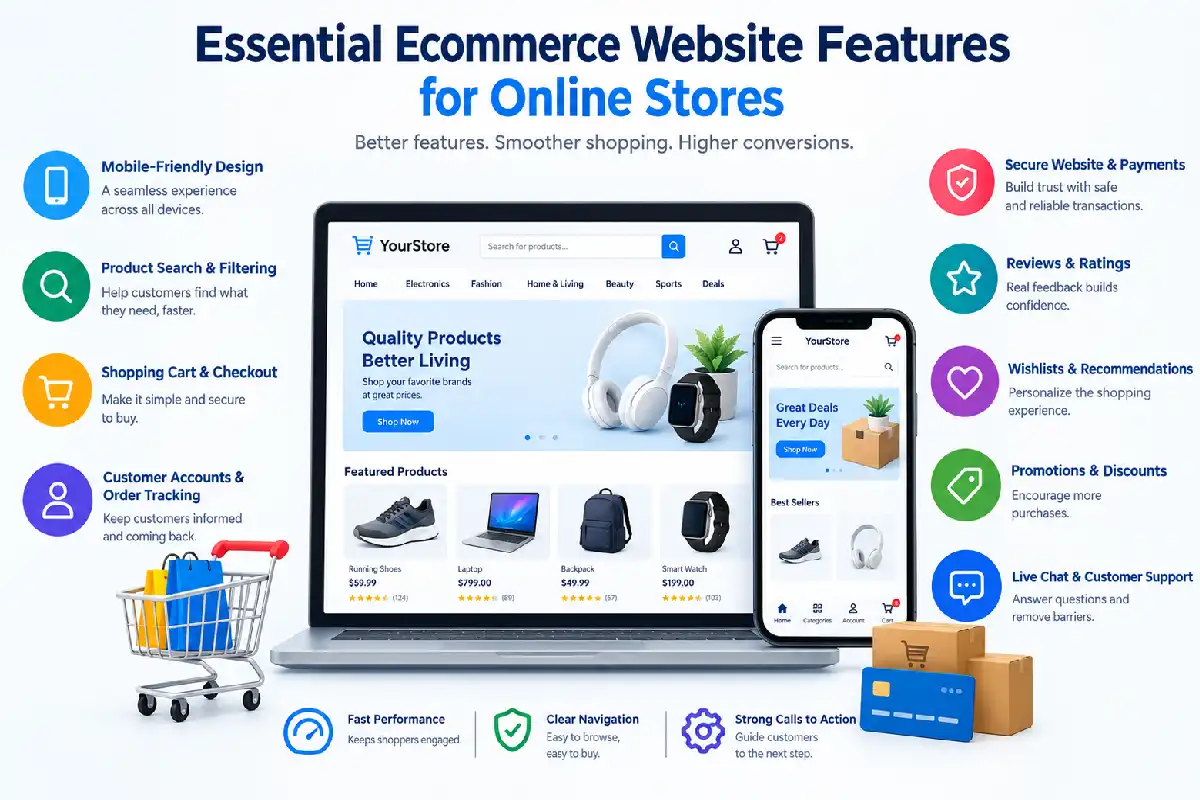
Essential Ecommerce Website Features for Online Stores
Last Updated: September 10, 2026
Essential Features. When building an ecommerce website, it‘s not enough to just have great product pages. Customers expect their online shopping experience to be fast, simple, safe, and convenient at every point in their experience. The appropriate ecommerce website elements assist with the browsing of products, comparison of the products offered, purchasing of the items, ordering the items and re-visiting the ecommerce store later on.
Whether it‘s building an online store from scratch, or upgrading your existing eCommerce website. Basic functionality could make all the difference. What features can an eCommerce website not live without?
Must-Have Features for an Ecommerce Website
An ecommerce web site needs to work smoothly from the very moment someone lands on it, right through the whole order process up to post delivery of the order. There are certain elements that are essential to allow it to work.
Mobile-Friendly Design
Utilize responsive design. Your website will be optimized for display on all devices, including smart phones, tablets, lap tops and desktop computers. All buttons, menu items, product images, fields and checkout sections will scale to fit the size of any particular device.
As customers are increasingly viewing and buying products on mobile phones, lack of good mobile experience may lead to lost sale.
Clear Navigation
Easy navigation lets visitors find products without having to click unnecessarily. Use well-defined categories, sub-categories, breadcrumbs and menus to establish a logical structure for your site.
In addition, a search bar needs to be displayed prominently and should be of high importance for larger product ranges stores.
High-Quality Product Pages
Every product page should provide enough information for customers to make a confident purchasing decision. Important elements include:
- Product name
- High-quality images
- Product description
- Price
- Available sizes or variations
- Stock status
- Product specifications
- Customer reviews
- Shipping information
- Return information
- Add-to-cart button
Product images should allow customers to examine important details, while descriptions should answer common questions before the customer reaches checkout.
Secure Website and Payments
Security Generalisimo. E-commerce cannot function effectively without implementing security measures. It is critically important that the purchaser has faith that their details are not going to be misused.
Implement HTTPS, secure payment gateways, suitable authentication controls and other general security options. Inform the user of the options available and put their mind at ease during the purchase process.
Product Search and Filtering Features
As an ecommerce catalog gets larger, product discovery is more and more important. It must be easy for the customer to find a particular product quickly.
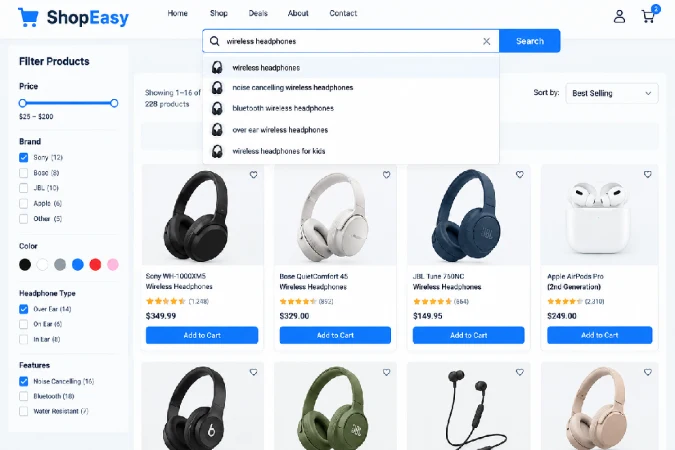
Powerful Product Search
A good search engine will highlight keywords based on names of products, brands, categories of products and casually used search terminologies. Use search suggestions or auto-complete to come to the product faster.
Display the information about product images, names, prices, ratings and availability may be helpful to the search results.
For the larger stores, advanced search also has features to accommodate for spelling alternatives and synonym/related word searching. A customer searching for ‘sneakers’, for instance, will expect to see shoes named ‘running shoes’ or ‘athletic shoes’.
Product Filters
Filters allow customers to narrow results according to attributes such as:
- Price
- Brand
- Size
- Color
- Material
- Rating
- Availability
- Product specifications
Filters are particularly valuable when a category contains dozens or hundreds of products.
Sorting Options
Customers should also be given the option of sorting the products by categories including, price, bestsellers, new arrivals, ratings or relevancy. Allowing the customer to decide what order they see the products in, helps them to navigate around more quickly.
Shopping Cart and Checkout Features
It is safe to assume that the shopping cart and checkout are two of the most vital parts of an ecommerce website. For a customer who is ready to make a purchase, adding items to their basket and proceeding to checkout should be an extremely smooth and painless experience.
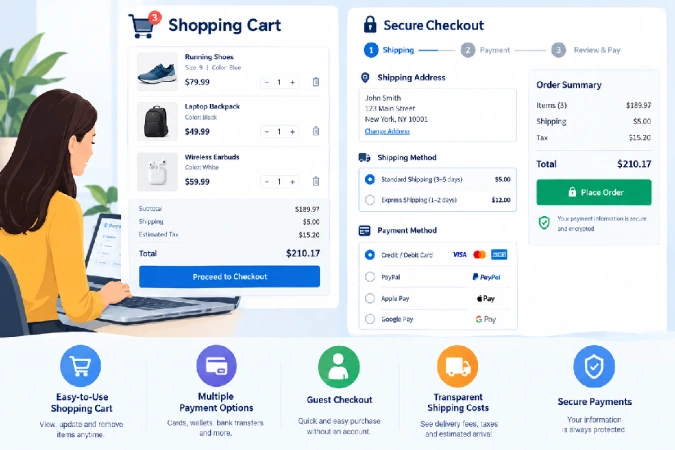
Easy-to-Use Shopping Cart
The cart needs to show the products added, the number of them, the prices and discounts and also an estimation for the total. Customers needs to be able to alter the quantities or delete products from the cart without having to go through the whole shopping again.
Displaying the products within the shopping cart can also help customers verify the products they added.
Multiple Payment Options
Your customers may favor different payment types. Depending on your target market, an ecommerce site could incorporate payment methods like credit/debit cards, e-wallets, bank transfer and country-specific payment methods.
Providing payment methods that the customer is already accustomed to will lower hesitation at the point of payment.
Guest Checkout
However, not every client desires to have an account before purchase. Guests can use a guest checkout to finalize an order without requiring additional registration, in order to save the time for new clients.
Alternatively, customers could be encouraged to open an account once their purchase has been completed, rather than having account opening as a required element prior to completing the purchase process.
Transparent Shipping Costs
The surprise shipping costs at checkout are a major reason many customers abandon carts. Present the shipping costs, taxes, estimated delivery times and final order total as soon as possible.
Customer Account and Order Tracking Features
Customer accounts can improve convenience while giving shoppers access to useful information after a purchase.
Account Management
A customer account can allow users to:
- View previous orders
- Save addresses
- Manage personal information
- Save preferred payment methods where appropriate
- Create wishlists
- Manage communication preferences
- Request returns or exchanges
Account functionality should remain simple and easy to manage.
Order Tracking
How about when its going to arrive?Customers need do to know where his order now.Order tracking is as the following:
Automatic e-mail/SMS notifications for instance at the stage of order confirmation, shipping, delivery, out for delivery, customer‘s mail/sms notification
Returns and Refunds
A simple return process can help give the customer confidence in the product and service that you supply. Display a policy for returning that is easy to see and describes: what you agree to return, the deadlines, the way to return, the time to receive a refund, conditions.
As far as possible users should be able to return items or check the status of returns from their accounts.
Ecommerce Features That Improve Conversion Rates
There are also a few other features of ecommerce sites that can help increase the number of visitors who actually purchase.
Customer Reviews and Ratings
Customer reviews from the social proof and allow the buyer to have confidence in the purchase. Show display ratings and written reviews on product pages, and think about giving customers the option to add images to reviews where it makes sense.
Genuine feedback will be useful in lowering risk; the risk that quality or fit or the performance of a product cannot be determined adequately over the internet.
Wishlists
Wishlists allow customers to save products for future consideration. This is useful for shoppers who are researching products or waiting before making a purchase.
For logged-in users, wishlists can also encourage repeat visits.
Personalized Recommendations
Recommendation functionalities suggest complementary or related products to the customers on the basis of their viewing behavior, purchase history or current viewed product.
For example, if someone views a laptop they might see suggested compatible accessories, laptop cases and wireless mice.
Promotions and Discount Codes
A dynamic promotion system can enable seasonal sale, first-order-discount, bundle purchase, free-shipping, timed promotions and other similar campaigns.
Promotions need to be clearly explained without detracted from the shopping experience.
Live Chat and Customer Support
Customers sometimes need answers before completing a purchase. Live chat, chatbots, FAQs, email support, or other customer-service tools can help resolve questions about products, shipping, payments, and returns.
Fast answers can remove purchase barriers and improve customer confidence.
Fast Website Performance
Site speed directly impacts the shopping experience, with slow loading times frustrating users and leading to abandonments.
Optimize images, decrease unnecessary scripts, make use of effective hosting and check website performance on desktops as well as mobile devices.
Strong Calls to Action
Find buttons for adding to a shopping cart, to buy now, to go to the shopping cart and to continue shopping.
Action words should be easily identifiable but they must also be coherent with the website‘s theme and design.
Conclusion
The most effective ecommerce websites need a range of key features together with a user-friendly, customer-centric approach. A mobile responsive website, straightforward navigation, powerful product search and filter capabilities, secure payments, an effective shopping cart, and an efficient checkout process create the core of the most profitable online store.
Other features that can add convenience and increase conversion rates are customer accounts, order tracking, reviews, wishlists, recommendations, and customer support/performance management tools.
It‘s not about just adding bells and whistles because they exist, rather the implementation should address a true problem in the customers’ journey. When a customer can find a product quickly, clearly see the available choices, make payment with ease and trust, and track their delivery, they have a high chance of completing a transaction and visiting the store again.