

How to Manage a Remote Startup Team
Last Updated: September 26, 2026
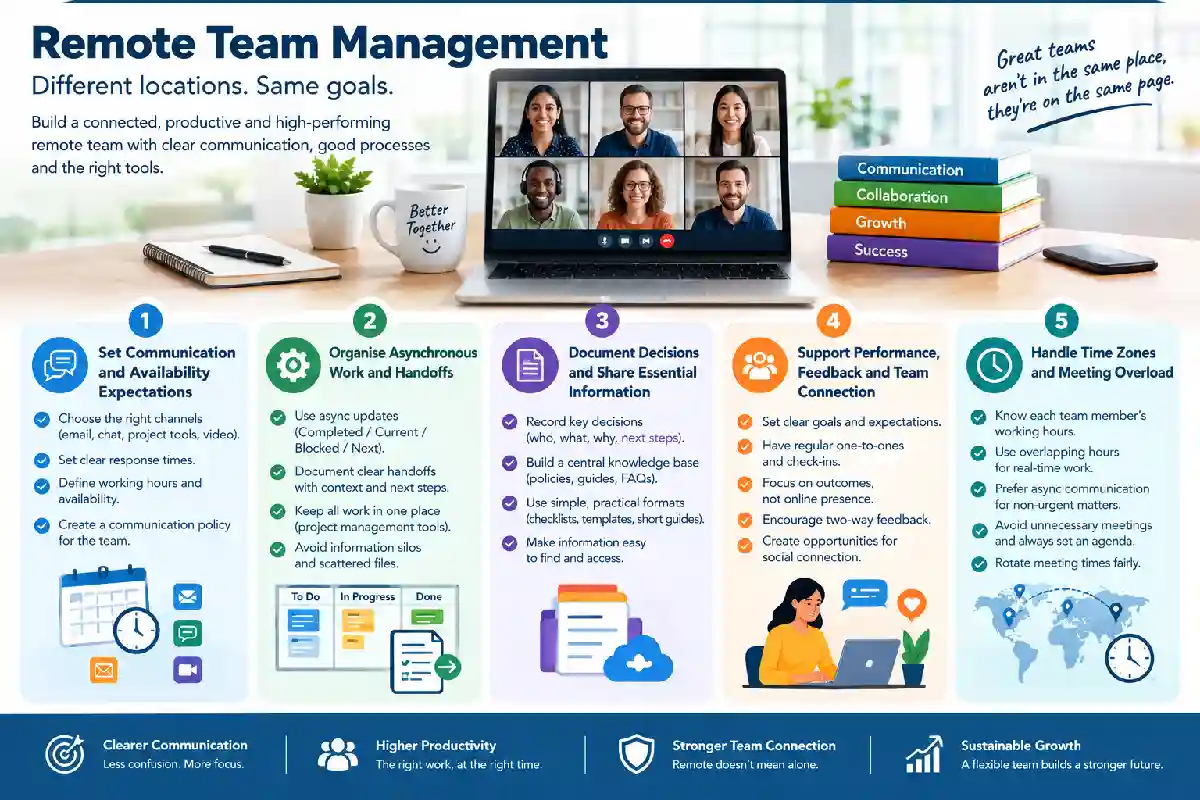
Running a remote startup team involves more than taking your office conversations onto video meetings and instant messaging services. To succeed, a remote team must set exact standards, establish efficient communication channels, formalize how-to procedures, and provide the necessary latitude for employees to be effective regardless of time zone.
Remote management can be a great opportunity for the startups by giving access to a wider groups of talents and cutting costs linked to offices. But it can also create some difficulties regarding communication, collaboration, accountability, time zones and team‘s proximity. A remote startup need then an operating system offering the benefits of autonomy with a total define of responsabilities.
Few practices below can be utilized by founders or managers to form an organised and high effective remote startup team.
Set Communication and Availability Expectations
For a remote worker, policies and procedures should be in place about when and how to communicate. If not, you will have some employees expect to be on call all the time, while others may take 20 minutes to reply to requests if they are busy.
Begin by establishing which form of communication to adopt for each circumstances.
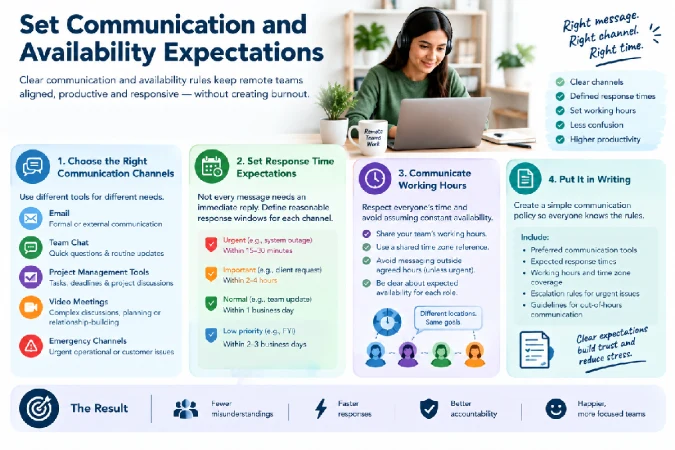
For example:
- Email: Formal or external communication
- Team chat: Quick questions and routine updates
- Project management tools: Tasks, deadlines, and project discussions
- Video meetings: Complex discussions, planning, or relationship-building
- Emergency channels: Urgent operational or customer issues
The team should also understand expected response times. Not every message needs an immediate response. Establishing reasonable response windows allows employees to focus on important work without constantly checking notifications.
Availability expectations are also related to working hours. When an organization has definied working hours, it has to make sure that these working hours are clear for employees, and that managers do not expect from remote workers availability outside the working hours.
A communication policy for written communication could define which questions are to be answered immediately and which concerns should be escalated right away and which questions can be handled in the next working period.
Organise Asynchronous Work and Handoffs
Working asynchronously enables employees to work toward a goal even if they are not all online at the same time. This is especially critical for remote startups
Employees can provide updates by tracking progress in collaborative tools rather than at weekly meetings.
A useful asynchronous update might include:
Completed: What was finished?
Current: What is being worked on now?
Blocked: Is anything preventing progress?
Next: What will happen next?
This structure gives managers and colleagues visibility without requiring another meeting.
Handoffs also need to be organised carefully. When work moves from one employee or time zone to another, the person handing over the task should provide enough context for the next person to continue without repeating research.
A good handoff can include:
- Current status
- Work completed
- Outstanding tasks
- Relevant files or links
- Important decisions
- Known problems
- Recommended next action
- Deadline
Remote teams need to be one source of truth for important projects. When the information is buried in private message streams, email chains, and various files, employees end up wasting hours digging around for the most current version of a document.
Document Decisions and Share Essential Information
Employees in a physical office get information about decisions informally from co-workers. Remote teams have less of this human to human interaction, so documentation becomes even more critical.
Any major decisions made should be documented in a place that the relevant individuals can easily find.
A simple decision record can include:
- Decision: What was decided?
- Date: When was the decision made?
- Owner: Who made or owns the decision?
- Reason: Why was it chosen?
- Impact: What changes as a result?
- Next steps: What needs to happen now?
Documentation is particularly valuable when a decision affects product development, pricing, customers, hiring, finances, or company strategy.
Remote startups should also create a central knowledge base for essential information. This could contain onboarding materials, company policies, process documentation, frequently asked questions, technical instructions, customer procedures, and internal guidelines.
Good documentation reduces dependency on individual employees. If someone is unavailable, another team member should be able to find enough information to continue important work.
However, documentation should remain practical. Avoid creating lengthy documents that employees rarely read. Short guides, checklists, templates, and clearly organised reference materials are often more useful.
Support Performance, Feedback and Team Connection
Remote employees still need clear goals and regular feedback. Distance should not reduce accountability or make employees feel disconnected from company objectives.
Managers should establish measurable expectations for each role. Employees need to understand what successful performance looks like and how their work contributes to broader startup goals.
Regular one-to-one meetings can provide an opportunity to discuss:
- Progress against goals
- Current challenges
- Workload
- Development needs
- Feedback
- Career objectives
- Support required from management
Performance should be evaluated primarily through outcomes and agreed responsibilities rather than online presence. An employee who produces strong results should not be considered less productive simply because they are not constantly visible in a team chat.
Feedback should also work in both directions. Managers can ask employees what is working well and where remote processes are creating unnecessary friction.
Team connection is another important consideration. Remote workers can be cut off from the ongoing communications that happen in an office. Startups can facilitate social interaction of remote workers by setting up an informal virtual social exchange, celebrating team milestones, setting up interest groups, occasionally having face to face events, or starting conference calls with some brief non work chat.
These activities should be a supplement rather than a substitution for good working conditions.
Handle Time Zones and Meeting Overload
Time zones can also be a big hassle when employees are spread across regions in startups. Something as simple as a meeting time that is convenient for one employee may be outside normal working time for another.
Initially monitor the usual working hours of each employee and find the overlapping hours. Overlapping hours may be used for activities that are really time-critical.
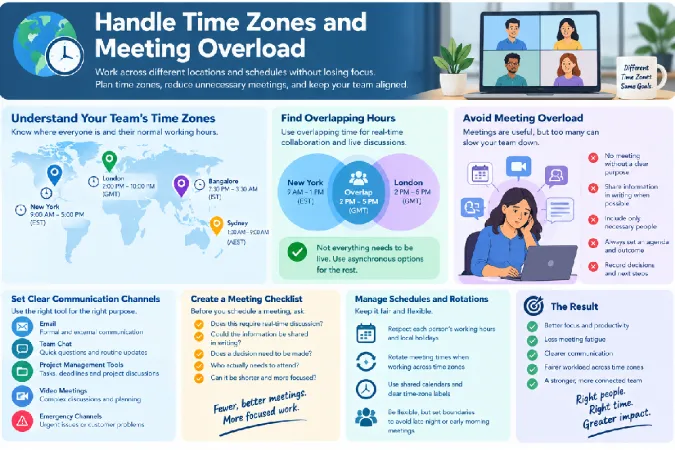
Use async options whenever possible.
Managers should also be resistant to holding meetings for the sole purpose of avoiding recording information. Instead they should question beforehand:
Start by documenting each employee’s normal working hours and identifying overlapping periods. Use overlapping hours for activities that genuinely require real-time collaboration.
For everything else, consider asynchronous alternatives.
Managers should also avoid scheduling meetings simply because it is easier than documenting information. Before creating a meeting, ask:
- Does this require real-time discussion?
- Could the information be shared in writing?
- Does a decision need to be made?
- Who actually needs to attend?
- Can the meeting have a clear agenda and outcome?
Decreasing superfluous meetings provides employees with less interruptions and greater stretches of undisturbed work time.
For meetings, give an agenda beforehand, record key decisions afterward, and make sure that a team member who misses it due to being in a different time zone can understand by reading the notes rather than overhearing conversations.
The rotation of hours in the meetings could be another kind way to share the inconvenience all employees.
Conclusion
Running a virtual startup team is about purposeful communication, honest expectations, dependable documentation, and trusting your teammates. It’s not about micromanaging employees but rather about putting the right system in place so folks can work unsupervised.
First, identify communication channels and other availability provisions. Next, put in place good asynchronous work practices, record key decisions, and develop easy-to-access knowledge sources. Third, enable employees with appropriate goals, periodic feedback, and compelling team interaction. Last, carefully consider time zones and reduce the burden of unnecessary meetings.
A successful remote team should have a clear understanding of what to do, who is responsible for it, where to look for sources of information, when to collaborate and how success is measured. When these foundations are in place, a startup is able to develop a remote working model that promotes efficiency, responsibility, agility and growth.