

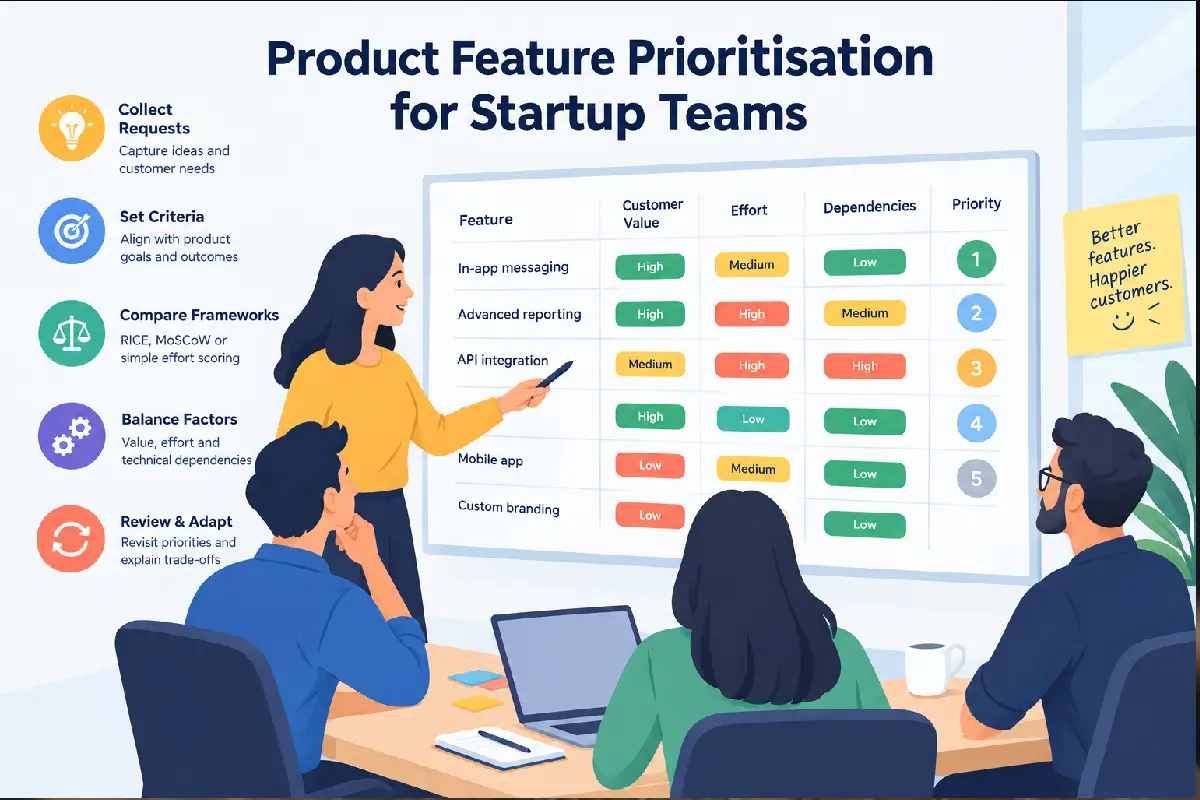
Product Feature Prioritisation for Startup Teams
Last Updated: September 30, 2026
There is never a dearth of product ideas at startups. Customers ask for features, founders find opportunities, sales team ask for features that may help them close deals, and developer find technical enhancements that are worth implementing. The dilemma is what to build now and what to defer and what not to build at all.
Product feature prioritisation provides a startup with a framework in which to make these decisions. Rather than every feature request being treated as equally important, teams can weigh opportunities against product objectives, customer value, difficulty, risk and technological limitations.
A beneficial prioritisation procedure does not require completely fisching the future. It establishes a clear decision making procedure that the process can be revisited once new evidence is discovered.
Collect Requests Without Promising Every Feature
Feature requests can come from nearly anywhere: customer interviews, support conversations, sales calls, product analytics, founders, employees, or your competitors’ product. First, funnel these requests uniformly, rather than having the most vocal one decide the next business investment.
Create a central feature-request backlog with information such as:
- The customer problem being reported
- Who is experiencing the problem
- How frequently it occurs
- The potential business impact
- Evidence supporting the request
- Related requests or existing solutions
- Estimated implementation complexity
Avoid immediately promising that a requested feature will be built. A request represents input, not necessarily a product commitment.
For example, five customers may ask for a particular reporting feature. Rather than directly writing “Build advanced reporting” on the Roadmap, note the real issue: “Customers need to know which of their activities are bringing in value”.
This leaves us open to the possibility of coming up with a more elegant solution that fulfills the same need.
Divide requests from validated problems. The customer might request a specific feature, because they think it will fix their problem, but the product team should check the real problem.
Define Scoring Criteria Around Product Goals
Prioritisation becomes more useful when the criteria reflect the startup’s current objectives.
A company trying to improve activation may prioritise features that help new users reach value faster. A startup focused on retention may place greater weight on features that reduce recurring customer problems. A business preparing for an enterprise market may need to consider security, permissions, reliability, and integration requirements.
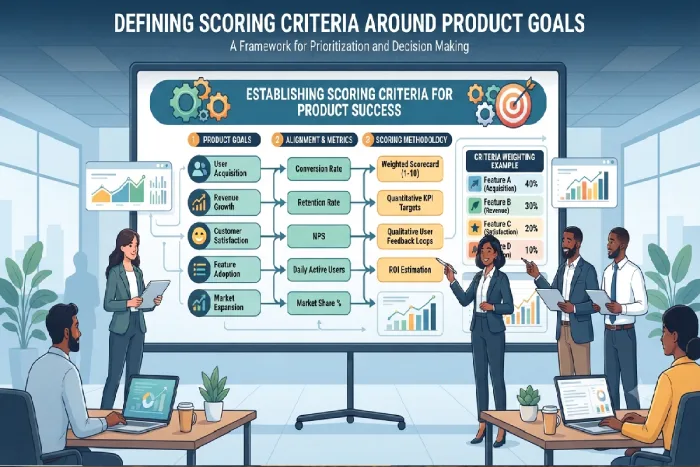
Common scoring criteria include:
Customer impact: number of customers affected and degree of impact.
Business impact: Will this feature increase revenue, retention, conversion, activation, or other critical business indicators?
Strategic alignment: Where does this work fit into the current phase of the product?
Confidence: What is the evidence supporting the anticipated result?
Effort: The extent of engineering, designing, testing, manufacturing and providing support needed.
Risk and dependencies: Is the feature reliant on infrastructure, third-party services, regulation or other product work?
Make the scoring system simple enough for the team to grasp why a particular item has been scored in a certain way. A complicated model can create false precision.
Compare RICE, MoSCoW and Simple Effort Scoring
Different prioritisation frameworks can be useful depending on the maturity and needs of the startup.
RICE
RICE considers Reach, Impact, Confidence, and Effort. It can help teams compare initiatives using several dimensions rather than relying on a single estimate.
A simplified approach is:
RICE score = Reach × Impact × Confidence ÷ Effort
Reach estimates how many users or customers could be affected during a defined period. Impact estimates the potential effect on an important outcome. Confidence represents how reliable the team’s evidence is, while effort estimates the resources required.
RICE can be helpful when a startup has enough product data to make reasonable estimates. However, teams should avoid treating the resulting number as an objective truth.
MoSCoW
MoSCoW divides requirements into:
- Must have
- Should have
- Could have
- Won’t have for now
This approach is easy to communicate and can work particularly well for a defined release or project.
For example, a payment-related release might classify successful transaction processing as a “Must have”, while an advanced customisation option could be a “Could have”.
Simple Effort Scoring
Early-stage teams may not need a sophisticated framework. A basic value-versus-effort comparison can be enough.
For each feature, estimate customer or business value and implementation effort. High-value, low-effort work can receive attention first, while low-value, high-effort work can be delayed.
The important point is consistency. The framework should improve conversations rather than become an administrative exercise.
Balance Customer Value, Effort and Technical Dependencies
A feature with strong customer demand is not automatically the next feature to build.
Suppose customers request an integration that would save them significant time. The value may be high, but the integration might require major changes to the product architecture. Building it immediately could delay several other improvements.
Technical dependencies therefore need to be visible during prioritisation.
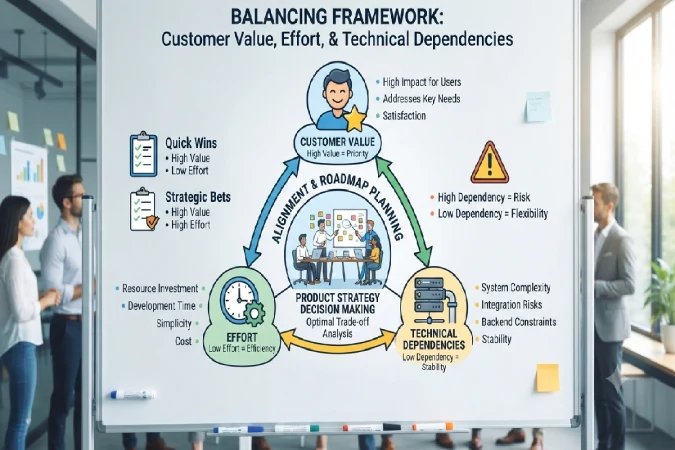
Ask questions such as:
- Does another feature need to be completed first?
- Will this work require database or architecture changes?
- Is there an external API or vendor dependency?
- Does the feature introduce security or reliability risks?
- Will maintaining it create significant ongoing costs?
- Can a smaller version solve most of the problem?
Teams should also distinguish between feature value and solution size. A customer problem might be important, but the first solution does not necessarily need to be large.
An MVP-style approach can help. Instead of building a complete feature with every requested option, identify the smallest useful version that can test whether the solution creates meaningful value.
Review Priorities and Explain Trade-Offs
Priorities should not remain fixed simply because they appeared on an earlier roadmap. Customer behaviour, product data, technical discoveries, competitive conditions, and company goals can change.
Set a regular review cycle—for example, every two to four weeks for an early-stage product. Review the highest-priority items and ask:
- What new evidence have we collected?
- Has customer demand changed?
- Did previous releases produce the expected outcome?
- Have effort estimates changed?
- Are new technical dependencies visible?
- Does the work still support the current business goal?
Equally as critical, let people know why parts are late or not accepted.
It also sounds better to a customer to say “we aren’t building this,” as the team currently is working on a different issue impacting more people, or the evidence doesn’t justify the amount of effort involved yet.
Remember to record key compromises internally too. A ‘short decision note’ will help you justify why one program took priority over others, what constraints you were working within, and when you might need to revisit the decision.
Conclusion
Product feature prioritisation enables startup teams to make sense of a long list of requests by systematically focusing in on the handful of choices to be made. The steps involved in the prioritisation include gathering requests with caution of what promises are made, and linking opportunities back to customer problems and existing product goals.
Frameworks like RICE and MoSCoW and a simple value versus effort scoring may be all that is needed for an early team. However way the team chooses to prioritize, its good practice to consider all of the customers value, the business outcomes, the confidence, the effort, the technical dependencies, and the risk.
Above all else, prioritisation should be a live evidence-based process, not a one-off ranking exercise. Review priorities frequently, record key trade-offs and be prepared to switch gears if other evidence indicates a different issue.
A good prioritisation system doesn‘t remove uncertainty, it makes the startup‘s assumptions visible and guides the judicious use of its scarce resources in the pursuit of the specific issues most relevant to its stage.