
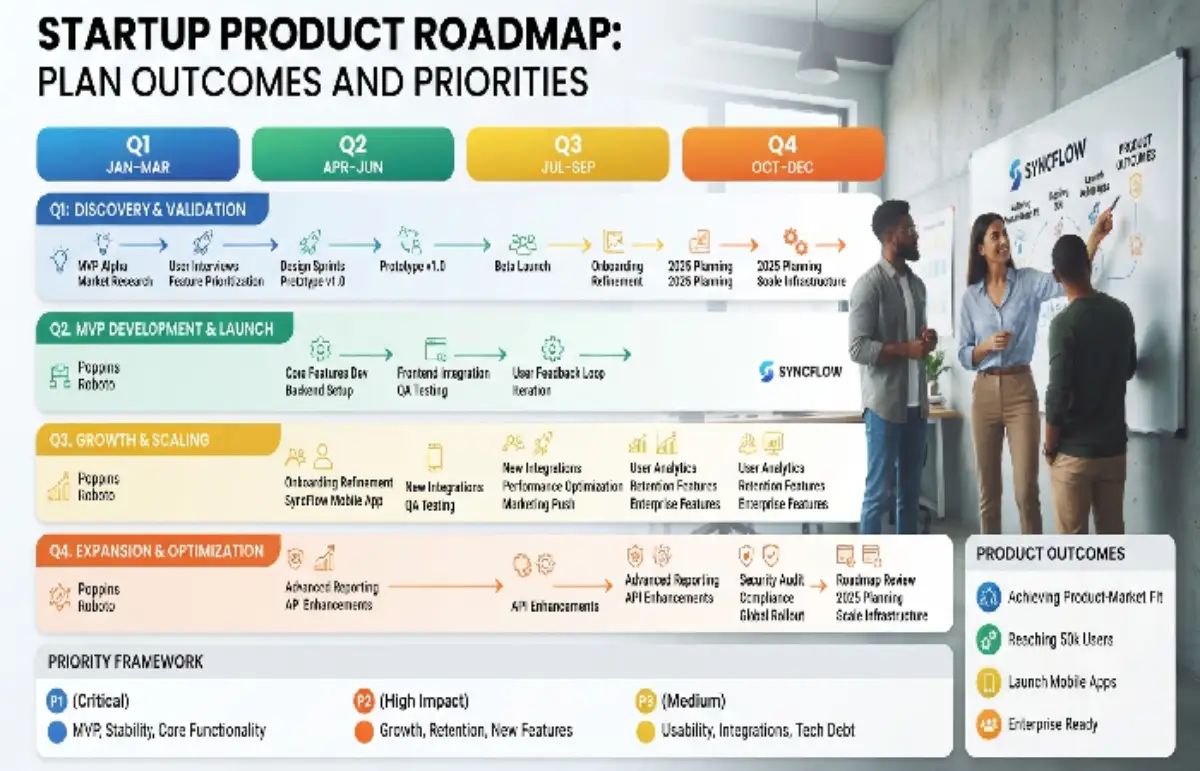
Startup Product Roadmap: Plan Outcomes and Priorities
Last Updated: September 30, 2026
A startup product roadmap is an overview of where a product is going and why some work is being prioritised over other work. A startup roadmap is not a strict project schedule so it needs to be adaptable since customer needs, the environment, technical limitations and business goals may change rapidly.
A good product roadmap doesn‘t try to predefine when teams will ship each feature weeks or months from now. Instead, it links customer problems with metrics, sorts work into valuable categories, and provides teams with a clear enough path to make decisions consistently.
Connect Product Outcomes to Customer Problems
Customer problems, not customer wanted features, should form the basis of a product roadmap.
What if, say, the reason for all too many ecommerce checkouts being abandoned is that customers struggle to understand delivery details? A feature-oriented roadmap might read, “Add delivery estimator.” An outcome-oriented roadmap would title the goal in terms of achieve “Believe delivery details.”
The second approach offers a lot more flexibility for your team, it could take a number of forms, the following reply ‘There would be a solution, that could be based around an estimator, more transparent delivery messaging, better order tracking or whatever other breakthrough you find through testing.’
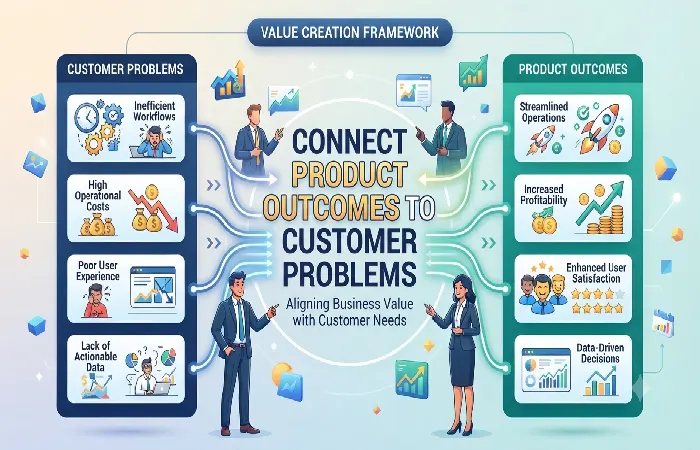
Begin by listing the key customer issues that your product addresses. For each issue, think about:
- Who experiences it?
- How frequently does it occur?
- How important is it to the customer?
- What alternatives do customers currently use?
- What evidence supports the problem?
- How could solving it benefit the business?
Then translate the problem into a product outcome.
Examples include:
- Increase successful onboarding completion.
- Reduce the time required to complete a core task.
- Improve repeat usage among a target customer group.
- Increase conversion from trial users to paying customers.
- Reduce customer support requests related to a specific workflow.
Outcomes provide a stronger foundation for prioritisation because they explain why work matters.
Choose a Roadmap Format for an Early-Stage Team
There is no single roadmap format that works for every startup. The best format depends on team size, product maturity, uncertainty, and how frequently priorities change.
An early-stage team can use a simple Now, Next, Later roadmap:
Now: Work currently being explored or developed.
Next: Important work likely to follow after current priorities.
Later: Potential opportunities that require more evidence or depend on other work.
This format avoids creating false precision when the team does not yet know exact delivery dates.
Another option is an outcome-based roadmap, where each period contains a customer or business outcome rather than a list of features.
For example:
| Period | Outcome | Example Work |
| Now | Improve activation | Simplify onboarding |
| Next | Increase repeat usage | Improve core workflow |
| Later | Expand customer use cases | Add supporting capabilities |
For startups working with investors, advisors, sales teams, or larger internal teams, a timeline-based roadmap may provide additional context. However, dates should reflect genuine commitments rather than optimistic estimates presented as certainty.
Avoid treating the roadmap as a promise that every item will be delivered on a specific date. Product discovery often reveals information that changes the plan.
Group Work into Themes and Milestones
A roadmap can become difficult to understand when every individual task is listed separately. Group related work into themes and milestones instead.
A theme represents a broader area of product improvement. Examples include:
- Improve onboarding
- Strengthen customer retention
- Simplify payments
- Expand reporting
- Improve product reliability
A milestone represents a meaningful stage of progress toward an outcome.
For example, an onboarding theme might contain milestones such as:
- Identify the largest onboarding drop-off.
- Test a simplified onboarding flow.
- Release the validated version.
- Measure activation changes.
This structure allows the team to understand the purpose behind individual tasks.
Keep technical implementation details in the team’s delivery or project-management system rather than filling the main roadmap with tickets. The roadmap should communicate direction and priorities, while task-management tools can handle detailed execution.
Prioritisation is also important. A startup usually has more potential work than available time and resources.
Consider factors such as:
- Customer impact
- Business impact
- Evidence supporting the opportunity
- Strategic importance
- Development effort
- Technical dependencies
- Risk reduction
- Learning value
A small feature that validates a major assumption may deserve attention before a large feature with uncertain customer value.
Communicate Uncertainty and Dependencies
Startup roadmaps contain uncertainty by nature. Customer behaviour, technical requirements, market conditions, and available resources can all change.
Instead of hiding uncertainty, communicate it clearly.

Use language such as:
- Exploring
- Planned
- In discovery
- Targeting
- Dependent on validation
- Under consideration
This helps stakeholders distinguish between committed work and potential future work.
Dependencies should also be visible. A product initiative might rely on another feature, an external integration, technical infrastructure, legal review, customer research, or a business decision.
For instance, a startup trying to support international payments must decide when it can afford to release, and is forced to consider the issues of payment-provider availability, currency coverage, compliance issues, and transaction reporting, all of which take different amounts of time.
Documenting it prevents there being false expectations.
As well, it helps to clarify assumptions behind main items on the roadmap. For example, any major future initiatives which assume customers will be willing to pay for a new feature should have that willingness-to-pay assumption validated prior to large development investments.
Review the Roadmap as Evidence Changes
Set a road map you‘ve got to keep revising it not build it and keep updating it.
Choose a review cycle that can keep pace with the startup. The team at the early stage will need to revisit priorities time and again as new customer evidence obsoletes existing understanding.
During each review, ask:
- What have we learned from customers?
- Which outcomes are improving?
- Which assumptions were incorrect?
- Have customer needs changed?
- Are current priorities still aligned with business goals?
- Have new technical or operational constraints appeared?
- Which initiatives should be accelerated, delayed, changed, or removed?
Use actual evidence whenever possible.
For example, if a new onboarding experiment produces better activation, the roadmap may shift toward scaling that improvement. If extensive testing shows that a planned feature solves a low-priority problem, the team may remove it.
This does not mean changing priorities every time someone suggests a new idea. Roadmap changes should be based on meaningful evidence and strategic considerations.
A simple roadmap review can classify initiatives into four groups:
Continue: Evidence still supports the planned direction.
Adjust: The goal remains relevant, but the approach needs modification.
Defer: The opportunity may be valuable but is not currently a priority.
Remove: Evidence no longer supports investing in the initiative.
Common Startup Product Roadmap Mistakes
Several mistakes can reduce the usefulness of a startup roadmap.
Treating the roadmap as a feature wishlist: A long list of requested features does not explain the outcomes the product is trying to achieve.
Providing dates that are too specific: such as dates in the distant future. Long term dates can be difficult to fulfill when assumptions change.
Ignoring customer evidence: decisions about the Roadmap should change as the team learns more about customer needs and behaviour.
Adding the missing tasks: Dilip‘s detailed engineering tasks should be within the delivery system and not within the strategy.
Prioritisation according solely to the demands of stakeholders: This is a useful starting point but should be used in conjunction with customer evidence, business objectives, effort and risk.
Neglecting to reveal dependencies: An apparently simple more initiative may depend on technical, operational, legal or external factors.
Conclusion
A startup product roadmap needs to set direction but not imply that the future is entirely knowable. Use customer problems, convert them into measurable outcomes, select a roadmap format that fits your uncertainty, and arrange work into themes and milestones.
Keep assumptions/dependencies/confidence levels visible. Most of all, monitor the roadmap as you go on.
A roadmap doesn‘t try to anticipate every piece of work the team will undertake. It seeks to establish a shared definition of what the product aims to accomplish, the rationale behind those goals, and the team‘s evolution in response to experience.