

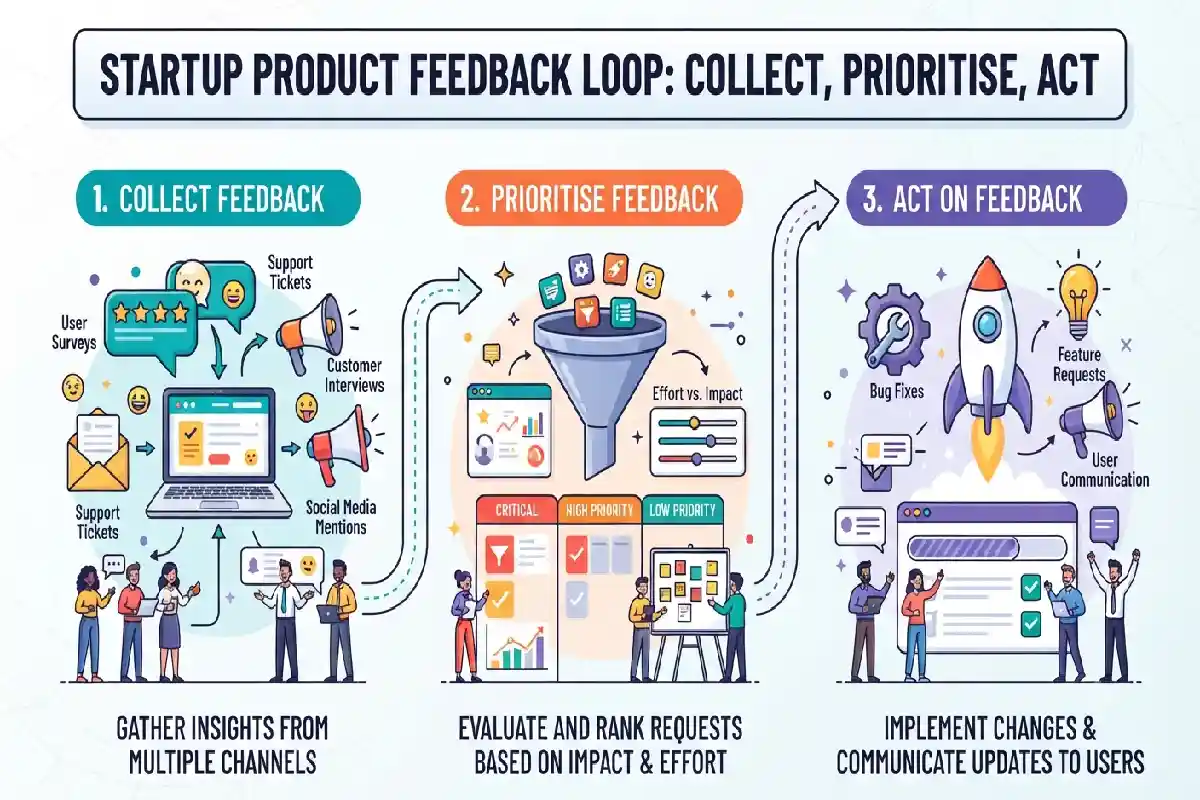
Startup Product Feedback: Collect, Prioritise and Act
Last Updated: September 30, 2026
Product feedback lets start teams get on-the-ground, real-world feedback from customers by sharing what they like about a product, where they‘re having trouble with it, and what they want to be able to do in the future. Just as new users can give early warnings of issues that don’t show up in analytics or in-house testing, feedback is most valuable when it‘s part of a process for translating observations into product decisions.
Not every suggestion is a feature, and not every complaint is a common issue. The art of feedback management is the synthesis of customer conversations, support interactions, surveys, reviews, and product usage logs into actionable insights.
It is also often a good process to ask for feedback, grasp the root cause and find the target, make improvements and verify whether the improvements help.
Choose Feedback Channels for Early Users
Startups can collect product feedback through several channels. The right mix depends on the product, customer type, and stage of the business.
Common channels include:
- Customer interviews
- Support conversations
- In-product feedback forms
- Surveys
- User testing sessions
- App or website reviews
- Community discussions
- Sales conversations
- Customer success calls
Direct conversations are particularly valuable during the early stages because they allow the team to ask follow-up questions. A short conversation can reveal why a customer requested a feature rather than simply recording the requested feature itself.
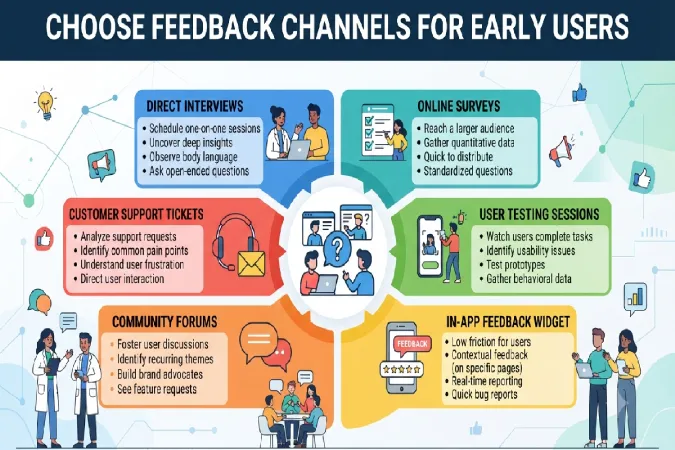
In-product feedback can capture problems close to the moment they occur. For example, a user who encounters an error during onboarding can report the issue immediately.
There‘s more benefit to having direct conversations early because we get the benefit of follow-up questions. Sometimes just a 3 minute call can show what someone wanted to do, not just what feature they wanted.
The in product feedback can be helpful in catching issues right at the moment. For example, a user runs into an error during the onboarding process, they can report it right then and there.
Support tickets can also provide information. For example, If several customers inquire on the same exact topic, this could indicate that the feature has low usability, is not explained properly or simply does not exist.
Set up a central feedback depot where information from other sources can be aggregated and analysed together. Include details of: customer segment, problem, proposed solution, evidence, date, associated product area.
Most of all do not treat each channel as a single source of truth; combine on the multiple channels and find common problem:
Ask Questions That Reveal Context and Problems
Good feedback questions ask about what happened and why; they don‘t ask the consumer to design the good for you.
Instead of asking, “What features should we add?”, ask questions such as:
- What were you trying to accomplish?
- What happened when you tried to do it?
- Where did you get stuck?
- How do you solve this problem today?
- How often does this problem occur?
- What impact does it have on your work?
- What did you expect the product to do?
- What workaround are you currently using?
Context matters because the same feature request can have very different meanings.
Suppose a customer asks for an export feature. They may not actually need a sophisticated export system. They may simply need to share a particular piece of information with a colleague.
Understanding the underlying job can reveal a simpler solution.
Avoid leading questions that encourage customers to confirm what the team already believes. Questions such as “Would you use this new feature?” can produce hypothetical answers that do not always reflect actual behaviour.
Whenever possible, ask about recent experiences. A customer describing something they did yesterday can usually provide more concrete information than someone predicting what they might do in the future. It could also be to share a specific piece of information with a colleague.
If you understand the underlying job, then it can be discovered that there is an easier way.
Don‘t ask leading questions to guide your customers into confirming the conclusion the team already believes. Hypothetical responses from questions like ‘Would you use this new feature?’ are not always reliable.
When you can, inquire about recent experiences. If a customer can tell you what they did in the past 24 hours, they‘ll normally have more to offer than a customer trying to predict what he‘ll be doing in the next 24 hours.
Combine Feedback with Product Usage Evidence
Customer satisfaction studies are useful, even, but they should always be considered in conjunction with other behavioural evidence.
A customer can complain about the usability of a feature, but product analytics can reveal that a lot of users are dropping out of the same workflow. Even stronger indicators.
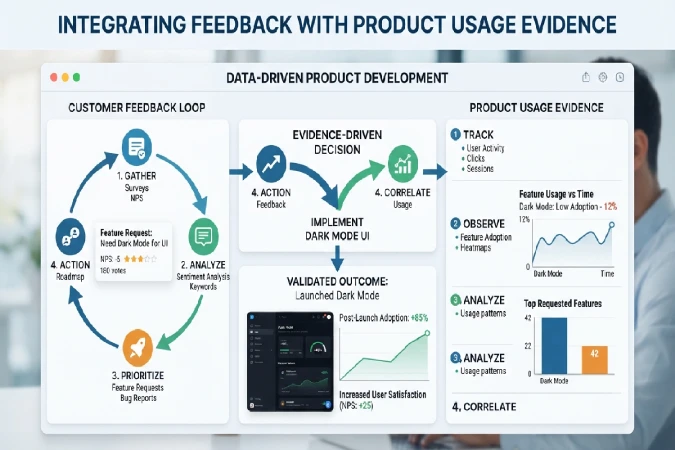
Useful product data can include:
- Feature adoption
- Activation rates
- Conversion rates
- Retention
- Task completion
- Drop-off points
- Search behaviour
- Error rates
- Support volume
The purpose is not to replace qualitative feedback with numbers. Instead, combine both types of evidence.
Qualitative feedback can explain why a problem occurs, while usage data can help show how often it occurs or where it appears in the customer journey.
For example, analytics might show that many users leave during onboarding. Interviews could reveal that users are confused about why certain information is required. The combined evidence gives the team a clearer starting point for improvement.
Be careful with small samples. One customer experiencing a problem can point us to a useful problem, but doesn‘t necessarily prove that it exists for everyone.
Segmented market evidence where relevant. New users, experienced customers, free customers, and paying customers can have different product experiences.
Prioritise Improvements and Close the Feedback Loop
After having obtained the feedback, cluster similar observations into higher-level problems.
If ten customers request ten different features that all happened to be related to slow reporting, the team might have ten slow reporting problems instead of ten feature requests.
Prioritise problems using criteria such as:
- Customer impact: How seriously does the problem affect users?
- Frequency: How often does it occur?
- Business impact: Could solving it affect activation, retention, revenue, or another important outcome?
- Evidence strength: How much evidence supports the problem?
- Effort: How difficult will the improvement be?
- Strategic fit: Does solving the problem support the current product direction?
This helps prevent the loudest customer or newest request from automatically becoming the highest priority.
After making a decision, close the feedback loop. Customers who provided meaningful feedback should not be left wondering whether anyone heard them.
You can communicate that the issue has been investigated, explain whether the team plans to address it, or clarify that it is not currently planned.
When an improvement is released, tell relevant customers when appropriate. This demonstrates that feedback contributes to product development while avoiding promises about every request.
Closing the loop also encourages future feedback because customers can see that their input enters a real process.
Check Whether Changes Solve the Original Problem
Shipping an improvement is not the final step. The team should check whether the change actually addressed the original problem.
Start by defining what improvement would look like.
For example:
- More users complete onboarding
- Fewer users abandon a particular workflow
- Support requests about the issue decline
- Customers complete a task with fewer errors
- Feature adoption increases
- Customers report that the original problem is easier to solve
Use a combination of behavioural data and customer feedback where possible.
Suppose customers reported that a dashboard was difficult to understand. The team redesigns the dashboard and then monitors task completion, usage patterns, and follow-up feedback.
If the original problem remains, investigate why. Perhaps the layout was not the real issue, or users lack information needed to interpret the dashboard.
Document the original problem, evidence, change made, and results. This creates a feedback history that helps the team learn which product decisions worked and which assumptions were incorrect.
Conclusion
The value of startup product feedback is maximized when you make it flow into an established product-learning process. Select channels for feedback that make sense for your initial customers and persistent data collection.
Don‘t just make feature requests, ask questions that reveal the customer context, purpose, behaviour and root problems. Use this qualitative information along with the product usage data for a complete picture of experience and magnitude.
Prioritise for customer impact, frequency, relevance to business, evidence, effort, and product strategy. Close the feedback loop by communicating decisions and, when appropriate, informing customers when changes are implemented.
Finally, check whether the change really addressed the problem you were trying to solve in the first place. This converts feedback from a series of opinions into an ongoing cycle of learning, prioritizing, improving and validating supporting a startup to create an evidence-based product instead of an assumption-based one.